budgeting - First Year Canada
First Year Canada

First Year Canada

  • Start Here

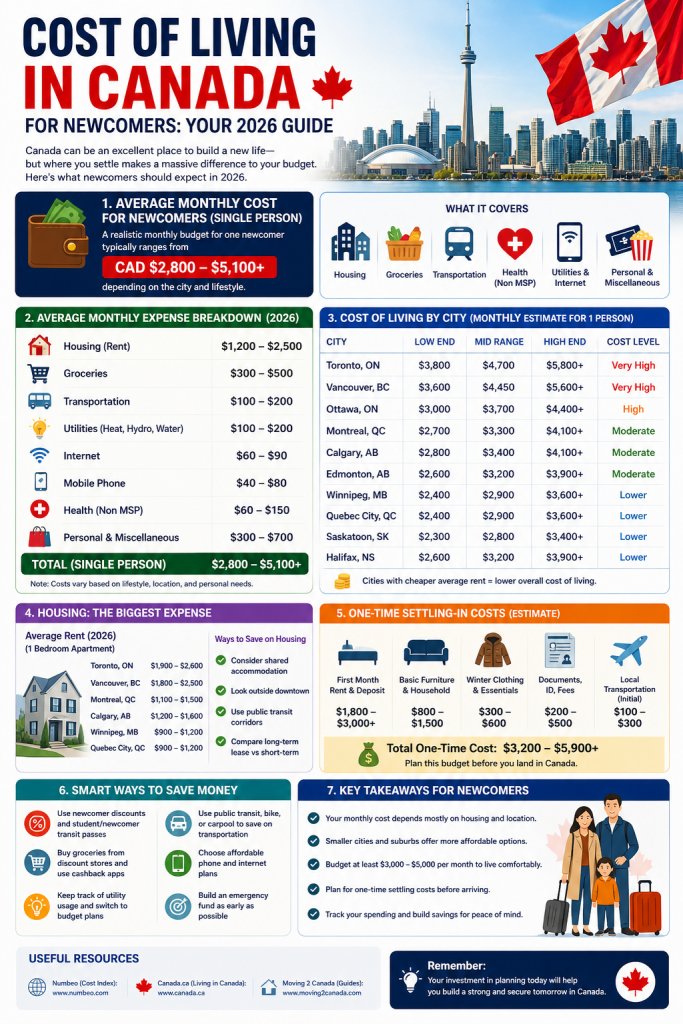
    Cost of Living in Canada for Newcomers: Your 2026 Guide

    Moving to a new country involves many considerations, and understanding the cost of living is arguably one of the most critical. For newcomers arriving in Canada in 2026, a clear and realistic financial plan is essential for a smooth transition and successful first year. Canada is known for its high quality of life, but this often comes with a commensurate cost, particularly in major urban centers. This guide from FirstYearCanada.com aims to provide a research-based explanation of the typical expenses you can expect, outlining key categories, offering estimated costs, and providing practical advice to help you budget effectively. We will explore how costs can vary significantly across different regions of Canada and offer strategies to manage your finances from the moment you arrive .

    Who This Guide Is For

    This comprehensive guide is designed for individuals and families who are planning to move to Canada or have recently arrived. This includes :
    • New immigrants and permanent residents: Those embarking on a new life in Canada.
    • International students: Individuals coming to study at Canadian universities or colleges.
    • Temporary foreign workers : Professionals and skilled tradespeople working in Canada on a temporary basis.
    • First-time residents : Anyone needing practical, accurate information about managing expenses in their first year in Canada.
    Our goal is to equip you with the knowledge needed to make informed financial decisions and avoid common pitfalls during your initial adjustment period.

    Practical Explanation: Understanding Canadian Expenses

    The “cost of living” refers to the amount of money needed to sustain a certain standard of living in a particular place. In Canada, this encompasses  various expenses that are typically categorized as follows:

    1. Housing Costs

    Housing is often the largest single expense for most Canadians, and newcomers are no exception. Costs vary dramatically based on location, type of dwelling, and amenities. In major cities like Vancouver and Toronto, rent can be significantly higher than in smaller cities or rural areas.
    • Rent: This is your monthly  payment for an apartment, basement suite, or house. Landlords typically require a deposit equivalent to one month’s rent (often called a security deposit or damage deposit) and sometimes the first and last month’s rent upfront.
    • Utilities: These include electricity , heating (natural gas or electric), water, and sometimes garbage collection. Some rental agreements include certain utilities, while others require you to pay them separately.
    • Renter’s Insurance: While not always mandatory, renter’s insurance is highly recommended to protect your belongings from theft, fire, or other damages, and to provide liability coverage.

    2. Food Expenses

    Your food budget will depend on your dietary habits,  where you shop, and how often you eat out. Grocery prices can fluctuate, but generally, cooking at home is far more economical than dining at restaurants or ordering takeout regularly.
    • Groceries: Major supermarket chains (e.g., Loblaws, Sobeys, Metro, Walmart, Costco) offer a range of products. Budgeting for groceries means planning meals , watching for sales, and potentially exploring ethnic markets for specific ingredients.
    • Dining Out: Eating at restaurants can be expensive. A casual meal for one might cost $20-$30, excluding drinks and tip.

    3. Transportation

    How you get around will significantly impact your budget.
    • Public Transit: Most Canadian cities have reliable public transit systems (buses, subways, streetcars, commuter trains). Monthly passes are usually available and are more cost-effective than single fares for regular commuters.
    • Car Ownership: This is a significant expense.  Costs include the purchase price (or lease payments), fuel, insurance (which can be very high for newcomers without a Canadian driving history), maintenance, parking, and registration fees.
    • Ride-sharing/Taxis: Services like Uber, Lyft,  or local taxis are convenient but can add up quickly if used frequently.

    4. Healthcare (Supplemental)

    Canada has a publicly funded healthcare system, meaning most medically necessary services are covered by your provincial or territorial health insurance plan once you are eligible. However, there are significant costs not covered:
    • Prescription Drugs: Unless you have private insurance (often through an employer) or are covered by a specific provincial program, you will pay for prescription medications.
    • Dental Care: Routine check-ups, cleanings, and major dental work are generally not covered by provincial health plans.
    • Eye Care: Eye exams and prescription eyewear  are typically not covered.
    Many newcomers obtain private health insurance for their initial waiting period for provincial coverage or to supplement provincial plans.

    5. Communication

    • Mobile Phone: Canada’s mobile phone plans can be more expensive than in many other countries. Shop around for plans that suit your data and call needs.
    • Internet: High-speed internet is a necessity for most households. Various providers offer different packages and speeds.

    6. Personal Care & Miscellaneous

    This category covers a wide range of personal expenses:
    • Clothing: Depending on your needs and preferences .
    • Toiletries & Personal Hygiene: Essential items like soap, shampoo, toothpaste.
    • Entertainment & Recreation: Movies, sports, hobbies, gym memberships.
    • Education Supplies: For students, textbooks and other materials.
    • Emergency Fund: Crucial for unexpected expenses.

    Step-by-Step: Building Your Newcomer Budget

    Creating a budget is a powerful tool for managing your finances in Canada. Here’s a step-by-step approach:
    1. Research City-Specific Costs: Before you even arrive, research the average costs for housing, transit, and groceries in your target city. Websites of local governments or rental listing sites can offer insights.
    2. Estimate Initial Settlement Costs: Factor in one-time expenses like your flight, visa fees, initial accommodation (e.g., hotel or Airbnb), first and last month’s rent, utility setup fees, furniture, and essential groceries for your first week. This initial fund is critical.
    3. Create a Monthly Budget: Once settled, track your income and list all your estimated monthly expenses. Use the categories above as a guide. Be realistic about your spending habits.
    4. Track Your Expenses: For the first few months, meticulously track every dollar you spend. This will reveal where your money is actually going and highlight areas for potential savings. Many banking apps and budgeting tools can help with this.
    5. Adjust and Save: Regularly review your budget. Are you overspending in certain areas? Can you cut back on non-essentials? Aim to build an emergency fund equal to 3-6 months of living expenses.

    Estimated Monthly Costs for a Single Newcomer in  Canada (2026)

    The following table provides estimated monthly costs for a single individual in various Canadian cities. These figures are estimates only and can vary significantly based on lifestyle, specific housing choices, and current market conditions. They are provided to give newcomers a general idea for planning purposes and should not be taken as definitive figures.
    Expense Category Vancouver / Toronto Calgary / Ottawa / Montreal Halifax / Winnipeg / Edmonton Smaller City / Town
    Housing (1-bedroom rent) $2,200 - $3,000+ $1,600 - $2,300 $1,300 - $1,900 $1,000 - $1,500
    Utilities (Electricity, Heat, Water) $150 - $250 $140 - $240 $130 - $230 $120 - $220
    Internet $70 - $100 $65 - $95 $60 - $90 $55 - $85
    Mobile Phone $45 - $75 $40 - $70 $35 - $65 $30 - $60
    Groceries $450 - $650 $400 - $600 $380 - $580 $350 - $550
    Public Transit Pass $110 - $160 $100 - $150 $90 - $140 $80 - $130
    Personal Care & Miscellaneous $250 - $450 $200 - $400 $180 - $380 $150 - $350
    Estimated Monthly Total (excluding major one-time costs) $3,275 - $4,685+ $2,645 - $3,855 $2,175 - $3,385 $1,785 - $2,895
    These totals do not include initial settlement costs, emergency funds, or private health insurance if needed. Always consult current local rental listings and municipal websites for the most up-to-date figures.

    Checklist for Managing Your Costs as a Newcomer

    Use this checklist to help manage your expenses effectively during your first year:
    • Thorough Pre-Arrival Research: Investigate specific city costs before you move.
    • Adequate Initial Settlement Fund: Ensure you have enough funds for your first 1-3 months, covering initial rent, deposits, and setup costs. Consider reviewing our guide on First Month in Canada: Your Essential Checklist for Newcomers.
    • Open a Canadian Bank Account Promptly: Essential for managing your money, receiving payments, and paying bills. See our guide on How to Open a Bank Account in Canada as a Newcomer 2026 Guide.
    • Create a Detailed Budget: Track income versus expenses to understand your financial flow.
    • Prioritize Public Transit: Opt for monthly passes over individual fares or car ownership initially.
    • Cook at Home: Minimize dining out to save significantly on food costs.
    • Explore Second-Hand Options: For furniture, kitchenware, and even clothing, consider used items from local marketplaces or thrift stores.
    • Understand Healthcare Access: Know what your provincial health plan covers and what it doesn’t. Budget for supplemental insurance if necessary.
    • Seek Free Community Resources: Many newcomer organizations offer free services, workshops, and support that can save you money.
    • Build an Emergency Fund: Start saving a portion of your income for unexpected expenses as soon as possible.

    Common Mistakes to  Avoid

    Newcomers often make certain financial errors due to unfamiliarity with Canadian systems. Be aware of these common pitfalls:
    • Underestimating Initial Settlement Costs: Many arrive with just enough for rent, forgetting about utility deposits, furniture, or unexpected expenses.
    • Not Budgeting for Emergencies: Life happens. Without an emergency fund, unexpected costs can quickly derail your financial stability.
    • Ignoring Regional Cost Differences: Assuming costs in one city are similar to another can lead to severe budget shortfalls. Research your specific location.
    • Overspending on Non-Essentials Early On: It’s tempting to enjoy new experiences, but prioritizing needs over wants in the first few months is crucial.
    • Not Understanding Canadian Banking and Credit: Familiarize yourself with how Canadian banks operate, fees, and how to build a credit history.
    • Signing Up for Expensive Phone/Internet Plans: Shop around and compare providers. Don’t commit to the first offer without checking competitors.

    Frequently Asked Questions (FAQ)

    Q: Is Canada an expensive country to live in?

    A: Canada’s cost of living is generally considered high, especially in major urban centers like Vancouver and Toronto. However, it offers a high quality of life, and costs can be more moderate in smaller cities and towns. Compared to some other developed nations, certain expenses like healthcare (for covered services) can be lower, while others like housing and mobile plans can be higher.

    Q: How much money should I bring as a newcomer to Canada?

    A: The exact amount depends on your family size, destination city, and whether you have pre-arranged employment and accommodation. Immigration, Refugees and Citizenship Canada (IRCC) provides specific settlement fund requirements for certain immigration programs. Beyond that, it is generally recommended to have enough funds to cover at least 3 to 6 months of living expenses, including initial rent and deposits, to ensure a comfortable start.

    Q: Can I save money in Canada as a newcomer?

    A: Yes, saving money is possible, but it requires diligent budgeting and conscious choices. Living outside the most expensive city centers, utilizing public transit, cooking at home, and being mindful of discretionary spending can help you save. Many newcomers successfully save money, especially once they are employed and accustomed to Canadian costs.

    Q: What are the cheapest cities in Canada for newcomers?

    A: Generally, smaller cities and towns in provinces like Manitoba, Saskatchewan, New Brunswick, and Newfoundland and Labrador tend to have lower housing costs and overall living expenses compared to major cities in Ontario, British Columbia, and Alberta. Examples include Winnipeg (Manitoba), Saskatoon (Saskatchewan), Fredericton (New Brunswick), and St. John’s (Newfoundland and Labrador).

    Disclaimer

    This article is for general information only and does not provide financial, legal, tax, or immigration advice. Rules, requirements, fees, and programs may change. Always check official sources or speak with a qualified professional before making decisions.

    Sources or Official Resources

    For the most current and official information, newcomers are encouraged to consult the following resources:
    • Immigration, Refugees and Citizenship Canada (IRCC): For settlement funds requirements and immigration programs. Visit Canada.ca/IRCC.
    • Statistics Canada: For data on income, expenses, and economic indicators. Visit Statcan.gc.ca.
    • Financial Consumer Agency of Canada (FCAC): For information on personal finance, banking, and budgeting. Visit Canada.ca/FCAC.
    • Canada Mortgage and Housing Corporation (CMHC): For housing market information and rental guides. Visit CMHC-SCHL.gc.ca.
    • Provincial and Territorial Government Websites: For specific information on healthcare, education, and social services in your chosen province or territory (e.g., Ontario.ca, BC.ca, Alberta.ca).
    • Official City Websites: For local public transit information, municipal services, and community resources (e.g., Toronto.ca, Vancouver.ca, Montreal.ca).

    Conclusion.

    Understanding  the cost of living in Canada is a foundational step for any newcomer. By carefully researching, creating a realistic budget, and being mindful of your spending, you can navigate your first year with greater confidence and financial stability. Canada offers incredible opportunities, and with proper planning, your journey here can be both rewarding and financially manageable. Welcome to Canada !
  • Banking

    Cost of Living in Canada for Newcomers: Your 2026 Guide

    Moving to a new country involves many considerations, and understanding the cost of living is arguably one of the most critical. For newcomers arriving in Canada in 2026, a clear and realistic financial plan is essential for a smooth transition and successful first year. Canada is known for its high quality of life, but this often comes with a commensurate cost, particularly in major urban centers. This guide from FirstYearCanada.com aims to provide a research-based explanation of the typical expenses you can expect, outlining key categories, offering estimated costs, and providing practical advice to help you budget effectively. We will explore how costs can vary significantly across different regions of Canada and offer strategies to manage your finances from the moment you arrive .

    Who This Guide Is For

    This comprehensive guide is designed for individuals and families who are planning to move to Canada or have recently arrived. This includes :
    • New immigrants and permanent residents: Those embarking on a new life in Canada.
    • International students: Individuals coming to study at Canadian universities or colleges.
    • Temporary foreign workers : Professionals and skilled tradespeople working in Canada on a temporary basis.
    • First-time residents : Anyone needing practical, accurate information about managing expenses in their first year in Canada.
    Our goal is to equip you with the knowledge needed to make informed financial decisions and avoid common pitfalls during your initial adjustment period.

    Practical Explanation: Understanding Canadian Expenses

    The “cost of living” refers to the amount of money needed to sustain a certain standard of living in a particular place. In Canada, this encompasses  various expenses that are typically categorized as follows:

    1. Housing Costs

    Housing is often the largest single expense for most Canadians, and newcomers are no exception. Costs vary dramatically based on location, type of dwelling, and amenities. In major cities like Vancouver and Toronto, rent can be significantly higher than in smaller cities or rural areas.
    • Rent: This is your monthly  payment for an apartment, basement suite, or house. Landlords typically require a deposit equivalent to one month’s rent (often called a security deposit or damage deposit) and sometimes the first and last month’s rent upfront.
    • Utilities: These include electricity , heating (natural gas or electric), water, and sometimes garbage collection. Some rental agreements include certain utilities, while others require you to pay them separately.
    • Renter’s Insurance: While not always mandatory, renter’s insurance is highly recommended to protect your belongings from theft, fire, or other damages, and to provide liability coverage.

    2. Food Expenses

    Your food budget will depend on your dietary habits,  where you shop, and how often you eat out. Grocery prices can fluctuate, but generally, cooking at home is far more economical than dining at restaurants or ordering takeout regularly.
    • Groceries: Major supermarket chains (e.g., Loblaws, Sobeys, Metro, Walmart, Costco) offer a range of products. Budgeting for groceries means planning meals , watching for sales, and potentially exploring ethnic markets for specific ingredients.
    • Dining Out: Eating at restaurants can be expensive. A casual meal for one might cost $20-$30, excluding drinks and tip.

    3. Transportation

    How you get around will significantly impact your budget.
    • Public Transit: Most Canadian cities have reliable public transit systems (buses, subways, streetcars, commuter trains). Monthly passes are usually available and are more cost-effective than single fares for regular commuters.
    • Car Ownership: This is a significant expense.  Costs include the purchase price (or lease payments), fuel, insurance (which can be very high for newcomers without a Canadian driving history), maintenance, parking, and registration fees.
    • Ride-sharing/Taxis: Services like Uber, Lyft,  or local taxis are convenient but can add up quickly if used frequently.

    4. Healthcare (Supplemental)

    Canada has a publicly funded healthcare system, meaning most medically necessary services are covered by your provincial or territorial health insurance plan once you are eligible. However, there are significant costs not covered:
    • Prescription Drugs: Unless you have private insurance (often through an employer) or are covered by a specific provincial program, you will pay for prescription medications.
    • Dental Care: Routine check-ups, cleanings, and major dental work are generally not covered by provincial health plans.
    • Eye Care: Eye exams and prescription eyewear  are typically not covered.
    Many newcomers obtain private health insurance for their initial waiting period for provincial coverage or to supplement provincial plans.

    5. Communication

    • Mobile Phone: Canada’s mobile phone plans can be more expensive than in many other countries. Shop around for plans that suit your data and call needs.
    • Internet: High-speed internet is a necessity for most households. Various providers offer different packages and speeds.

    6. Personal Care & Miscellaneous

    This category covers a wide range of personal expenses:
    • Clothing: Depending on your needs and preferences .
    • Toiletries & Personal Hygiene: Essential items like soap, shampoo, toothpaste.
    • Entertainment & Recreation: Movies, sports, hobbies, gym memberships.
    • Education Supplies: For students, textbooks and other materials.
    • Emergency Fund: Crucial for unexpected expenses.

    Step-by-Step: Building Your Newcomer Budget

    Creating a budget is a powerful tool for managing your finances in Canada. Here’s a step-by-step approach:
    1. Research City-Specific Costs: Before you even arrive, research the average costs for housing, transit, and groceries in your target city. Websites of local governments or rental listing sites can offer insights.
    2. Estimate Initial Settlement Costs: Factor in one-time expenses like your flight, visa fees, initial accommodation (e.g., hotel or Airbnb), first and last month’s rent, utility setup fees, furniture, and essential groceries for your first week. This initial fund is critical.
    3. Create a Monthly Budget: Once settled, track your income and list all your estimated monthly expenses. Use the categories above as a guide. Be realistic about your spending habits.
    4. Track Your Expenses: For the first few months, meticulously track every dollar you spend. This will reveal where your money is actually going and highlight areas for potential savings. Many banking apps and budgeting tools can help with this.
    5. Adjust and Save: Regularly review your budget. Are you overspending in certain areas? Can you cut back on non-essentials? Aim to build an emergency fund equal to 3-6 months of living expenses.

    Estimated Monthly Costs for a Single Newcomer in  Canada (2026)

    The following table provides estimated monthly costs for a single individual in various Canadian cities. These figures are estimates only and can vary significantly based on lifestyle, specific housing choices, and current market conditions. They are provided to give newcomers a general idea for planning purposes and should not be taken as definitive figures.
    Expense Category Vancouver / Toronto Calgary / Ottawa / Montreal Halifax / Winnipeg / Edmonton Smaller City / Town
    Housing (1-bedroom rent) $2,200 - $3,000+ $1,600 - $2,300 $1,300 - $1,900 $1,000 - $1,500
    Utilities (Electricity, Heat, Water) $150 - $250 $140 - $240 $130 - $230 $120 - $220
    Internet $70 - $100 $65 - $95 $60 - $90 $55 - $85
    Mobile Phone $45 - $75 $40 - $70 $35 - $65 $30 - $60
    Groceries $450 - $650 $400 - $600 $380 - $580 $350 - $550
    Public Transit Pass $110 - $160 $100 - $150 $90 - $140 $80 - $130
    Personal Care & Miscellaneous $250 - $450 $200 - $400 $180 - $380 $150 - $350
    Estimated Monthly Total (excluding major one-time costs) $3,275 - $4,685+ $2,645 - $3,855 $2,175 - $3,385 $1,785 - $2,895
    These totals do not include initial settlement costs, emergency funds, or private health insurance if needed. Always consult current local rental listings and municipal websites for the most up-to-date figures.

    Checklist for Managing Your Costs as a Newcomer

    Use this checklist to help manage your expenses effectively during your first year:
    • Thorough Pre-Arrival Research: Investigate specific city costs before you move.
    • Adequate Initial Settlement Fund: Ensure you have enough funds for your first 1-3 months, covering initial rent, deposits, and setup costs. Consider reviewing our guide on First Month in Canada: Your Essential Checklist for Newcomers.
    • Open a Canadian Bank Account Promptly: Essential for managing your money, receiving payments, and paying bills. See our guide on How to Open a Bank Account in Canada as a Newcomer 2026 Guide.
    • Create a Detailed Budget: Track income versus expenses to understand your financial flow.
    • Prioritize Public Transit: Opt for monthly passes over individual fares or car ownership initially.
    • Cook at Home: Minimize dining out to save significantly on food costs.
    • Explore Second-Hand Options: For furniture, kitchenware, and even clothing, consider used items from local marketplaces or thrift stores.
    • Understand Healthcare Access: Know what your provincial health plan covers and what it doesn’t. Budget for supplemental insurance if necessary.
    • Seek Free Community Resources: Many newcomer organizations offer free services, workshops, and support that can save you money.
    • Build an Emergency Fund: Start saving a portion of your income for unexpected expenses as soon as possible.

    Common Mistakes to  Avoid

    Newcomers often make certain financial errors due to unfamiliarity with Canadian systems. Be aware of these common pitfalls:
    • Underestimating Initial Settlement Costs: Many arrive with just enough for rent, forgetting about utility deposits, furniture, or unexpected expenses.
    • Not Budgeting for Emergencies: Life happens. Without an emergency fund, unexpected costs can quickly derail your financial stability.
    • Ignoring Regional Cost Differences: Assuming costs in one city are similar to another can lead to severe budget shortfalls. Research your specific location.
    • Overspending on Non-Essentials Early On: It’s tempting to enjoy new experiences, but prioritizing needs over wants in the first few months is crucial.
    • Not Understanding Canadian Banking and Credit: Familiarize yourself with how Canadian banks operate, fees, and how to build a credit history.
    • Signing Up for Expensive Phone/Internet Plans: Shop around and compare providers. Don’t commit to the first offer without checking competitors.

    Frequently Asked Questions (FAQ)

    Q: Is Canada an expensive country to live in?

    A: Canada’s cost of living is generally considered high, especially in major urban centers like Vancouver and Toronto. However, it offers a high quality of life, and costs can be more moderate in smaller cities and towns. Compared to some other developed nations, certain expenses like healthcare (for covered services) can be lower, while others like housing and mobile plans can be higher.

    Q: How much money should I bring as a newcomer to Canada?

    A: The exact amount depends on your family size, destination city, and whether you have pre-arranged employment and accommodation. Immigration, Refugees and Citizenship Canada (IRCC) provides specific settlement fund requirements for certain immigration programs. Beyond that, it is generally recommended to have enough funds to cover at least 3 to 6 months of living expenses, including initial rent and deposits, to ensure a comfortable start.

    Q: Can I save money in Canada as a newcomer?

    A: Yes, saving money is possible, but it requires diligent budgeting and conscious choices. Living outside the most expensive city centers, utilizing public transit, cooking at home, and being mindful of discretionary spending can help you save. Many newcomers successfully save money, especially once they are employed and accustomed to Canadian costs.

    Q: What are the cheapest cities in Canada for newcomers?

    A: Generally, smaller cities and towns in provinces like Manitoba, Saskatchewan, New Brunswick, and Newfoundland and Labrador tend to have lower housing costs and overall living expenses compared to major cities in Ontario, British Columbia, and Alberta. Examples include Winnipeg (Manitoba), Saskatoon (Saskatchewan), Fredericton (New Brunswick), and St. John’s (Newfoundland and Labrador).

    Disclaimer

    This article is for general information only and does not provide financial, legal, tax, or immigration advice. Rules, requirements, fees, and programs may change. Always check official sources or speak with a qualified professional before making decisions.

    Sources or Official Resources

    For the most current and official information, newcomers are encouraged to consult the following resources:
    • Immigration, Refugees and Citizenship Canada (IRCC): For settlement funds requirements and immigration programs. Visit Canada.ca/IRCC.
    • Statistics Canada: For data on income, expenses, and economic indicators. Visit Statcan.gc.ca.
    • Financial Consumer Agency of Canada (FCAC): For information on personal finance, banking, and budgeting. Visit Canada.ca/FCAC.
    • Canada Mortgage and Housing Corporation (CMHC): For housing market information and rental guides. Visit CMHC-SCHL.gc.ca.
    • Provincial and Territorial Government Websites: For specific information on healthcare, education, and social services in your chosen province or territory (e.g., Ontario.ca, BC.ca, Alberta.ca).
    • Official City Websites: For local public transit information, municipal services, and community resources (e.g., Toronto.ca, Vancouver.ca, Montreal.ca).

    Conclusion.

    Understanding  the cost of living in Canada is a foundational step for any newcomer. By carefully researching, creating a realistic budget, and being mindful of your spending, you can navigate your first year with greater confidence and financial stability. Canada offers incredible opportunities, and with proper planning, your journey here can be both rewarding and financially manageable. Welcome to Canada !
  • Cost of Living

    Cost of Living in Canada for Newcomers: Your 2026 Guide

    Moving to a new country involves many considerations, and understanding the cost of living is arguably one of the most critical. For newcomers arriving in Canada in 2026, a clear and realistic financial plan is essential for a smooth transition and successful first year. Canada is known for its high quality of life, but this often comes with a commensurate cost, particularly in major urban centers. This guide from FirstYearCanada.com aims to provide a research-based explanation of the typical expenses you can expect, outlining key categories, offering estimated costs, and providing practical advice to help you budget effectively. We will explore how costs can vary significantly across different regions of Canada and offer strategies to manage your finances from the moment you arrive .

    Who This Guide Is For

    This comprehensive guide is designed for individuals and families who are planning to move to Canada or have recently arrived. This includes :
    • New immigrants and permanent residents: Those embarking on a new life in Canada.
    • International students: Individuals coming to study at Canadian universities or colleges.
    • Temporary foreign workers : Professionals and skilled tradespeople working in Canada on a temporary basis.
    • First-time residents : Anyone needing practical, accurate information about managing expenses in their first year in Canada.
    Our goal is to equip you with the knowledge needed to make informed financial decisions and avoid common pitfalls during your initial adjustment period.

    Practical Explanation: Understanding Canadian Expenses

    The “cost of living” refers to the amount of money needed to sustain a certain standard of living in a particular place. In Canada, this encompasses  various expenses that are typically categorized as follows:

    1. Housing Costs

    Housing is often the largest single expense for most Canadians, and newcomers are no exception. Costs vary dramatically based on location, type of dwelling, and amenities. In major cities like Vancouver and Toronto, rent can be significantly higher than in smaller cities or rural areas.
    • Rent: This is your monthly  payment for an apartment, basement suite, or house. Landlords typically require a deposit equivalent to one month’s rent (often called a security deposit or damage deposit) and sometimes the first and last month’s rent upfront.
    • Utilities: These include electricity , heating (natural gas or electric), water, and sometimes garbage collection. Some rental agreements include certain utilities, while others require you to pay them separately.
    • Renter’s Insurance: While not always mandatory, renter’s insurance is highly recommended to protect your belongings from theft, fire, or other damages, and to provide liability coverage.

    2. Food Expenses

    Your food budget will depend on your dietary habits,  where you shop, and how often you eat out. Grocery prices can fluctuate, but generally, cooking at home is far more economical than dining at restaurants or ordering takeout regularly.
    • Groceries: Major supermarket chains (e.g., Loblaws, Sobeys, Metro, Walmart, Costco) offer a range of products. Budgeting for groceries means planning meals , watching for sales, and potentially exploring ethnic markets for specific ingredients.
    • Dining Out: Eating at restaurants can be expensive. A casual meal for one might cost $20-$30, excluding drinks and tip.

    3. Transportation

    How you get around will significantly impact your budget.
    • Public Transit: Most Canadian cities have reliable public transit systems (buses, subways, streetcars, commuter trains). Monthly passes are usually available and are more cost-effective than single fares for regular commuters.
    • Car Ownership: This is a significant expense.  Costs include the purchase price (or lease payments), fuel, insurance (which can be very high for newcomers without a Canadian driving history), maintenance, parking, and registration fees.
    • Ride-sharing/Taxis: Services like Uber, Lyft,  or local taxis are convenient but can add up quickly if used frequently.

    4. Healthcare (Supplemental)

    Canada has a publicly funded healthcare system, meaning most medically necessary services are covered by your provincial or territorial health insurance plan once you are eligible. However, there are significant costs not covered:
    • Prescription Drugs: Unless you have private insurance (often through an employer) or are covered by a specific provincial program, you will pay for prescription medications.
    • Dental Care: Routine check-ups, cleanings, and major dental work are generally not covered by provincial health plans.
    • Eye Care: Eye exams and prescription eyewear  are typically not covered.
    Many newcomers obtain private health insurance for their initial waiting period for provincial coverage or to supplement provincial plans.

    5. Communication

    • Mobile Phone: Canada’s mobile phone plans can be more expensive than in many other countries. Shop around for plans that suit your data and call needs.
    • Internet: High-speed internet is a necessity for most households. Various providers offer different packages and speeds.

    6. Personal Care & Miscellaneous

    This category covers a wide range of personal expenses:
    • Clothing: Depending on your needs and preferences .
    • Toiletries & Personal Hygiene: Essential items like soap, shampoo, toothpaste.
    • Entertainment & Recreation: Movies, sports, hobbies, gym memberships.
    • Education Supplies: For students, textbooks and other materials.
    • Emergency Fund: Crucial for unexpected expenses.

    Step-by-Step: Building Your Newcomer Budget

    Creating a budget is a powerful tool for managing your finances in Canada. Here’s a step-by-step approach:
    1. Research City-Specific Costs: Before you even arrive, research the average costs for housing, transit, and groceries in your target city. Websites of local governments or rental listing sites can offer insights.
    2. Estimate Initial Settlement Costs: Factor in one-time expenses like your flight, visa fees, initial accommodation (e.g., hotel or Airbnb), first and last month’s rent, utility setup fees, furniture, and essential groceries for your first week. This initial fund is critical.
    3. Create a Monthly Budget: Once settled, track your income and list all your estimated monthly expenses. Use the categories above as a guide. Be realistic about your spending habits.
    4. Track Your Expenses: For the first few months, meticulously track every dollar you spend. This will reveal where your money is actually going and highlight areas for potential savings. Many banking apps and budgeting tools can help with this.
    5. Adjust and Save: Regularly review your budget. Are you overspending in certain areas? Can you cut back on non-essentials? Aim to build an emergency fund equal to 3-6 months of living expenses.

    Estimated Monthly Costs for a Single Newcomer in  Canada (2026)

    The following table provides estimated monthly costs for a single individual in various Canadian cities. These figures are estimates only and can vary significantly based on lifestyle, specific housing choices, and current market conditions. They are provided to give newcomers a general idea for planning purposes and should not be taken as definitive figures.
    Expense Category Vancouver / Toronto Calgary / Ottawa / Montreal Halifax / Winnipeg / Edmonton Smaller City / Town
    Housing (1-bedroom rent) $2,200 - $3,000+ $1,600 - $2,300 $1,300 - $1,900 $1,000 - $1,500
    Utilities (Electricity, Heat, Water) $150 - $250 $140 - $240 $130 - $230 $120 - $220
    Internet $70 - $100 $65 - $95 $60 - $90 $55 - $85
    Mobile Phone $45 - $75 $40 - $70 $35 - $65 $30 - $60
    Groceries $450 - $650 $400 - $600 $380 - $580 $350 - $550
    Public Transit Pass $110 - $160 $100 - $150 $90 - $140 $80 - $130
    Personal Care & Miscellaneous $250 - $450 $200 - $400 $180 - $380 $150 - $350
    Estimated Monthly Total (excluding major one-time costs) $3,275 - $4,685+ $2,645 - $3,855 $2,175 - $3,385 $1,785 - $2,895
    These totals do not include initial settlement costs, emergency funds, or private health insurance if needed. Always consult current local rental listings and municipal websites for the most up-to-date figures.

    Checklist for Managing Your Costs as a Newcomer

    Use this checklist to help manage your expenses effectively during your first year:
    • Thorough Pre-Arrival Research: Investigate specific city costs before you move.
    • Adequate Initial Settlement Fund: Ensure you have enough funds for your first 1-3 months, covering initial rent, deposits, and setup costs. Consider reviewing our guide on First Month in Canada: Your Essential Checklist for Newcomers.
    • Open a Canadian Bank Account Promptly: Essential for managing your money, receiving payments, and paying bills. See our guide on How to Open a Bank Account in Canada as a Newcomer 2026 Guide.
    • Create a Detailed Budget: Track income versus expenses to understand your financial flow.
    • Prioritize Public Transit: Opt for monthly passes over individual fares or car ownership initially.
    • Cook at Home: Minimize dining out to save significantly on food costs.
    • Explore Second-Hand Options: For furniture, kitchenware, and even clothing, consider used items from local marketplaces or thrift stores.
    • Understand Healthcare Access: Know what your provincial health plan covers and what it doesn’t. Budget for supplemental insurance if necessary.
    • Seek Free Community Resources: Many newcomer organizations offer free services, workshops, and support that can save you money.
    • Build an Emergency Fund: Start saving a portion of your income for unexpected expenses as soon as possible.

    Common Mistakes to  Avoid

    Newcomers often make certain financial errors due to unfamiliarity with Canadian systems. Be aware of these common pitfalls:
    • Underestimating Initial Settlement Costs: Many arrive with just enough for rent, forgetting about utility deposits, furniture, or unexpected expenses.
    • Not Budgeting for Emergencies: Life happens. Without an emergency fund, unexpected costs can quickly derail your financial stability.
    • Ignoring Regional Cost Differences: Assuming costs in one city are similar to another can lead to severe budget shortfalls. Research your specific location.
    • Overspending on Non-Essentials Early On: It’s tempting to enjoy new experiences, but prioritizing needs over wants in the first few months is crucial.
    • Not Understanding Canadian Banking and Credit: Familiarize yourself with how Canadian banks operate, fees, and how to build a credit history.
    • Signing Up for Expensive Phone/Internet Plans: Shop around and compare providers. Don’t commit to the first offer without checking competitors.

    Frequently Asked Questions (FAQ)

    Q: Is Canada an expensive country to live in?

    A: Canada’s cost of living is generally considered high, especially in major urban centers like Vancouver and Toronto. However, it offers a high quality of life, and costs can be more moderate in smaller cities and towns. Compared to some other developed nations, certain expenses like healthcare (for covered services) can be lower, while others like housing and mobile plans can be higher.

    Q: How much money should I bring as a newcomer to Canada?

    A: The exact amount depends on your family size, destination city, and whether you have pre-arranged employment and accommodation. Immigration, Refugees and Citizenship Canada (IRCC) provides specific settlement fund requirements for certain immigration programs. Beyond that, it is generally recommended to have enough funds to cover at least 3 to 6 months of living expenses, including initial rent and deposits, to ensure a comfortable start.

    Q: Can I save money in Canada as a newcomer?

    A: Yes, saving money is possible, but it requires diligent budgeting and conscious choices. Living outside the most expensive city centers, utilizing public transit, cooking at home, and being mindful of discretionary spending can help you save. Many newcomers successfully save money, especially once they are employed and accustomed to Canadian costs.

    Q: What are the cheapest cities in Canada for newcomers?

    A: Generally, smaller cities and towns in provinces like Manitoba, Saskatchewan, New Brunswick, and Newfoundland and Labrador tend to have lower housing costs and overall living expenses compared to major cities in Ontario, British Columbia, and Alberta. Examples include Winnipeg (Manitoba), Saskatoon (Saskatchewan), Fredericton (New Brunswick), and St. John’s (Newfoundland and Labrador).

    Disclaimer

    This article is for general information only and does not provide financial, legal, tax, or immigration advice. Rules, requirements, fees, and programs may change. Always check official sources or speak with a qualified professional before making decisions.

    Sources or Official Resources

    For the most current and official information, newcomers are encouraged to consult the following resources:
    • Immigration, Refugees and Citizenship Canada (IRCC): For settlement funds requirements and immigration programs. Visit Canada.ca/IRCC.
    • Statistics Canada: For data on income, expenses, and economic indicators. Visit Statcan.gc.ca.
    • Financial Consumer Agency of Canada (FCAC): For information on personal finance, banking, and budgeting. Visit Canada.ca/FCAC.
    • Canada Mortgage and Housing Corporation (CMHC): For housing market information and rental guides. Visit CMHC-SCHL.gc.ca.
    • Provincial and Territorial Government Websites: For specific information on healthcare, education, and social services in your chosen province or territory (e.g., Ontario.ca, BC.ca, Alberta.ca).
    • Official City Websites: For local public transit information, municipal services, and community resources (e.g., Toronto.ca, Vancouver.ca, Montreal.ca).

    Conclusion.

    Understanding  the cost of living in Canada is a foundational step for any newcomer. By carefully researching, creating a realistic budget, and being mindful of your spending, you can navigate your first year with greater confidence and financial stability. Canada offers incredible opportunities, and with proper planning, your journey here can be both rewarding and financially manageable. Welcome to Canada !
  • Credit Score

    Cost of Living in Canada for Newcomers: Your 2026 Guide

    Moving to a new country involves many considerations, and understanding the cost of living is arguably one of the most critical. For newcomers arriving in Canada in 2026, a clear and realistic financial plan is essential for a smooth transition and successful first year. Canada is known for its high quality of life, but this often comes with a commensurate cost, particularly in major urban centers. This guide from FirstYearCanada.com aims to provide a research-based explanation of the typical expenses you can expect, outlining key categories, offering estimated costs, and providing practical advice to help you budget effectively. We will explore how costs can vary significantly across different regions of Canada and offer strategies to manage your finances from the moment you arrive .

    Who This Guide Is For

    This comprehensive guide is designed for individuals and families who are planning to move to Canada or have recently arrived. This includes :
    • New immigrants and permanent residents: Those embarking on a new life in Canada.
    • International students: Individuals coming to study at Canadian universities or colleges.
    • Temporary foreign workers : Professionals and skilled tradespeople working in Canada on a temporary basis.
    • First-time residents : Anyone needing practical, accurate information about managing expenses in their first year in Canada.
    Our goal is to equip you with the knowledge needed to make informed financial decisions and avoid common pitfalls during your initial adjustment period.

    Practical Explanation: Understanding Canadian Expenses

    The “cost of living” refers to the amount of money needed to sustain a certain standard of living in a particular place. In Canada, this encompasses  various expenses that are typically categorized as follows:

    1. Housing Costs

    Housing is often the largest single expense for most Canadians, and newcomers are no exception. Costs vary dramatically based on location, type of dwelling, and amenities. In major cities like Vancouver and Toronto, rent can be significantly higher than in smaller cities or rural areas.
    • Rent: This is your monthly  payment for an apartment, basement suite, or house. Landlords typically require a deposit equivalent to one month’s rent (often called a security deposit or damage deposit) and sometimes the first and last month’s rent upfront.
    • Utilities: These include electricity , heating (natural gas or electric), water, and sometimes garbage collection. Some rental agreements include certain utilities, while others require you to pay them separately.
    • Renter’s Insurance: While not always mandatory, renter’s insurance is highly recommended to protect your belongings from theft, fire, or other damages, and to provide liability coverage.

    2. Food Expenses

    Your food budget will depend on your dietary habits,  where you shop, and how often you eat out. Grocery prices can fluctuate, but generally, cooking at home is far more economical than dining at restaurants or ordering takeout regularly.
    • Groceries: Major supermarket chains (e.g., Loblaws, Sobeys, Metro, Walmart, Costco) offer a range of products. Budgeting for groceries means planning meals , watching for sales, and potentially exploring ethnic markets for specific ingredients.
    • Dining Out: Eating at restaurants can be expensive. A casual meal for one might cost $20-$30, excluding drinks and tip.

    3. Transportation

    How you get around will significantly impact your budget.
    • Public Transit: Most Canadian cities have reliable public transit systems (buses, subways, streetcars, commuter trains). Monthly passes are usually available and are more cost-effective than single fares for regular commuters.
    • Car Ownership: This is a significant expense.  Costs include the purchase price (or lease payments), fuel, insurance (which can be very high for newcomers without a Canadian driving history), maintenance, parking, and registration fees.
    • Ride-sharing/Taxis: Services like Uber, Lyft,  or local taxis are convenient but can add up quickly if used frequently.

    4. Healthcare (Supplemental)

    Canada has a publicly funded healthcare system, meaning most medically necessary services are covered by your provincial or territorial health insurance plan once you are eligible. However, there are significant costs not covered:
    • Prescription Drugs: Unless you have private insurance (often through an employer) or are covered by a specific provincial program, you will pay for prescription medications.
    • Dental Care: Routine check-ups, cleanings, and major dental work are generally not covered by provincial health plans.
    • Eye Care: Eye exams and prescription eyewear  are typically not covered.
    Many newcomers obtain private health insurance for their initial waiting period for provincial coverage or to supplement provincial plans.

    5. Communication

    • Mobile Phone: Canada’s mobile phone plans can be more expensive than in many other countries. Shop around for plans that suit your data and call needs.
    • Internet: High-speed internet is a necessity for most households. Various providers offer different packages and speeds.

    6. Personal Care & Miscellaneous

    This category covers a wide range of personal expenses:
    • Clothing: Depending on your needs and preferences .
    • Toiletries & Personal Hygiene: Essential items like soap, shampoo, toothpaste.
    • Entertainment & Recreation: Movies, sports, hobbies, gym memberships.
    • Education Supplies: For students, textbooks and other materials.
    • Emergency Fund: Crucial for unexpected expenses.

    Step-by-Step: Building Your Newcomer Budget

    Creating a budget is a powerful tool for managing your finances in Canada. Here’s a step-by-step approach:
    1. Research City-Specific Costs: Before you even arrive, research the average costs for housing, transit, and groceries in your target city. Websites of local governments or rental listing sites can offer insights.
    2. Estimate Initial Settlement Costs: Factor in one-time expenses like your flight, visa fees, initial accommodation (e.g., hotel or Airbnb), first and last month’s rent, utility setup fees, furniture, and essential groceries for your first week. This initial fund is critical.
    3. Create a Monthly Budget: Once settled, track your income and list all your estimated monthly expenses. Use the categories above as a guide. Be realistic about your spending habits.
    4. Track Your Expenses: For the first few months, meticulously track every dollar you spend. This will reveal where your money is actually going and highlight areas for potential savings. Many banking apps and budgeting tools can help with this.
    5. Adjust and Save: Regularly review your budget. Are you overspending in certain areas? Can you cut back on non-essentials? Aim to build an emergency fund equal to 3-6 months of living expenses.

    Estimated Monthly Costs for a Single Newcomer in  Canada (2026)

    The following table provides estimated monthly costs for a single individual in various Canadian cities. These figures are estimates only and can vary significantly based on lifestyle, specific housing choices, and current market conditions. They are provided to give newcomers a general idea for planning purposes and should not be taken as definitive figures.
    Expense Category Vancouver / Toronto Calgary / Ottawa / Montreal Halifax / Winnipeg / Edmonton Smaller City / Town
    Housing (1-bedroom rent) $2,200 - $3,000+ $1,600 - $2,300 $1,300 - $1,900 $1,000 - $1,500
    Utilities (Electricity, Heat, Water) $150 - $250 $140 - $240 $130 - $230 $120 - $220
    Internet $70 - $100 $65 - $95 $60 - $90 $55 - $85
    Mobile Phone $45 - $75 $40 - $70 $35 - $65 $30 - $60
    Groceries $450 - $650 $400 - $600 $380 - $580 $350 - $550
    Public Transit Pass $110 - $160 $100 - $150 $90 - $140 $80 - $130
    Personal Care & Miscellaneous $250 - $450 $200 - $400 $180 - $380 $150 - $350
    Estimated Monthly Total (excluding major one-time costs) $3,275 - $4,685+ $2,645 - $3,855 $2,175 - $3,385 $1,785 - $2,895
    These totals do not include initial settlement costs, emergency funds, or private health insurance if needed. Always consult current local rental listings and municipal websites for the most up-to-date figures.

    Checklist for Managing Your Costs as a Newcomer

    Use this checklist to help manage your expenses effectively during your first year:
    • Thorough Pre-Arrival Research: Investigate specific city costs before you move.
    • Adequate Initial Settlement Fund: Ensure you have enough funds for your first 1-3 months, covering initial rent, deposits, and setup costs. Consider reviewing our guide on First Month in Canada: Your Essential Checklist for Newcomers.
    • Open a Canadian Bank Account Promptly: Essential for managing your money, receiving payments, and paying bills. See our guide on How to Open a Bank Account in Canada as a Newcomer 2026 Guide.
    • Create a Detailed Budget: Track income versus expenses to understand your financial flow.
    • Prioritize Public Transit: Opt for monthly passes over individual fares or car ownership initially.
    • Cook at Home: Minimize dining out to save significantly on food costs.
    • Explore Second-Hand Options: For furniture, kitchenware, and even clothing, consider used items from local marketplaces or thrift stores.
    • Understand Healthcare Access: Know what your provincial health plan covers and what it doesn’t. Budget for supplemental insurance if necessary.
    • Seek Free Community Resources: Many newcomer organizations offer free services, workshops, and support that can save you money.
    • Build an Emergency Fund: Start saving a portion of your income for unexpected expenses as soon as possible.

    Common Mistakes to  Avoid

    Newcomers often make certain financial errors due to unfamiliarity with Canadian systems. Be aware of these common pitfalls:
    • Underestimating Initial Settlement Costs: Many arrive with just enough for rent, forgetting about utility deposits, furniture, or unexpected expenses.
    • Not Budgeting for Emergencies: Life happens. Without an emergency fund, unexpected costs can quickly derail your financial stability.
    • Ignoring Regional Cost Differences: Assuming costs in one city are similar to another can lead to severe budget shortfalls. Research your specific location.
    • Overspending on Non-Essentials Early On: It’s tempting to enjoy new experiences, but prioritizing needs over wants in the first few months is crucial.
    • Not Understanding Canadian Banking and Credit: Familiarize yourself with how Canadian banks operate, fees, and how to build a credit history.
    • Signing Up for Expensive Phone/Internet Plans: Shop around and compare providers. Don’t commit to the first offer without checking competitors.

    Frequently Asked Questions (FAQ)

    Q: Is Canada an expensive country to live in?

    A: Canada’s cost of living is generally considered high, especially in major urban centers like Vancouver and Toronto. However, it offers a high quality of life, and costs can be more moderate in smaller cities and towns. Compared to some other developed nations, certain expenses like healthcare (for covered services) can be lower, while others like housing and mobile plans can be higher.

    Q: How much money should I bring as a newcomer to Canada?

    A: The exact amount depends on your family size, destination city, and whether you have pre-arranged employment and accommodation. Immigration, Refugees and Citizenship Canada (IRCC) provides specific settlement fund requirements for certain immigration programs. Beyond that, it is generally recommended to have enough funds to cover at least 3 to 6 months of living expenses, including initial rent and deposits, to ensure a comfortable start.

    Q: Can I save money in Canada as a newcomer?

    A: Yes, saving money is possible, but it requires diligent budgeting and conscious choices. Living outside the most expensive city centers, utilizing public transit, cooking at home, and being mindful of discretionary spending can help you save. Many newcomers successfully save money, especially once they are employed and accustomed to Canadian costs.

    Q: What are the cheapest cities in Canada for newcomers?

    A: Generally, smaller cities and towns in provinces like Manitoba, Saskatchewan, New Brunswick, and Newfoundland and Labrador tend to have lower housing costs and overall living expenses compared to major cities in Ontario, British Columbia, and Alberta. Examples include Winnipeg (Manitoba), Saskatoon (Saskatchewan), Fredericton (New Brunswick), and St. John’s (Newfoundland and Labrador).

    Disclaimer

    This article is for general information only and does not provide financial, legal, tax, or immigration advice. Rules, requirements, fees, and programs may change. Always check official sources or speak with a qualified professional before making decisions.

    Sources or Official Resources

    For the most current and official information, newcomers are encouraged to consult the following resources:
    • Immigration, Refugees and Citizenship Canada (IRCC): For settlement funds requirements and immigration programs. Visit Canada.ca/IRCC.
    • Statistics Canada: For data on income, expenses, and economic indicators. Visit Statcan.gc.ca.
    • Financial Consumer Agency of Canada (FCAC): For information on personal finance, banking, and budgeting. Visit Canada.ca/FCAC.
    • Canada Mortgage and Housing Corporation (CMHC): For housing market information and rental guides. Visit CMHC-SCHL.gc.ca.
    • Provincial and Territorial Government Websites: For specific information on healthcare, education, and social services in your chosen province or territory (e.g., Ontario.ca, BC.ca, Alberta.ca).
    • Official City Websites: For local public transit information, municipal services, and community resources (e.g., Toronto.ca, Vancouver.ca, Montreal.ca).

    Conclusion.

    Understanding  the cost of living in Canada is a foundational step for any newcomer. By carefully researching, creating a realistic budget, and being mindful of your spending, you can navigate your first year with greater confidence and financial stability. Canada offers incredible opportunities, and with proper planning, your journey here can be both rewarding and financially manageable. Welcome to Canada !
  • Documents & Taxes

    Cost of Living in Canada for Newcomers: Your 2026 Guide

    Moving to a new country involves many considerations, and understanding the cost of living is arguably one of the most critical. For newcomers arriving in Canada in 2026, a clear and realistic financial plan is essential for a smooth transition and successful first year. Canada is known for its high quality of life, but this often comes with a commensurate cost, particularly in major urban centers. This guide from FirstYearCanada.com aims to provide a research-based explanation of the typical expenses you can expect, outlining key categories, offering estimated costs, and providing practical advice to help you budget effectively. We will explore how costs can vary significantly across different regions of Canada and offer strategies to manage your finances from the moment you arrive .

    Who This Guide Is For

    This comprehensive guide is designed for individuals and families who are planning to move to Canada or have recently arrived. This includes :
    • New immigrants and permanent residents: Those embarking on a new life in Canada.
    • International students: Individuals coming to study at Canadian universities or colleges.
    • Temporary foreign workers : Professionals and skilled tradespeople working in Canada on a temporary basis.
    • First-time residents : Anyone needing practical, accurate information about managing expenses in their first year in Canada.
    Our goal is to equip you with the knowledge needed to make informed financial decisions and avoid common pitfalls during your initial adjustment period.

    Practical Explanation: Understanding Canadian Expenses

    The “cost of living” refers to the amount of money needed to sustain a certain standard of living in a particular place. In Canada, this encompasses  various expenses that are typically categorized as follows:

    1. Housing Costs

    Housing is often the largest single expense for most Canadians, and newcomers are no exception. Costs vary dramatically based on location, type of dwelling, and amenities. In major cities like Vancouver and Toronto, rent can be significantly higher than in smaller cities or rural areas.
    • Rent: This is your monthly  payment for an apartment, basement suite, or house. Landlords typically require a deposit equivalent to one month’s rent (often called a security deposit or damage deposit) and sometimes the first and last month’s rent upfront.
    • Utilities: These include electricity , heating (natural gas or electric), water, and sometimes garbage collection. Some rental agreements include certain utilities, while others require you to pay them separately.
    • Renter’s Insurance: While not always mandatory, renter’s insurance is highly recommended to protect your belongings from theft, fire, or other damages, and to provide liability coverage.

    2. Food Expenses

    Your food budget will depend on your dietary habits,  where you shop, and how often you eat out. Grocery prices can fluctuate, but generally, cooking at home is far more economical than dining at restaurants or ordering takeout regularly.
    • Groceries: Major supermarket chains (e.g., Loblaws, Sobeys, Metro, Walmart, Costco) offer a range of products. Budgeting for groceries means planning meals , watching for sales, and potentially exploring ethnic markets for specific ingredients.
    • Dining Out: Eating at restaurants can be expensive. A casual meal for one might cost $20-$30, excluding drinks and tip.

    3. Transportation

    How you get around will significantly impact your budget.
    • Public Transit: Most Canadian cities have reliable public transit systems (buses, subways, streetcars, commuter trains). Monthly passes are usually available and are more cost-effective than single fares for regular commuters.
    • Car Ownership: This is a significant expense.  Costs include the purchase price (or lease payments), fuel, insurance (which can be very high for newcomers without a Canadian driving history), maintenance, parking, and registration fees.
    • Ride-sharing/Taxis: Services like Uber, Lyft,  or local taxis are convenient but can add up quickly if used frequently.

    4. Healthcare (Supplemental)

    Canada has a publicly funded healthcare system, meaning most medically necessary services are covered by your provincial or territorial health insurance plan once you are eligible. However, there are significant costs not covered:
    • Prescription Drugs: Unless you have private insurance (often through an employer) or are covered by a specific provincial program, you will pay for prescription medications.
    • Dental Care: Routine check-ups, cleanings, and major dental work are generally not covered by provincial health plans.
    • Eye Care: Eye exams and prescription eyewear  are typically not covered.
    Many newcomers obtain private health insurance for their initial waiting period for provincial coverage or to supplement provincial plans.

    5. Communication

    • Mobile Phone: Canada’s mobile phone plans can be more expensive than in many other countries. Shop around for plans that suit your data and call needs.
    • Internet: High-speed internet is a necessity for most households. Various providers offer different packages and speeds.

    6. Personal Care & Miscellaneous

    This category covers a wide range of personal expenses:
    • Clothing: Depending on your needs and preferences .
    • Toiletries & Personal Hygiene: Essential items like soap, shampoo, toothpaste.
    • Entertainment & Recreation: Movies, sports, hobbies, gym memberships.
    • Education Supplies: For students, textbooks and other materials.
    • Emergency Fund: Crucial for unexpected expenses.

    Step-by-Step: Building Your Newcomer Budget

    Creating a budget is a powerful tool for managing your finances in Canada. Here’s a step-by-step approach:
    1. Research City-Specific Costs: Before you even arrive, research the average costs for housing, transit, and groceries in your target city. Websites of local governments or rental listing sites can offer insights.
    2. Estimate Initial Settlement Costs: Factor in one-time expenses like your flight, visa fees, initial accommodation (e.g., hotel or Airbnb), first and last month’s rent, utility setup fees, furniture, and essential groceries for your first week. This initial fund is critical.
    3. Create a Monthly Budget: Once settled, track your income and list all your estimated monthly expenses. Use the categories above as a guide. Be realistic about your spending habits.
    4. Track Your Expenses: For the first few months, meticulously track every dollar you spend. This will reveal where your money is actually going and highlight areas for potential savings. Many banking apps and budgeting tools can help with this.
    5. Adjust and Save: Regularly review your budget. Are you overspending in certain areas? Can you cut back on non-essentials? Aim to build an emergency fund equal to 3-6 months of living expenses.

    Estimated Monthly Costs for a Single Newcomer in  Canada (2026)

    The following table provides estimated monthly costs for a single individual in various Canadian cities. These figures are estimates only and can vary significantly based on lifestyle, specific housing choices, and current market conditions. They are provided to give newcomers a general idea for planning purposes and should not be taken as definitive figures.
    Expense Category Vancouver / Toronto Calgary / Ottawa / Montreal Halifax / Winnipeg / Edmonton Smaller City / Town
    Housing (1-bedroom rent) $2,200 - $3,000+ $1,600 - $2,300 $1,300 - $1,900 $1,000 - $1,500
    Utilities (Electricity, Heat, Water) $150 - $250 $140 - $240 $130 - $230 $120 - $220
    Internet $70 - $100 $65 - $95 $60 - $90 $55 - $85
    Mobile Phone $45 - $75 $40 - $70 $35 - $65 $30 - $60
    Groceries $450 - $650 $400 - $600 $380 - $580 $350 - $550
    Public Transit Pass $110 - $160 $100 - $150 $90 - $140 $80 - $130
    Personal Care & Miscellaneous $250 - $450 $200 - $400 $180 - $380 $150 - $350
    Estimated Monthly Total (excluding major one-time costs) $3,275 - $4,685+ $2,645 - $3,855 $2,175 - $3,385 $1,785 - $2,895
    These totals do not include initial settlement costs, emergency funds, or private health insurance if needed. Always consult current local rental listings and municipal websites for the most up-to-date figures.

    Checklist for Managing Your Costs as a Newcomer

    Use this checklist to help manage your expenses effectively during your first year:
    • Thorough Pre-Arrival Research: Investigate specific city costs before you move.
    • Adequate Initial Settlement Fund: Ensure you have enough funds for your first 1-3 months, covering initial rent, deposits, and setup costs. Consider reviewing our guide on First Month in Canada: Your Essential Checklist for Newcomers.
    • Open a Canadian Bank Account Promptly: Essential for managing your money, receiving payments, and paying bills. See our guide on How to Open a Bank Account in Canada as a Newcomer 2026 Guide.
    • Create a Detailed Budget: Track income versus expenses to understand your financial flow.
    • Prioritize Public Transit: Opt for monthly passes over individual fares or car ownership initially.
    • Cook at Home: Minimize dining out to save significantly on food costs.
    • Explore Second-Hand Options: For furniture, kitchenware, and even clothing, consider used items from local marketplaces or thrift stores.
    • Understand Healthcare Access: Know what your provincial health plan covers and what it doesn’t. Budget for supplemental insurance if necessary.
    • Seek Free Community Resources: Many newcomer organizations offer free services, workshops, and support that can save you money.
    • Build an Emergency Fund: Start saving a portion of your income for unexpected expenses as soon as possible.

    Common Mistakes to  Avoid

    Newcomers often make certain financial errors due to unfamiliarity with Canadian systems. Be aware of these common pitfalls:
    • Underestimating Initial Settlement Costs: Many arrive with just enough for rent, forgetting about utility deposits, furniture, or unexpected expenses.
    • Not Budgeting for Emergencies: Life happens. Without an emergency fund, unexpected costs can quickly derail your financial stability.
    • Ignoring Regional Cost Differences: Assuming costs in one city are similar to another can lead to severe budget shortfalls. Research your specific location.
    • Overspending on Non-Essentials Early On: It’s tempting to enjoy new experiences, but prioritizing needs over wants in the first few months is crucial.
    • Not Understanding Canadian Banking and Credit: Familiarize yourself with how Canadian banks operate, fees, and how to build a credit history.
    • Signing Up for Expensive Phone/Internet Plans: Shop around and compare providers. Don’t commit to the first offer without checking competitors.

    Frequently Asked Questions (FAQ)

    Q: Is Canada an expensive country to live in?

    A: Canada’s cost of living is generally considered high, especially in major urban centers like Vancouver and Toronto. However, it offers a high quality of life, and costs can be more moderate in smaller cities and towns. Compared to some other developed nations, certain expenses like healthcare (for covered services) can be lower, while others like housing and mobile plans can be higher.

    Q: How much money should I bring as a newcomer to Canada?

    A: The exact amount depends on your family size, destination city, and whether you have pre-arranged employment and accommodation. Immigration, Refugees and Citizenship Canada (IRCC) provides specific settlement fund requirements for certain immigration programs. Beyond that, it is generally recommended to have enough funds to cover at least 3 to 6 months of living expenses, including initial rent and deposits, to ensure a comfortable start.

    Q: Can I save money in Canada as a newcomer?

    A: Yes, saving money is possible, but it requires diligent budgeting and conscious choices. Living outside the most expensive city centers, utilizing public transit, cooking at home, and being mindful of discretionary spending can help you save. Many newcomers successfully save money, especially once they are employed and accustomed to Canadian costs.

    Q: What are the cheapest cities in Canada for newcomers?

    A: Generally, smaller cities and towns in provinces like Manitoba, Saskatchewan, New Brunswick, and Newfoundland and Labrador tend to have lower housing costs and overall living expenses compared to major cities in Ontario, British Columbia, and Alberta. Examples include Winnipeg (Manitoba), Saskatoon (Saskatchewan), Fredericton (New Brunswick), and St. John’s (Newfoundland and Labrador).

    Disclaimer

    This article is for general information only and does not provide financial, legal, tax, or immigration advice. Rules, requirements, fees, and programs may change. Always check official sources or speak with a qualified professional before making decisions.

    Sources or Official Resources

    For the most current and official information, newcomers are encouraged to consult the following resources:
    • Immigration, Refugees and Citizenship Canada (IRCC): For settlement funds requirements and immigration programs. Visit Canada.ca/IRCC.
    • Statistics Canada: For data on income, expenses, and economic indicators. Visit Statcan.gc.ca.
    • Financial Consumer Agency of Canada (FCAC): For information on personal finance, banking, and budgeting. Visit Canada.ca/FCAC.
    • Canada Mortgage and Housing Corporation (CMHC): For housing market information and rental guides. Visit CMHC-SCHL.gc.ca.
    • Provincial and Territorial Government Websites: For specific information on healthcare, education, and social services in your chosen province or territory (e.g., Ontario.ca, BC.ca, Alberta.ca).
    • Official City Websites: For local public transit information, municipal services, and community resources (e.g., Toronto.ca, Vancouver.ca, Montreal.ca).

    Conclusion.

    Understanding  the cost of living in Canada is a foundational step for any newcomer. By carefully researching, creating a realistic budget, and being mindful of your spending, you can navigate your first year with greater confidence and financial stability. Canada offers incredible opportunities, and with proper planning, your journey here can be both rewarding and financially manageable. Welcome to Canada !
  • Jobs

    Cost of Living in Canada for Newcomers: Your 2026 Guide

    Moving to a new country involves many considerations, and understanding the cost of living is arguably one of the most critical. For newcomers arriving in Canada in 2026, a clear and realistic financial plan is essential for a smooth transition and successful first year. Canada is known for its high quality of life, but this often comes with a commensurate cost, particularly in major urban centers. This guide from FirstYearCanada.com aims to provide a research-based explanation of the typical expenses you can expect, outlining key categories, offering estimated costs, and providing practical advice to help you budget effectively. We will explore how costs can vary significantly across different regions of Canada and offer strategies to manage your finances from the moment you arrive .

    Who This Guide Is For

    This comprehensive guide is designed for individuals and families who are planning to move to Canada or have recently arrived. This includes :
    • New immigrants and permanent residents: Those embarking on a new life in Canada.
    • International students: Individuals coming to study at Canadian universities or colleges.
    • Temporary foreign workers : Professionals and skilled tradespeople working in Canada on a temporary basis.
    • First-time residents : Anyone needing practical, accurate information about managing expenses in their first year in Canada.
    Our goal is to equip you with the knowledge needed to make informed financial decisions and avoid common pitfalls during your initial adjustment period.

    Practical Explanation: Understanding Canadian Expenses

    The “cost of living” refers to the amount of money needed to sustain a certain standard of living in a particular place. In Canada, this encompasses  various expenses that are typically categorized as follows:

    1. Housing Costs

    Housing is often the largest single expense for most Canadians, and newcomers are no exception. Costs vary dramatically based on location, type of dwelling, and amenities. In major cities like Vancouver and Toronto, rent can be significantly higher than in smaller cities or rural areas.
    • Rent: This is your monthly  payment for an apartment, basement suite, or house. Landlords typically require a deposit equivalent to one month’s rent (often called a security deposit or damage deposit) and sometimes the first and last month’s rent upfront.
    • Utilities: These include electricity , heating (natural gas or electric), water, and sometimes garbage collection. Some rental agreements include certain utilities, while others require you to pay them separately.
    • Renter’s Insurance: While not always mandatory, renter’s insurance is highly recommended to protect your belongings from theft, fire, or other damages, and to provide liability coverage.

    2. Food Expenses

    Your food budget will depend on your dietary habits,  where you shop, and how often you eat out. Grocery prices can fluctuate, but generally, cooking at home is far more economical than dining at restaurants or ordering takeout regularly.
    • Groceries: Major supermarket chains (e.g., Loblaws, Sobeys, Metro, Walmart, Costco) offer a range of products. Budgeting for groceries means planning meals , watching for sales, and potentially exploring ethnic markets for specific ingredients.
    • Dining Out: Eating at restaurants can be expensive. A casual meal for one might cost $20-$30, excluding drinks and tip.

    3. Transportation

    How you get around will significantly impact your budget.
    • Public Transit: Most Canadian cities have reliable public transit systems (buses, subways, streetcars, commuter trains). Monthly passes are usually available and are more cost-effective than single fares for regular commuters.
    • Car Ownership: This is a significant expense.  Costs include the purchase price (or lease payments), fuel, insurance (which can be very high for newcomers without a Canadian driving history), maintenance, parking, and registration fees.
    • Ride-sharing/Taxis: Services like Uber, Lyft,  or local taxis are convenient but can add up quickly if used frequently.

    4. Healthcare (Supplemental)

    Canada has a publicly funded healthcare system, meaning most medically necessary services are covered by your provincial or territorial health insurance plan once you are eligible. However, there are significant costs not covered:
    • Prescription Drugs: Unless you have private insurance (often through an employer) or are covered by a specific provincial program, you will pay for prescription medications.
    • Dental Care: Routine check-ups, cleanings, and major dental work are generally not covered by provincial health plans.
    • Eye Care: Eye exams and prescription eyewear  are typically not covered.
    Many newcomers obtain private health insurance for their initial waiting period for provincial coverage or to supplement provincial plans.

    5. Communication

    • Mobile Phone: Canada’s mobile phone plans can be more expensive than in many other countries. Shop around for plans that suit your data and call needs.
    • Internet: High-speed internet is a necessity for most households. Various providers offer different packages and speeds.

    6. Personal Care & Miscellaneous

    This category covers a wide range of personal expenses:
    • Clothing: Depending on your needs and preferences .
    • Toiletries & Personal Hygiene: Essential items like soap, shampoo, toothpaste.
    • Entertainment & Recreation: Movies, sports, hobbies, gym memberships.
    • Education Supplies: For students, textbooks and other materials.
    • Emergency Fund: Crucial for unexpected expenses.

    Step-by-Step: Building Your Newcomer Budget

    Creating a budget is a powerful tool for managing your finances in Canada. Here’s a step-by-step approach:
    1. Research City-Specific Costs: Before you even arrive, research the average costs for housing, transit, and groceries in your target city. Websites of local governments or rental listing sites can offer insights.
    2. Estimate Initial Settlement Costs: Factor in one-time expenses like your flight, visa fees, initial accommodation (e.g., hotel or Airbnb), first and last month’s rent, utility setup fees, furniture, and essential groceries for your first week. This initial fund is critical.
    3. Create a Monthly Budget: Once settled, track your income and list all your estimated monthly expenses. Use the categories above as a guide. Be realistic about your spending habits.
    4. Track Your Expenses: For the first few months, meticulously track every dollar you spend. This will reveal where your money is actually going and highlight areas for potential savings. Many banking apps and budgeting tools can help with this.
    5. Adjust and Save: Regularly review your budget. Are you overspending in certain areas? Can you cut back on non-essentials? Aim to build an emergency fund equal to 3-6 months of living expenses.

    Estimated Monthly Costs for a Single Newcomer in  Canada (2026)

    The following table provides estimated monthly costs for a single individual in various Canadian cities. These figures are estimates only and can vary significantly based on lifestyle, specific housing choices, and current market conditions. They are provided to give newcomers a general idea for planning purposes and should not be taken as definitive figures.
    Expense Category Vancouver / Toronto Calgary / Ottawa / Montreal Halifax / Winnipeg / Edmonton Smaller City / Town
    Housing (1-bedroom rent) $2,200 - $3,000+ $1,600 - $2,300 $1,300 - $1,900 $1,000 - $1,500
    Utilities (Electricity, Heat, Water) $150 - $250 $140 - $240 $130 - $230 $120 - $220
    Internet $70 - $100 $65 - $95 $60 - $90 $55 - $85
    Mobile Phone $45 - $75 $40 - $70 $35 - $65 $30 - $60
    Groceries $450 - $650 $400 - $600 $380 - $580 $350 - $550
    Public Transit Pass $110 - $160 $100 - $150 $90 - $140 $80 - $130
    Personal Care & Miscellaneous $250 - $450 $200 - $400 $180 - $380 $150 - $350
    Estimated Monthly Total (excluding major one-time costs) $3,275 - $4,685+ $2,645 - $3,855 $2,175 - $3,385 $1,785 - $2,895
    These totals do not include initial settlement costs, emergency funds, or private health insurance if needed. Always consult current local rental listings and municipal websites for the most up-to-date figures.

    Checklist for Managing Your Costs as a Newcomer

    Use this checklist to help manage your expenses effectively during your first year:
    • Thorough Pre-Arrival Research: Investigate specific city costs before you move.
    • Adequate Initial Settlement Fund: Ensure you have enough funds for your first 1-3 months, covering initial rent, deposits, and setup costs. Consider reviewing our guide on First Month in Canada: Your Essential Checklist for Newcomers.
    • Open a Canadian Bank Account Promptly: Essential for managing your money, receiving payments, and paying bills. See our guide on How to Open a Bank Account in Canada as a Newcomer 2026 Guide.
    • Create a Detailed Budget: Track income versus expenses to understand your financial flow.
    • Prioritize Public Transit: Opt for monthly passes over individual fares or car ownership initially.
    • Cook at Home: Minimize dining out to save significantly on food costs.
    • Explore Second-Hand Options: For furniture, kitchenware, and even clothing, consider used items from local marketplaces or thrift stores.
    • Understand Healthcare Access: Know what your provincial health plan covers and what it doesn’t. Budget for supplemental insurance if necessary.
    • Seek Free Community Resources: Many newcomer organizations offer free services, workshops, and support that can save you money.
    • Build an Emergency Fund: Start saving a portion of your income for unexpected expenses as soon as possible.

    Common Mistakes to  Avoid

    Newcomers often make certain financial errors due to unfamiliarity with Canadian systems. Be aware of these common pitfalls:
    • Underestimating Initial Settlement Costs: Many arrive with just enough for rent, forgetting about utility deposits, furniture, or unexpected expenses.
    • Not Budgeting for Emergencies: Life happens. Without an emergency fund, unexpected costs can quickly derail your financial stability.
    • Ignoring Regional Cost Differences: Assuming costs in one city are similar to another can lead to severe budget shortfalls. Research your specific location.
    • Overspending on Non-Essentials Early On: It’s tempting to enjoy new experiences, but prioritizing needs over wants in the first few months is crucial.
    • Not Understanding Canadian Banking and Credit: Familiarize yourself with how Canadian banks operate, fees, and how to build a credit history.
    • Signing Up for Expensive Phone/Internet Plans: Shop around and compare providers. Don’t commit to the first offer without checking competitors.

    Frequently Asked Questions (FAQ)

    Q: Is Canada an expensive country to live in?

    A: Canada’s cost of living is generally considered high, especially in major urban centers like Vancouver and Toronto. However, it offers a high quality of life, and costs can be more moderate in smaller cities and towns. Compared to some other developed nations, certain expenses like healthcare (for covered services) can be lower, while others like housing and mobile plans can be higher.

    Q: How much money should I bring as a newcomer to Canada?

    A: The exact amount depends on your family size, destination city, and whether you have pre-arranged employment and accommodation. Immigration, Refugees and Citizenship Canada (IRCC) provides specific settlement fund requirements for certain immigration programs. Beyond that, it is generally recommended to have enough funds to cover at least 3 to 6 months of living expenses, including initial rent and deposits, to ensure a comfortable start.

    Q: Can I save money in Canada as a newcomer?

    A: Yes, saving money is possible, but it requires diligent budgeting and conscious choices. Living outside the most expensive city centers, utilizing public transit, cooking at home, and being mindful of discretionary spending can help you save. Many newcomers successfully save money, especially once they are employed and accustomed to Canadian costs.

    Q: What are the cheapest cities in Canada for newcomers?

    A: Generally, smaller cities and towns in provinces like Manitoba, Saskatchewan, New Brunswick, and Newfoundland and Labrador tend to have lower housing costs and overall living expenses compared to major cities in Ontario, British Columbia, and Alberta. Examples include Winnipeg (Manitoba), Saskatoon (Saskatchewan), Fredericton (New Brunswick), and St. John’s (Newfoundland and Labrador).

    Disclaimer

    This article is for general information only and does not provide financial, legal, tax, or immigration advice. Rules, requirements, fees, and programs may change. Always check official sources or speak with a qualified professional before making decisions.

    Sources or Official Resources

    For the most current and official information, newcomers are encouraged to consult the following resources:
    • Immigration, Refugees and Citizenship Canada (IRCC): For settlement funds requirements and immigration programs. Visit Canada.ca/IRCC.
    • Statistics Canada: For data on income, expenses, and economic indicators. Visit Statcan.gc.ca.
    • Financial Consumer Agency of Canada (FCAC): For information on personal finance, banking, and budgeting. Visit Canada.ca/FCAC.
    • Canada Mortgage and Housing Corporation (CMHC): For housing market information and rental guides. Visit CMHC-SCHL.gc.ca.
    • Provincial and Territorial Government Websites: For specific information on healthcare, education, and social services in your chosen province or territory (e.g., Ontario.ca, BC.ca, Alberta.ca).
    • Official City Websites: For local public transit information, municipal services, and community resources (e.g., Toronto.ca, Vancouver.ca, Montreal.ca).

    Conclusion.

    Understanding  the cost of living in Canada is a foundational step for any newcomer. By carefully researching, creating a realistic budget, and being mindful of your spending, you can navigate your first year with greater confidence and financial stability. Canada offers incredible opportunities, and with proper planning, your journey here can be both rewarding and financially manageable. Welcome to Canada !
  • Renting

    Cost of Living in Canada for Newcomers: Your 2026 Guide

    Moving to a new country involves many considerations, and understanding the cost of living is arguably one of the most critical. For newcomers arriving in Canada in 2026, a clear and realistic financial plan is essential for a smooth transition and successful first year. Canada is known for its high quality of life, but this often comes with a commensurate cost, particularly in major urban centers. This guide from FirstYearCanada.com aims to provide a research-based explanation of the typical expenses you can expect, outlining key categories, offering estimated costs, and providing practical advice to help you budget effectively. We will explore how costs can vary significantly across different regions of Canada and offer strategies to manage your finances from the moment you arrive .

    Who This Guide Is For

    This comprehensive guide is designed for individuals and families who are planning to move to Canada or have recently arrived. This includes :
    • New immigrants and permanent residents: Those embarking on a new life in Canada.
    • International students: Individuals coming to study at Canadian universities or colleges.
    • Temporary foreign workers : Professionals and skilled tradespeople working in Canada on a temporary basis.
    • First-time residents : Anyone needing practical, accurate information about managing expenses in their first year in Canada.
    Our goal is to equip you with the knowledge needed to make informed financial decisions and avoid common pitfalls during your initial adjustment period.

    Practical Explanation: Understanding Canadian Expenses

    The “cost of living” refers to the amount of money needed to sustain a certain standard of living in a particular place. In Canada, this encompasses  various expenses that are typically categorized as follows:

    1. Housing Costs

    Housing is often the largest single expense for most Canadians, and newcomers are no exception. Costs vary dramatically based on location, type of dwelling, and amenities. In major cities like Vancouver and Toronto, rent can be significantly higher than in smaller cities or rural areas.
    • Rent: This is your monthly  payment for an apartment, basement suite, or house. Landlords typically require a deposit equivalent to one month’s rent (often called a security deposit or damage deposit) and sometimes the first and last month’s rent upfront.
    • Utilities: These include electricity , heating (natural gas or electric), water, and sometimes garbage collection. Some rental agreements include certain utilities, while others require you to pay them separately.
    • Renter’s Insurance: While not always mandatory, renter’s insurance is highly recommended to protect your belongings from theft, fire, or other damages, and to provide liability coverage.

    2. Food Expenses

    Your food budget will depend on your dietary habits,  where you shop, and how often you eat out. Grocery prices can fluctuate, but generally, cooking at home is far more economical than dining at restaurants or ordering takeout regularly.
    • Groceries: Major supermarket chains (e.g., Loblaws, Sobeys, Metro, Walmart, Costco) offer a range of products. Budgeting for groceries means planning meals , watching for sales, and potentially exploring ethnic markets for specific ingredients.
    • Dining Out: Eating at restaurants can be expensive. A casual meal for one might cost $20-$30, excluding drinks and tip.

    3. Transportation

    How you get around will significantly impact your budget.
    • Public Transit: Most Canadian cities have reliable public transit systems (buses, subways, streetcars, commuter trains). Monthly passes are usually available and are more cost-effective than single fares for regular commuters.
    • Car Ownership: This is a significant expense.  Costs include the purchase price (or lease payments), fuel, insurance (which can be very high for newcomers without a Canadian driving history), maintenance, parking, and registration fees.
    • Ride-sharing/Taxis: Services like Uber, Lyft,  or local taxis are convenient but can add up quickly if used frequently.

    4. Healthcare (Supplemental)

    Canada has a publicly funded healthcare system, meaning most medically necessary services are covered by your provincial or territorial health insurance plan once you are eligible. However, there are significant costs not covered:
    • Prescription Drugs: Unless you have private insurance (often through an employer) or are covered by a specific provincial program, you will pay for prescription medications.
    • Dental Care: Routine check-ups, cleanings, and major dental work are generally not covered by provincial health plans.
    • Eye Care: Eye exams and prescription eyewear  are typically not covered.
    Many newcomers obtain private health insurance for their initial waiting period for provincial coverage or to supplement provincial plans.

    5. Communication

    • Mobile Phone: Canada’s mobile phone plans can be more expensive than in many other countries. Shop around for plans that suit your data and call needs.
    • Internet: High-speed internet is a necessity for most households. Various providers offer different packages and speeds.

    6. Personal Care & Miscellaneous

    This category covers a wide range of personal expenses:
    • Clothing: Depending on your needs and preferences .
    • Toiletries & Personal Hygiene: Essential items like soap, shampoo, toothpaste.
    • Entertainment & Recreation: Movies, sports, hobbies, gym memberships.
    • Education Supplies: For students, textbooks and other materials.
    • Emergency Fund: Crucial for unexpected expenses.

    Step-by-Step: Building Your Newcomer Budget

    Creating a budget is a powerful tool for managing your finances in Canada. Here’s a step-by-step approach:
    1. Research City-Specific Costs: Before you even arrive, research the average costs for housing, transit, and groceries in your target city. Websites of local governments or rental listing sites can offer insights.
    2. Estimate Initial Settlement Costs: Factor in one-time expenses like your flight, visa fees, initial accommodation (e.g., hotel or Airbnb), first and last month’s rent, utility setup fees, furniture, and essential groceries for your first week. This initial fund is critical.
    3. Create a Monthly Budget: Once settled, track your income and list all your estimated monthly expenses. Use the categories above as a guide. Be realistic about your spending habits.
    4. Track Your Expenses: For the first few months, meticulously track every dollar you spend. This will reveal where your money is actually going and highlight areas for potential savings. Many banking apps and budgeting tools can help with this.
    5. Adjust and Save: Regularly review your budget. Are you overspending in certain areas? Can you cut back on non-essentials? Aim to build an emergency fund equal to 3-6 months of living expenses.

    Estimated Monthly Costs for a Single Newcomer in  Canada (2026)

    The following table provides estimated monthly costs for a single individual in various Canadian cities. These figures are estimates only and can vary significantly based on lifestyle, specific housing choices, and current market conditions. They are provided to give newcomers a general idea for planning purposes and should not be taken as definitive figures.
    Expense Category Vancouver / Toronto Calgary / Ottawa / Montreal Halifax / Winnipeg / Edmonton Smaller City / Town
    Housing (1-bedroom rent) $2,200 - $3,000+ $1,600 - $2,300 $1,300 - $1,900 $1,000 - $1,500
    Utilities (Electricity, Heat, Water) $150 - $250 $140 - $240 $130 - $230 $120 - $220
    Internet $70 - $100 $65 - $95 $60 - $90 $55 - $85
    Mobile Phone $45 - $75 $40 - $70 $35 - $65 $30 - $60
    Groceries $450 - $650 $400 - $600 $380 - $580 $350 - $550
    Public Transit Pass $110 - $160 $100 - $150 $90 - $140 $80 - $130
    Personal Care & Miscellaneous $250 - $450 $200 - $400 $180 - $380 $150 - $350
    Estimated Monthly Total (excluding major one-time costs) $3,275 - $4,685+ $2,645 - $3,855 $2,175 - $3,385 $1,785 - $2,895
    These totals do not include initial settlement costs, emergency funds, or private health insurance if needed. Always consult current local rental listings and municipal websites for the most up-to-date figures.

    Checklist for Managing Your Costs as a Newcomer

    Use this checklist to help manage your expenses effectively during your first year:
    • Thorough Pre-Arrival Research: Investigate specific city costs before you move.
    • Adequate Initial Settlement Fund: Ensure you have enough funds for your first 1-3 months, covering initial rent, deposits, and setup costs. Consider reviewing our guide on First Month in Canada: Your Essential Checklist for Newcomers.
    • Open a Canadian Bank Account Promptly: Essential for managing your money, receiving payments, and paying bills. See our guide on How to Open a Bank Account in Canada as a Newcomer 2026 Guide.
    • Create a Detailed Budget: Track income versus expenses to understand your financial flow.
    • Prioritize Public Transit: Opt for monthly passes over individual fares or car ownership initially.
    • Cook at Home: Minimize dining out to save significantly on food costs.
    • Explore Second-Hand Options: For furniture, kitchenware, and even clothing, consider used items from local marketplaces or thrift stores.
    • Understand Healthcare Access: Know what your provincial health plan covers and what it doesn’t. Budget for supplemental insurance if necessary.
    • Seek Free Community Resources: Many newcomer organizations offer free services, workshops, and support that can save you money.
    • Build an Emergency Fund: Start saving a portion of your income for unexpected expenses as soon as possible.

    Common Mistakes to  Avoid

    Newcomers often make certain financial errors due to unfamiliarity with Canadian systems. Be aware of these common pitfalls:
    • Underestimating Initial Settlement Costs: Many arrive with just enough for rent, forgetting about utility deposits, furniture, or unexpected expenses.
    • Not Budgeting for Emergencies: Life happens. Without an emergency fund, unexpected costs can quickly derail your financial stability.
    • Ignoring Regional Cost Differences: Assuming costs in one city are similar to another can lead to severe budget shortfalls. Research your specific location.
    • Overspending on Non-Essentials Early On: It’s tempting to enjoy new experiences, but prioritizing needs over wants in the first few months is crucial.
    • Not Understanding Canadian Banking and Credit: Familiarize yourself with how Canadian banks operate, fees, and how to build a credit history.
    • Signing Up for Expensive Phone/Internet Plans: Shop around and compare providers. Don’t commit to the first offer without checking competitors.

    Frequently Asked Questions (FAQ)

    Q: Is Canada an expensive country to live in?

    A: Canada’s cost of living is generally considered high, especially in major urban centers like Vancouver and Toronto. However, it offers a high quality of life, and costs can be more moderate in smaller cities and towns. Compared to some other developed nations, certain expenses like healthcare (for covered services) can be lower, while others like housing and mobile plans can be higher.

    Q: How much money should I bring as a newcomer to Canada?

    A: The exact amount depends on your family size, destination city, and whether you have pre-arranged employment and accommodation. Immigration, Refugees and Citizenship Canada (IRCC) provides specific settlement fund requirements for certain immigration programs. Beyond that, it is generally recommended to have enough funds to cover at least 3 to 6 months of living expenses, including initial rent and deposits, to ensure a comfortable start.

    Q: Can I save money in Canada as a newcomer?

    A: Yes, saving money is possible, but it requires diligent budgeting and conscious choices. Living outside the most expensive city centers, utilizing public transit, cooking at home, and being mindful of discretionary spending can help you save. Many newcomers successfully save money, especially once they are employed and accustomed to Canadian costs.

    Q: What are the cheapest cities in Canada for newcomers?

    A: Generally, smaller cities and towns in provinces like Manitoba, Saskatchewan, New Brunswick, and Newfoundland and Labrador tend to have lower housing costs and overall living expenses compared to major cities in Ontario, British Columbia, and Alberta. Examples include Winnipeg (Manitoba), Saskatoon (Saskatchewan), Fredericton (New Brunswick), and St. John’s (Newfoundland and Labrador).

    Disclaimer

    This article is for general information only and does not provide financial, legal, tax, or immigration advice. Rules, requirements, fees, and programs may change. Always check official sources or speak with a qualified professional before making decisions.

    Sources or Official Resources

    For the most current and official information, newcomers are encouraged to consult the following resources:
    • Immigration, Refugees and Citizenship Canada (IRCC): For settlement funds requirements and immigration programs. Visit Canada.ca/IRCC.
    • Statistics Canada: For data on income, expenses, and economic indicators. Visit Statcan.gc.ca.
    • Financial Consumer Agency of Canada (FCAC): For information on personal finance, banking, and budgeting. Visit Canada.ca/FCAC.
    • Canada Mortgage and Housing Corporation (CMHC): For housing market information and rental guides. Visit CMHC-SCHL.gc.ca.
    • Provincial and Territorial Government Websites: For specific information on healthcare, education, and social services in your chosen province or territory (e.g., Ontario.ca, BC.ca, Alberta.ca).
    • Official City Websites: For local public transit information, municipal services, and community resources (e.g., Toronto.ca, Vancouver.ca, Montreal.ca).

    Conclusion.

    Understanding  the cost of living in Canada is a foundational step for any newcomer. By carefully researching, creating a realistic budget, and being mindful of your spending, you can navigate your first year with greater confidence and financial stability. Canada offers incredible opportunities, and with proper planning, your journey here can be both rewarding and financially manageable. Welcome to Canada !
  • Student Life

    Cost of Living in Canada for Newcomers: Your 2026 Guide

    Moving to a new country involves many considerations, and understanding the cost of living is arguably one of the most critical. For newcomers arriving in Canada in 2026, a clear and realistic financial plan is essential for a smooth transition and successful first year. Canada is known for its high quality of life, but this often comes with a commensurate cost, particularly in major urban centers. This guide from FirstYearCanada.com aims to provide a research-based explanation of the typical expenses you can expect, outlining key categories, offering estimated costs, and providing practical advice to help you budget effectively. We will explore how costs can vary significantly across different regions of Canada and offer strategies to manage your finances from the moment you arrive .

    Who This Guide Is For

    This comprehensive guide is designed for individuals and families who are planning to move to Canada or have recently arrived. This includes :
    • New immigrants and permanent residents: Those embarking on a new life in Canada.
    • International students: Individuals coming to study at Canadian universities or colleges.
    • Temporary foreign workers : Professionals and skilled tradespeople working in Canada on a temporary basis.
    • First-time residents : Anyone needing practical, accurate information about managing expenses in their first year in Canada.
    Our goal is to equip you with the knowledge needed to make informed financial decisions and avoid common pitfalls during your initial adjustment period.

    Practical Explanation: Understanding Canadian Expenses

    The “cost of living” refers to the amount of money needed to sustain a certain standard of living in a particular place. In Canada, this encompasses  various expenses that are typically categorized as follows:

    1. Housing Costs

    Housing is often the largest single expense for most Canadians, and newcomers are no exception. Costs vary dramatically based on location, type of dwelling, and amenities. In major cities like Vancouver and Toronto, rent can be significantly higher than in smaller cities or rural areas.
    • Rent: This is your monthly  payment for an apartment, basement suite, or house. Landlords typically require a deposit equivalent to one month’s rent (often called a security deposit or damage deposit) and sometimes the first and last month’s rent upfront.
    • Utilities: These include electricity , heating (natural gas or electric), water, and sometimes garbage collection. Some rental agreements include certain utilities, while others require you to pay them separately.
    • Renter’s Insurance: While not always mandatory, renter’s insurance is highly recommended to protect your belongings from theft, fire, or other damages, and to provide liability coverage.

    2. Food Expenses

    Your food budget will depend on your dietary habits,  where you shop, and how often you eat out. Grocery prices can fluctuate, but generally, cooking at home is far more economical than dining at restaurants or ordering takeout regularly.
    • Groceries: Major supermarket chains (e.g., Loblaws, Sobeys, Metro, Walmart, Costco) offer a range of products. Budgeting for groceries means planning meals , watching for sales, and potentially exploring ethnic markets for specific ingredients.
    • Dining Out: Eating at restaurants can be expensive. A casual meal for one might cost $20-$30, excluding drinks and tip.

    3. Transportation

    How you get around will significantly impact your budget.
    • Public Transit: Most Canadian cities have reliable public transit systems (buses, subways, streetcars, commuter trains). Monthly passes are usually available and are more cost-effective than single fares for regular commuters.
    • Car Ownership: This is a significant expense.  Costs include the purchase price (or lease payments), fuel, insurance (which can be very high for newcomers without a Canadian driving history), maintenance, parking, and registration fees.
    • Ride-sharing/Taxis: Services like Uber, Lyft,  or local taxis are convenient but can add up quickly if used frequently.

    4. Healthcare (Supplemental)

    Canada has a publicly funded healthcare system, meaning most medically necessary services are covered by your provincial or territorial health insurance plan once you are eligible. However, there are significant costs not covered:
    • Prescription Drugs: Unless you have private insurance (often through an employer) or are covered by a specific provincial program, you will pay for prescription medications.
    • Dental Care: Routine check-ups, cleanings, and major dental work are generally not covered by provincial health plans.
    • Eye Care: Eye exams and prescription eyewear  are typically not covered.
    Many newcomers obtain private health insurance for their initial waiting period for provincial coverage or to supplement provincial plans.

    5. Communication

    • Mobile Phone: Canada’s mobile phone plans can be more expensive than in many other countries. Shop around for plans that suit your data and call needs.
    • Internet: High-speed internet is a necessity for most households. Various providers offer different packages and speeds.

    6. Personal Care & Miscellaneous

    This category covers a wide range of personal expenses:
    • Clothing: Depending on your needs and preferences .
    • Toiletries & Personal Hygiene: Essential items like soap, shampoo, toothpaste.
    • Entertainment & Recreation: Movies, sports, hobbies, gym memberships.
    • Education Supplies: For students, textbooks and other materials.
    • Emergency Fund: Crucial for unexpected expenses.

    Step-by-Step: Building Your Newcomer Budget

    Creating a budget is a powerful tool for managing your finances in Canada. Here’s a step-by-step approach:
    1. Research City-Specific Costs: Before you even arrive, research the average costs for housing, transit, and groceries in your target city. Websites of local governments or rental listing sites can offer insights.
    2. Estimate Initial Settlement Costs: Factor in one-time expenses like your flight, visa fees, initial accommodation (e.g., hotel or Airbnb), first and last month’s rent, utility setup fees, furniture, and essential groceries for your first week. This initial fund is critical.
    3. Create a Monthly Budget: Once settled, track your income and list all your estimated monthly expenses. Use the categories above as a guide. Be realistic about your spending habits.
    4. Track Your Expenses: For the first few months, meticulously track every dollar you spend. This will reveal where your money is actually going and highlight areas for potential savings. Many banking apps and budgeting tools can help with this.
    5. Adjust and Save: Regularly review your budget. Are you overspending in certain areas? Can you cut back on non-essentials? Aim to build an emergency fund equal to 3-6 months of living expenses.

    Estimated Monthly Costs for a Single Newcomer in  Canada (2026)

    The following table provides estimated monthly costs for a single individual in various Canadian cities. These figures are estimates only and can vary significantly based on lifestyle, specific housing choices, and current market conditions. They are provided to give newcomers a general idea for planning purposes and should not be taken as definitive figures.
    Expense Category Vancouver / Toronto Calgary / Ottawa / Montreal Halifax / Winnipeg / Edmonton Smaller City / Town
    Housing (1-bedroom rent) $2,200 - $3,000+ $1,600 - $2,300 $1,300 - $1,900 $1,000 - $1,500
    Utilities (Electricity, Heat, Water) $150 - $250 $140 - $240 $130 - $230 $120 - $220
    Internet $70 - $100 $65 - $95 $60 - $90 $55 - $85
    Mobile Phone $45 - $75 $40 - $70 $35 - $65 $30 - $60
    Groceries $450 - $650 $400 - $600 $380 - $580 $350 - $550
    Public Transit Pass $110 - $160 $100 - $150 $90 - $140 $80 - $130
    Personal Care & Miscellaneous $250 - $450 $200 - $400 $180 - $380 $150 - $350
    Estimated Monthly Total (excluding major one-time costs) $3,275 - $4,685+ $2,645 - $3,855 $2,175 - $3,385 $1,785 - $2,895
    These totals do not include initial settlement costs, emergency funds, or private health insurance if needed. Always consult current local rental listings and municipal websites for the most up-to-date figures.

    Checklist for Managing Your Costs as a Newcomer

    Use this checklist to help manage your expenses effectively during your first year:
    • Thorough Pre-Arrival Research: Investigate specific city costs before you move.
    • Adequate Initial Settlement Fund: Ensure you have enough funds for your first 1-3 months, covering initial rent, deposits, and setup costs. Consider reviewing our guide on First Month in Canada: Your Essential Checklist for Newcomers.
    • Open a Canadian Bank Account Promptly: Essential for managing your money, receiving payments, and paying bills. See our guide on How to Open a Bank Account in Canada as a Newcomer 2026 Guide.
    • Create a Detailed Budget: Track income versus expenses to understand your financial flow.
    • Prioritize Public Transit: Opt for monthly passes over individual fares or car ownership initially.
    • Cook at Home: Minimize dining out to save significantly on food costs.
    • Explore Second-Hand Options: For furniture, kitchenware, and even clothing, consider used items from local marketplaces or thrift stores.
    • Understand Healthcare Access: Know what your provincial health plan covers and what it doesn’t. Budget for supplemental insurance if necessary.
    • Seek Free Community Resources: Many newcomer organizations offer free services, workshops, and support that can save you money.
    • Build an Emergency Fund: Start saving a portion of your income for unexpected expenses as soon as possible.

    Common Mistakes to  Avoid

    Newcomers often make certain financial errors due to unfamiliarity with Canadian systems. Be aware of these common pitfalls:
    • Underestimating Initial Settlement Costs: Many arrive with just enough for rent, forgetting about utility deposits, furniture, or unexpected expenses.
    • Not Budgeting for Emergencies: Life happens. Without an emergency fund, unexpected costs can quickly derail your financial stability.
    • Ignoring Regional Cost Differences: Assuming costs in one city are similar to another can lead to severe budget shortfalls. Research your specific location.
    • Overspending on Non-Essentials Early On: It’s tempting to enjoy new experiences, but prioritizing needs over wants in the first few months is crucial.
    • Not Understanding Canadian Banking and Credit: Familiarize yourself with how Canadian banks operate, fees, and how to build a credit history.
    • Signing Up for Expensive Phone/Internet Plans: Shop around and compare providers. Don’t commit to the first offer without checking competitors.

    Frequently Asked Questions (FAQ)

    Q: Is Canada an expensive country to live in?

    A: Canada’s cost of living is generally considered high, especially in major urban centers like Vancouver and Toronto. However, it offers a high quality of life, and costs can be more moderate in smaller cities and towns. Compared to some other developed nations, certain expenses like healthcare (for covered services) can be lower, while others like housing and mobile plans can be higher.

    Q: How much money should I bring as a newcomer to Canada?

    A: The exact amount depends on your family size, destination city, and whether you have pre-arranged employment and accommodation. Immigration, Refugees and Citizenship Canada (IRCC) provides specific settlement fund requirements for certain immigration programs. Beyond that, it is generally recommended to have enough funds to cover at least 3 to 6 months of living expenses, including initial rent and deposits, to ensure a comfortable start.

    Q: Can I save money in Canada as a newcomer?

    A: Yes, saving money is possible, but it requires diligent budgeting and conscious choices. Living outside the most expensive city centers, utilizing public transit, cooking at home, and being mindful of discretionary spending can help you save. Many newcomers successfully save money, especially once they are employed and accustomed to Canadian costs.

    Q: What are the cheapest cities in Canada for newcomers?

    A: Generally, smaller cities and towns in provinces like Manitoba, Saskatchewan, New Brunswick, and Newfoundland and Labrador tend to have lower housing costs and overall living expenses compared to major cities in Ontario, British Columbia, and Alberta. Examples include Winnipeg (Manitoba), Saskatoon (Saskatchewan), Fredericton (New Brunswick), and St. John’s (Newfoundland and Labrador).

    Disclaimer

    This article is for general information only and does not provide financial, legal, tax, or immigration advice. Rules, requirements, fees, and programs may change. Always check official sources or speak with a qualified professional before making decisions.

    Sources or Official Resources

    For the most current and official information, newcomers are encouraged to consult the following resources:
    • Immigration, Refugees and Citizenship Canada (IRCC): For settlement funds requirements and immigration programs. Visit Canada.ca/IRCC.
    • Statistics Canada: For data on income, expenses, and economic indicators. Visit Statcan.gc.ca.
    • Financial Consumer Agency of Canada (FCAC): For information on personal finance, banking, and budgeting. Visit Canada.ca/FCAC.
    • Canada Mortgage and Housing Corporation (CMHC): For housing market information and rental guides. Visit CMHC-SCHL.gc.ca.
    • Provincial and Territorial Government Websites: For specific information on healthcare, education, and social services in your chosen province or territory (e.g., Ontario.ca, BC.ca, Alberta.ca).
    • Official City Websites: For local public transit information, municipal services, and community resources (e.g., Toronto.ca, Vancouver.ca, Montreal.ca).

    Conclusion.

    Understanding  the cost of living in Canada is a foundational step for any newcomer. By carefully researching, creating a realistic budget, and being mindful of your spending, you can navigate your first year with greater confidence and financial stability. Canada offers incredible opportunities, and with proper planning, your journey here can be both rewarding and financially manageable. Welcome to Canada !

Tag: budgeting

  • Home
  • Posts Tagged budgeting
  • Cost of Living
  • 0
  • 17 min read

Cost of Living in Canada for Newcomers Your 2026 Guide

  • First Year Canada Editorial Team
  • May 2, 2026
Cost of Living in Canada for Newcomers Your 2026 Guide

Planning your move to Canada? This comprehensive 2026 guide breaks down the cost of living for newcomers, offering practical insights into housing, food, transportation, and other essential expenses across different Canadian cities.


  • Student Life
  • 1
  • 15 min read

Your Essential Student Budget in Canada Guide for Newcomers

  • dvt
  • May 2, 2026
Your Essential Student Budget in Canada Guide for Newcomers

Navigating your finances as an international student in Canada can be challenging. This guide provides practical steps to create and manage your student budget in Canada effectively.

Recent Posts

  • Understanding utility bills in Canada – How to Understand Utility Bills in Canada: A Newcomer’s Guide (2026)
  • Documents Needed to Rent in Canada as a Newcomer
  • What Is a Lease Agreement in Canada? Your Newcomer’s Guide (2026)
  • Finding a Family Doctor in Canada – Finding the Right Family Doctor in Canada as a Newcomer
  • LinkedIn Tips Canada for Newcomers
  1. Cost of Living in Canada for Newcomers: Your 2026 Guide on Your Essential Student Budget in Canada Guide for Newcomers
  2. choose a bank Canada newcomer - How to Choose a Bank in Canada as a Newcomer in 2026 on First Month in Canada: Your Essential Checklist for Newcomers
  3. Avoid Common Newcomer Mistakes Canada: Your 2026 Guide on Cost of Living in Canada for Newcomers Your 2026 Guide
  4. best cities in Canada - Best Cities for Newcomers in Canada: Your 2026 Guide on First job Canada no experience – How to Find Your First Job in Canada Without Canadian Experience
  5. first job Canada no experience - Find Your First Job in Canada Without Canadian Experience on How to Open a Bank Account in Canada as a Newcomer 2026 Guide
First Year Canada
First Year Canada helps newcomers understand their first year in Canada with practical guides on banking, renting, credit score, jobs, documents, taxes, cost of living, and everyday life.

Quick Links

  • Contact
  • Privacy Policy
  • Editorial Policy
  • Disclaimer
  • Terms of Use
  • About

Cloud Tags

banking bills budgeting Canada Canada guide cost of living credit score day jobs Canada documents electricity employment essentials expenses finance Finding a Doctor in Canada first apartment Canada first job Canada first year first year Canada gas guide Healthcare in Canada housing immigrants international students internet job search Canada landlord LinkedIn mistakes newcomer Newcomer Benefits newcomer jobs newcomers newcomers in Canada newcomer work rental contract renting renting in Canada rent without credit history settlement tenant rights utilities utility bills water
First Year Canada 2026  |  Privacy Policy