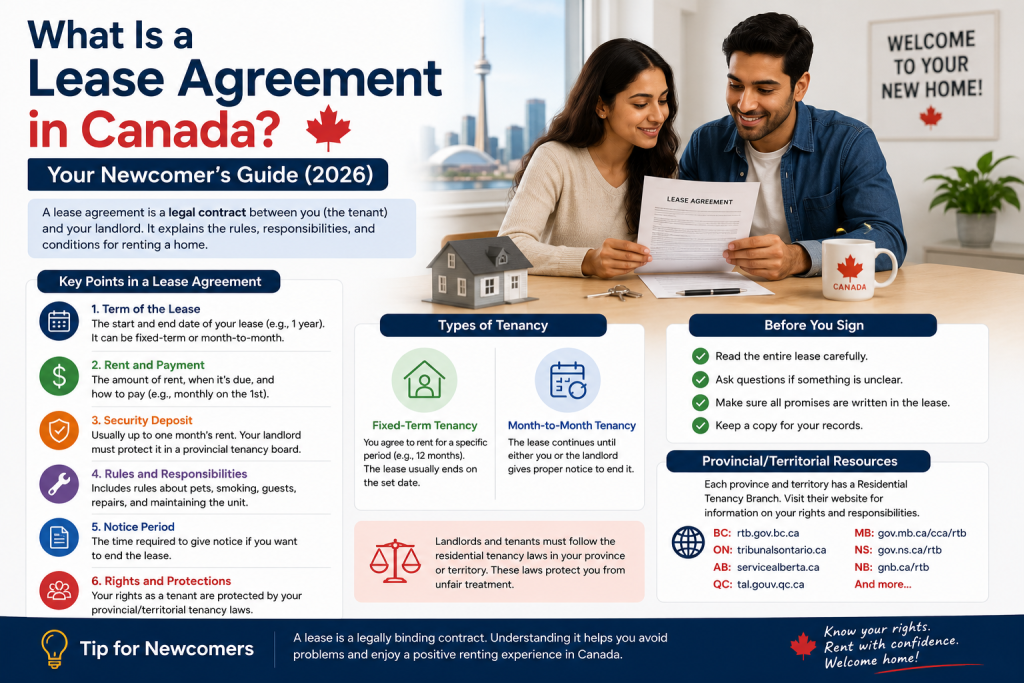

lease agreement in Canada can be easier to manage when you know the basic steps, documents, costs, and official sources to check as a newcomer in Canada.
Introduction
For newcomers arriving in Canada, finding suitable housing is one of the first and most important steps. A key part of securing a home is understanding the rental contract you will sign. This guide explains what is a lease agreement in Canada, outlining its purpose, your rights, and your responsibilities as a tenant. Knowing these details will help you navigate the Canadian rental market with confidence and avoid common pitfalls.
Who This Guide Is For
This guide is specifically designed for:
- New immigrants and permanent residents
- International students
- Temporary foreign workers
- Anyone renting a home in Canada for the first time
If you are new to Canada and planning to rent an apartment, house, or room, this information will provide a solid foundation for understanding your rental contract.
Practical Explanation: Your Lease Agreement
A lease agreement, also often called a rental agreement or tenancy agreement, is a legally binding contract between a tenant (you) and a landlord (the property owner or manager). It outlines the terms and conditions of your tenancy, including rent, duration, responsibilities, and rules for living in the property. In Canada, rental laws are primarily governed by provincial and territorial legislation, so while there are common elements, specific rules can vary slightly from one province to another.
The purpose of a lease agreement in Canada is to protect both the tenant and the landlord by clearly stating their rights and obligations. It creates a clear understanding of what is expected from both parties during the rental period.
Key Components of a Canadian Lease Agreement
While specific forms may differ, most lease agreements in Canada will include:
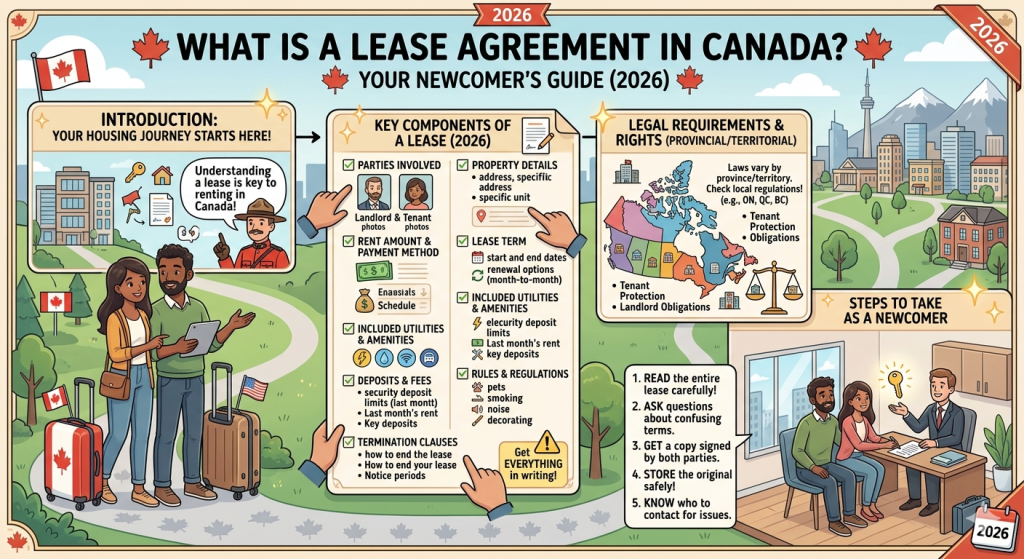
- Names of Parties: Full legal names of all tenants and the landlord.
- Property Address: The full address of the rental unit.
- Term of Tenancy: The start and end dates of the agreement. This can be a fixed term (e.g., one year) or month-to-month.
- Rent Amount: The exact amount of rent, when it is due, and how it should be paid (e.g., cheque, e-transfer).
- Security/Damage Deposit: The amount of any deposit required, and rules for its return. Provincial laws set limits on deposit amounts.
- Utilities: Which utilities are included in the rent (e.g., heat, hydro, water, internet) and which you are responsible for. You can learn more about understanding Canadian utility bills.
- Rules and Regulations: Pet policies, smoking policies, rules for common areas, noise restrictions, etc.
- Maintenance Responsibilities: Who is responsible for repairs and maintenance (e.g., landlord for major repairs, tenant for general cleanliness).
- Termination Clause: Conditions under which the lease can be ended by either party, including required notice periods.
Fixed-Term vs. Month-to-Month Leases
When you sign a lease agreement in Canada, you will typically enter into one of two main types:
- Fixed-Term Lease: This is for a specific period, usually 6 or 12 months. During this term, neither you nor the landlord can easily terminate the agreement without cause or mutual consent. At the end of the fixed term, the lease often automatically converts to a month-to-month tenancy, unless a new fixed-term lease is signed or proper notice to end the tenancy is given.
- Month-to-Month Lease: This agreement continues on a monthly basis until either you or the landlord provides proper notice to end it. This offers more flexibility but less stability than a fixed-term lease.
Steps to Understanding Your Lease Agreement
- Read Every Word: Do not rush. Read the entire document carefully, including any attached addendums or schedules.
- Ask Questions: If anything is unclear, ask the landlord for clarification before you sign. It is better to ask too many questions than to sign something you do not fully understand.
- Understand Your Rights and Responsibilities: Familiarize yourself with the tenant rights and landlord responsibilities in your specific province or territory. This knowledge empowers you.
- Check for Inclusions: Confirm what is included in the rent (utilities, appliances, parking, storage). Refer to our guide on Cost of Living in Canada for Newcomers for a broader perspective.
- Inspect the Property: Before moving in, conduct a thorough inspection of the unit with your landlord. Document any existing damages with photos or videos and ensure they are noted in a move-in inspection report, which should be signed by both parties. This protects your damage deposit.
- Keep a Copy: Always keep a signed copy of your lease agreement and any related documents (e.g., inspection reports, rent receipts) in a safe place.
Lease Agreement Checklist Before Signing
Use this checklist to ensure you cover all important points before signing your rental agreement:
- Read Entire Document: Have you read every clause, including fine print?
- Understand Rent: Is the rent amount, due date, and payment method clear?
- Deposits: Do you understand the security/damage deposit amount and conditions for return?
- Utilities: Is it clear which utilities are included and which are your responsibility?
- Term: Do you know if it’s a fixed-term or month-to-month lease, and its duration?
- Rules: Are all rules (pets, smoking, guests, noise) understood and acceptable?
- Maintenance: Is it clear who is responsible for specific repairs and maintenance?
- Early Termination: Do you understand the conditions for breaking the lease early?
- Signatures: Will all tenants be listed and sign the agreement?
- Property Condition: Is a move-in inspection report completed and signed?
- Copy: Will you receive a signed copy of the complete agreement?
- Provincial Laws: Are you aware of basic tenant rights in your province?
Common Lease Agreement Terms Explained
| Term | Explanation | Newcomer Tip |
|---|---|---|
| Tenant | The person(s) renting the property. | You are the tenant. Understand your rights and responsibilities. |
| Landlord | The owner or manager of the rental property. | Your point of contact for property issues and rent. |
| Rent | The amount paid periodically for the use of the property. | Usually paid monthly. Keep records of all payments. |
| Security/Damage Deposit | Money held by the landlord to cover potential damages or unpaid rent. | Limits are set by provincial law. Should be returned (with interest in some provinces) after you move out, less any legitimate deductions. |
| Utilities | Services like electricity (hydro), gas, water, internet, and heat. | Confirm which are included in rent. If not, budget for them. See How to Understand Utility Bills in Canada. |
| Lease Term | The duration of the rental agreement (e.g., 1 year, month-to-month). | A fixed term offers stability; month-to-month offers flexibility. |
| Notice to Vacate | Formal written notice required by either party to end the tenancy. | Usually 30-60 days, depending on the province and lease type. |
| Sublet | When a tenant rents out their unit to another person for a portion of their lease term. | Often requires landlord’s permission. Different from assigning a lease. |
| Assignment | When a tenant transfers their entire lease agreement to a new tenant. | Requires landlord’s permission. The new tenant takes over the original lease. |
Common Mistakes Newcomers Make to Avoid
- Not Reading the Entire Lease: Signing without fully understanding all clauses can lead to future disputes or unexpected costs.
- Not Documenting Property Condition: Failing to take photos or videos of the unit’s condition before moving in can make it difficult to dispute deductions from your damage deposit later.
- Paying Cash Without Receipts: Always get a receipt for any cash payments, especially for rent or deposits. Using methods like Interac e-Transfer often provides a digital record.
- Ignoring Provincial Tenant Laws: Assuming all provinces have the same rules can be a mistake. Research the specific tenant rights in your province.
- Not Understanding Utility Responsibilities: Be clear on which utilities you are responsible for. Unexpected utility bills can significantly impact your budget.
- Not Knowing How to End the Lease: Misunderstanding the notice period required to end your tenancy can result in extra rent payments or legal issues.
Frequently Asked Questions About Lease Agreements in Canada
What documents do I need to sign a lease agreement in Canada?
To sign a lease agreement in Canada, you will typically need government-issued identification (passport, driver’s license), proof of income (employment letter, pay stubs, bank statements), and sometimes references (previous landlords, employers). Some landlords may also request a credit check, though this can be challenging for newcomers without Canadian credit history. You can find more details in our guide on What Documents Do You Need to Rent in Canada as a Newcomer.
Can a landlord ask for a ‘key deposit’ in Canada?
Yes, in many provinces, landlords can ask for a key deposit. However, there are usually limits on the amount (e.g., the actual cost of the key or fob) and it must be refundable when you return the key at the end of your tenancy. Always check your provincial residential tenancy act for specific rules.
What happens if I need to break my lease early?
Breaking a lease early can have financial consequences. Your lease agreement should outline the terms for early termination. Generally, you may be responsible for paying rent until the end of the fixed term or until a new tenant is found. In some cases, you may be able to assign your lease to another tenant with the landlord’s consent. Always communicate with your landlord immediately if you need to end your lease early.
Are oral lease agreements valid in Canada?
While oral agreements can be legally binding in some situations, it is highly recommended to always have a written lease agreement. A written contract provides clear documentation of all terms and conditions, making it easier to resolve disputes and prove what was agreed upon. For newcomers, a written agreement offers better protection and clarity.
Can my landlord increase my rent during a fixed-term lease?
Generally, no. For a fixed-term lease, your rent cannot be increased until the term ends. If your lease converts to a month-to-month tenancy after the fixed term, your landlord can increase the rent, but they must follow provincial rules regarding notice periods (usually 90 days) and often there are limits on how much the rent can be increased each year.
Disclaimer
This article is for general information only and does not provide financial, legal, tax, or immigration advice. Rules, requirements, fees, and programs may change. Always check official sources or speak with a qualified professional before making decisions.
Sources and Official Resources
- Canada Mortgage and Housing Corporation (CMHC): Provides information and resources on housing in Canada, including renting.
- Government of Canada – Housing: General information and links to provincial and territorial housing resources.
- Renting in Ontario: Your Rights: An example of provincial resources for tenant rights. (Note: Specific provincial government websites provide detailed tenancy laws for their respective jurisdictions. Newcomers should check the official government website for their specific province or territory.)
Conclusion
Understanding what is a lease agreement in Canada is a crucial step for any newcomer establishing themselves in a new home. By carefully reviewing your rental contract, knowing your rights and responsibilities, and asking questions, you can ensure a smooth and secure tenancy. Remember to keep all your documents organized and to consult official provincial resources for specific legal details. Welcome to your new home in Canada!


Pingback: How to Read and Sign a