essentials - First Year Canada
First Year Canada

First Year Canada

  • Start Here
    Get phone plan Canada newcomers can be easier to manage when you know the basic steps , documents , costs , and official sources to check as a newcomer in Canada.

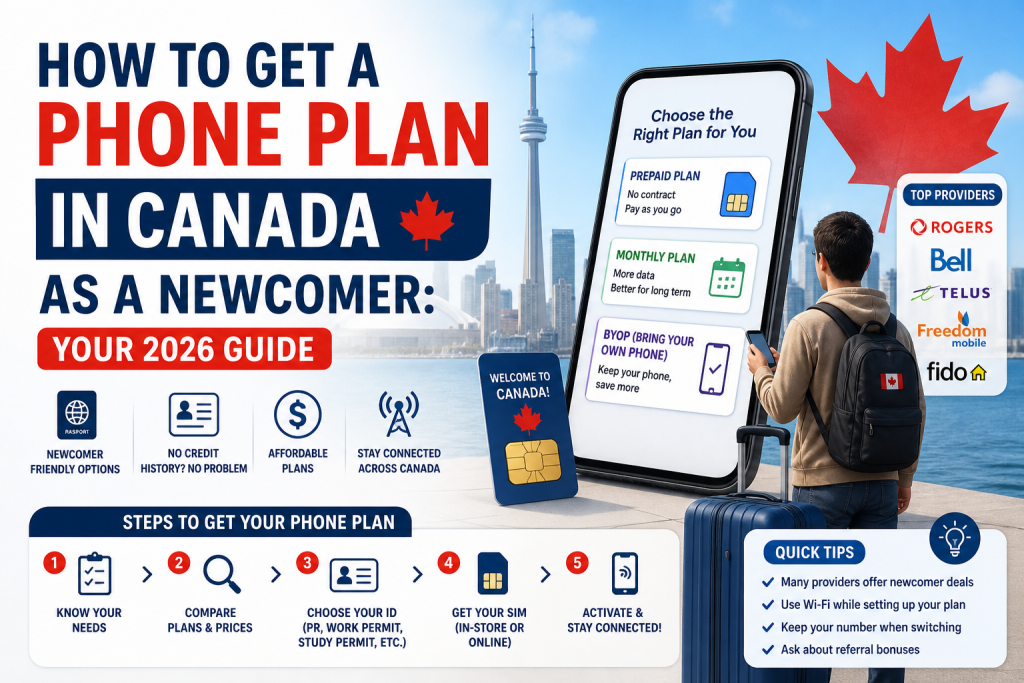
    Arriving in Canada as a newcomer brings many exciting opportunities , but also a list of essential tasks to get settled. One of the most crucial steps is to get a phone plan in Canada newcomers need to stay connected with family , friends , and essential services. A reliable phone plan is not just for calls; it's for navigation , online banking , job applications , and emergencies. This comprehensive guide will walk you through everything you need to know to choose and activate your first Canadian mobile phone plan.

    Who This Guide Is For

    This guide is specifically designed for :
    • International students arriving in Canada.
    • New permanent residents.
    • Temporary foreign workers.
    • Anyone new to Canada needing practical , step-by-step advice on getting mobile phone service.

    Practical Explanation : Understanding Canadian Phone Plans

    The Canadian mobile market is primarily dominated by three major carriers : Bell , Rogers , and Telus. These companies , often referred to as the 'Big Three ,' own various 'flanker brands' or 'subsidiaries' that offer more budget-friendly options. Understanding this structure can help you find a plan that fits your needs and budget.

    Major Carriers vs. Flanker Brands

    • Major Carriers (Bell , Rogers , Telus) : Offer extensive network coverage , often premium services , and the latest devices. Plans can be more expensive.
    • Flanker Brands (e.g. , Fido by Rogers , Koodo by Telus , Virgin Plus by Bell) : Typically offer more affordable plans with slightly less perks but still use the parent company's reliable network. Good value for many newcomers.
    • Mobile Virtual Network Operators (MVNOs - e.g. , Public Mobile , Freedom Mobile , Chatr , Lucky Mobile) : These smaller providers often offer the most competitive prices , sometimes with specific regional coverage limitations or fewer customer service options. Freedom Mobile , for instance , has strong urban coverage but less reach in rural areas compared to the Big Three.

    Prepaid vs. Postpaid Plans

    When you get a phone plan in Canada newcomers will generally choose between two main types :
    • Prepaid (Pay-As-You-Go) : You pay for your service upfront , usually on a monthly basis. There's no credit check , no long-term contract , and you control your spending. This is often the easiest option for newcomers without a Canadian credit history. You can top up your balance online , at convenience stores , or through the provider's app.
    • Postpaid (Contract) Plans : You sign a contract , typically for 12 or 24 months , and receive a monthly bill for your usage. These plans often come with better data allowances , unlimited talk and text , and the option to finance a new phone over the contract term. However , they almost always require a credit check , which can be challenging for newcomers.

    Step-by-Step Guide : How to Get a Phone Plan in Canada as a Newcomer

    Step 1 : Assess Your Needs and Budget

    • Data Usage : How much data do you anticipate using? Most plans start at 5 GB and go up to 'unlimited' (which usually means throttled speeds after a certain cap). For daily navigation , social media , and messaging , 10-20 GB is a good starting point.
    • Talk & Text : Most Canadian plans include unlimited nationwide talk and text. International calling may be an add-on.
    • Device : Do you have an unlocked phone from your home country? If so , you can use it. If not , you'll need to buy one outright or finance one through a postpaid plan (which might be difficult initially).
    • Budget : Basic plans can start from $25-$35 per month for prepaid , while postpaid plans with more data can range from $50-$80+ per month , excluding device costs. Consider the overall cost of living in Canada when budgeting for your phone plan.

    Step 2 : Gather Your Documents

    While requirements can vary slightly by provider , here’s what you'll commonly need :
    • Primary Identification : Your passport , Canadian study permit , or work permit.
    • Secondary Identification : A driver's license (if you have one) , or another form of government-issued ID.
    • Proof of Address : This can be a challenge for newcomers. Options include a utility bill (if you've already set one up) , a rental agreement , or sometimes a letter from your educational institution or employer. If you don't have a permanent address yet , some providers may allow you to use a temporary address , but prepaid options are usually more flexible.
    • Canadian Bank Account : Essential for postpaid plans for recurring payments. For prepaid , you can often pay with a credit card or debit card. Learn how to open a bank account in Canada as a newcomer.

    Step 3 : Research Providers and Plans

    Once you know your needs and have your documents ready , compare options. Visit the websites of different providers or go to a multi-brand electronics store like Best Buy or The Mobile Shop (inside Loblaws/Real Canadian Superstore) where you can compare plans side-by-side. Consider :
    • Coverage : Check their coverage maps for the areas you'll be living and working/studying in.
    • Customer Service : Read reviews or ask other newcomers about their experiences.
    • Newcomer Offers : Some providers occasionally have special offers for new arrivals , especially international students.

    Example Comparison Table (Prices are illustrative and subject to change)

    Provider Type Example Brands Typical Monthly Cost (Data) Credit Check Required Best For
    Major Carrier Bell , Rogers , Telus $70-100+ (20-50GB+) Yes High data users , device financing , extensive coverage
    Flanker Brand Fido , Koodo , Virgin Plus $45-70 (10-30GB) Often (sometimes flexible) Good balance of cost , coverage , and features
    MVNO/Budget Freedom Mobile , Public Mobile , Chatr $25-50 (5-20GB) No (for prepaid) Budget-conscious , urban living , no credit history

    Step 4 : Choose a Plan and Activate Service

    You can purchase a plan online or by visiting a store. For newcomers , visiting a physical store is often recommended , as staff can help you navigate options , verify documents , and activate your SIM card on the spot. Bring all your documents from Step 2.
    • SIM Card vs. eSIM : Most new phones support eSIM (electronic SIM) , which means no physical card is needed. Providers can provision this remotely. If your phone doesn't support eSIM , you'll get a physical SIM card.
    • Activation : The store representative will activate your SIM card , and you should have service within minutes. You'll receive a new Canadian phone number.

    Step 5 : Set Up Payment and Manage Your Account

    • Prepaid : Remember to top up your account before your plan expires to avoid service interruption. Many offer auto-top-up options.
    • Postpaid : Ensure your monthly payments are set up , usually through direct debit from your Canadian bank account or a Canadian credit card. Missed payments can negatively affect your credit score in Canada.
    • Online Account : Create an online account with your provider to monitor data usage , manage your plan , and pay bills.

    Newcomer Phone Plan Checklist

    • ✓ Unlocked phone (if bringing your own)
    • ✓ Passport
    • ✓ Study Permit / Work Permit / PR Card
    • ✓ Proof of Canadian address (rental agreement , utility bill , school letter)
    • ✓ Canadian bank account details (for postpaid) or payment method (credit/debit card for prepaid)
    • ✓ Research on local coverage for your area
    • ✓ Comparison of prepaid vs. postpaid options
    • ✓ Understanding of data , talk , and text needs
    • ✓ Budget for monthly costs

    Common Mistakes to Avoid When Getting a Phone Plan in Canada

    To avoid common newcomer mistakes in Canada , pay attention to these points :
    • Not Checking Coverage : A cheap plan is useless if it doesn't work where you live or work. Always check the provider's coverage map.
    • Signing Long Contracts Without Understanding : Postpaid plans usually mean a 12 or 24-month commitment. Understand cancellation fees and terms before signing , especially if your stay in Canada is uncertain.
    • Overpaying for Data : Many newcomers overestimate their data needs. Start with a moderate plan (e.g. , 10-15 GB) and upgrade if necessary. Wi-Fi is widely available in Canada.
    • Ignoring Prepaid Options : For newcomers without a credit history , prepaid plans are often the best and simplest starting point. Don't feel pressured into a postpaid contract if it doesn't suit your situation.
    • Not Asking About Newcomer Deals : Some providers , especially near universities or immigrant service centres , might have special offers for international students or new permanent residents. Always ask!
    • Forgetting to Unlock Your Phone : If you bring a phone from your home country , ensure it's unlocked. A locked phone will only work with its original network.

    FAQ : Getting a Phone Plan in Canada

    Q : Can I use my phone from my home country in Canada?

    A : Yes , if your phone is unlocked and compatible with Canadian network frequencies (GSM 850/1900 MHz , LTE bands 2 , 4 , 5 , 7 , 12 , 13 , 17 , 66). Most modern smartphones are compatible. You'll just need a Canadian SIM card or eSIM.

    Q : Do I need a credit history to get a phone plan in Canada?

    A : For postpaid plans , a credit check is almost always required. As a newcomer , you likely won't have a Canadian credit history. Prepaid plans do not require a credit check and are an excellent option to start. Some providers might offer postpaid plans with a security deposit for newcomers.

    Q : What is the average cost of a phone plan in Canada?

    A : A basic prepaid plan with moderate data (5-10 GB) can range from $25-$45 per month. Postpaid plans with more data and possibly a financed phone can range from $50-$100+ per month. Prices vary significantly based on data , provider , and promotions.

    Q : Can I keep my phone number if I switch providers later?

    A : Yes , once you have a Canadian phone number , you can usually 'port' it (transfer it) to a new provider if you decide to switch. This process is straightforward and typically handled by your new provider.

    Q : Should I get a plan with a new phone or bring my own?

    A : Bringing your own unlocked phone is generally more cost-effective , as you avoid device financing fees. If your phone is old or incompatible , consider buying an affordable new phone outright or opting for a prepaid plan that includes a basic device. Postpaid plans with financed devices are harder to get without a credit history.

    Disclaimer

    This article is for general information only and does not provide financial , legal , tax , or immigration advice. Rules , requirements , fees , and programs may change. Always check official sources or speak with a qualified professional before making decisions.

    Sources or Official Resources

    • Innovation , Science and Economic Development Canada (ISED) - For telecommunications policy information.
    • Canadian Radio-television and Telecommunications Commission (CRTC) - For consumer rights and telecom regulations.
    • Check individual mobile provider websites (Bell , Rogers , Telus , Fido , Koodo , Virgin Plus , Freedom Mobile , Public Mobile , etc.) for their latest plans and specific newcomer offers.

    Getting a phone plan in Canada as a newcomer is a fundamental step towards settling in. By understanding your options , preparing your documents , and avoiding common pitfalls , you can quickly get connected and navigate your new life with ease. Remember to compare plans , ask questions , and choose what best fits your immediate needs and long-term plans in Canada. Welcome to Canada , and enjoy staying connected!
  • Banking
    Get phone plan Canada newcomers can be easier to manage when you know the basic steps , documents , costs , and official sources to check as a newcomer in Canada.

    Arriving in Canada as a newcomer brings many exciting opportunities , but also a list of essential tasks to get settled. One of the most crucial steps is to get a phone plan in Canada newcomers need to stay connected with family , friends , and essential services. A reliable phone plan is not just for calls; it's for navigation , online banking , job applications , and emergencies. This comprehensive guide will walk you through everything you need to know to choose and activate your first Canadian mobile phone plan.

    Who This Guide Is For

    This guide is specifically designed for :
    • International students arriving in Canada.
    • New permanent residents.
    • Temporary foreign workers.
    • Anyone new to Canada needing practical , step-by-step advice on getting mobile phone service.

    Practical Explanation : Understanding Canadian Phone Plans

    The Canadian mobile market is primarily dominated by three major carriers : Bell , Rogers , and Telus. These companies , often referred to as the 'Big Three ,' own various 'flanker brands' or 'subsidiaries' that offer more budget-friendly options. Understanding this structure can help you find a plan that fits your needs and budget.

    Major Carriers vs. Flanker Brands

    • Major Carriers (Bell , Rogers , Telus) : Offer extensive network coverage , often premium services , and the latest devices. Plans can be more expensive.
    • Flanker Brands (e.g. , Fido by Rogers , Koodo by Telus , Virgin Plus by Bell) : Typically offer more affordable plans with slightly less perks but still use the parent company's reliable network. Good value for many newcomers.
    • Mobile Virtual Network Operators (MVNOs - e.g. , Public Mobile , Freedom Mobile , Chatr , Lucky Mobile) : These smaller providers often offer the most competitive prices , sometimes with specific regional coverage limitations or fewer customer service options. Freedom Mobile , for instance , has strong urban coverage but less reach in rural areas compared to the Big Three.

    Prepaid vs. Postpaid Plans

    When you get a phone plan in Canada newcomers will generally choose between two main types :
    • Prepaid (Pay-As-You-Go) : You pay for your service upfront , usually on a monthly basis. There's no credit check , no long-term contract , and you control your spending. This is often the easiest option for newcomers without a Canadian credit history. You can top up your balance online , at convenience stores , or through the provider's app.
    • Postpaid (Contract) Plans : You sign a contract , typically for 12 or 24 months , and receive a monthly bill for your usage. These plans often come with better data allowances , unlimited talk and text , and the option to finance a new phone over the contract term. However , they almost always require a credit check , which can be challenging for newcomers.

    Step-by-Step Guide : How to Get a Phone Plan in Canada as a Newcomer

    Step 1 : Assess Your Needs and Budget

    • Data Usage : How much data do you anticipate using? Most plans start at 5 GB and go up to 'unlimited' (which usually means throttled speeds after a certain cap). For daily navigation , social media , and messaging , 10-20 GB is a good starting point.
    • Talk & Text : Most Canadian plans include unlimited nationwide talk and text. International calling may be an add-on.
    • Device : Do you have an unlocked phone from your home country? If so , you can use it. If not , you'll need to buy one outright or finance one through a postpaid plan (which might be difficult initially).
    • Budget : Basic plans can start from $25-$35 per month for prepaid , while postpaid plans with more data can range from $50-$80+ per month , excluding device costs. Consider the overall cost of living in Canada when budgeting for your phone plan.

    Step 2 : Gather Your Documents

    While requirements can vary slightly by provider , here’s what you'll commonly need :
    • Primary Identification : Your passport , Canadian study permit , or work permit.
    • Secondary Identification : A driver's license (if you have one) , or another form of government-issued ID.
    • Proof of Address : This can be a challenge for newcomers. Options include a utility bill (if you've already set one up) , a rental agreement , or sometimes a letter from your educational institution or employer. If you don't have a permanent address yet , some providers may allow you to use a temporary address , but prepaid options are usually more flexible.
    • Canadian Bank Account : Essential for postpaid plans for recurring payments. For prepaid , you can often pay with a credit card or debit card. Learn how to open a bank account in Canada as a newcomer.

    Step 3 : Research Providers and Plans

    Once you know your needs and have your documents ready , compare options. Visit the websites of different providers or go to a multi-brand electronics store like Best Buy or The Mobile Shop (inside Loblaws/Real Canadian Superstore) where you can compare plans side-by-side. Consider :
    • Coverage : Check their coverage maps for the areas you'll be living and working/studying in.
    • Customer Service : Read reviews or ask other newcomers about their experiences.
    • Newcomer Offers : Some providers occasionally have special offers for new arrivals , especially international students.

    Example Comparison Table (Prices are illustrative and subject to change)

    Provider Type Example Brands Typical Monthly Cost (Data) Credit Check Required Best For
    Major Carrier Bell , Rogers , Telus $70-100+ (20-50GB+) Yes High data users , device financing , extensive coverage
    Flanker Brand Fido , Koodo , Virgin Plus $45-70 (10-30GB) Often (sometimes flexible) Good balance of cost , coverage , and features
    MVNO/Budget Freedom Mobile , Public Mobile , Chatr $25-50 (5-20GB) No (for prepaid) Budget-conscious , urban living , no credit history

    Step 4 : Choose a Plan and Activate Service

    You can purchase a plan online or by visiting a store. For newcomers , visiting a physical store is often recommended , as staff can help you navigate options , verify documents , and activate your SIM card on the spot. Bring all your documents from Step 2.
    • SIM Card vs. eSIM : Most new phones support eSIM (electronic SIM) , which means no physical card is needed. Providers can provision this remotely. If your phone doesn't support eSIM , you'll get a physical SIM card.
    • Activation : The store representative will activate your SIM card , and you should have service within minutes. You'll receive a new Canadian phone number.

    Step 5 : Set Up Payment and Manage Your Account

    • Prepaid : Remember to top up your account before your plan expires to avoid service interruption. Many offer auto-top-up options.
    • Postpaid : Ensure your monthly payments are set up , usually through direct debit from your Canadian bank account or a Canadian credit card. Missed payments can negatively affect your credit score in Canada.
    • Online Account : Create an online account with your provider to monitor data usage , manage your plan , and pay bills.

    Newcomer Phone Plan Checklist

    • ✓ Unlocked phone (if bringing your own)
    • ✓ Passport
    • ✓ Study Permit / Work Permit / PR Card
    • ✓ Proof of Canadian address (rental agreement , utility bill , school letter)
    • ✓ Canadian bank account details (for postpaid) or payment method (credit/debit card for prepaid)
    • ✓ Research on local coverage for your area
    • ✓ Comparison of prepaid vs. postpaid options
    • ✓ Understanding of data , talk , and text needs
    • ✓ Budget for monthly costs

    Common Mistakes to Avoid When Getting a Phone Plan in Canada

    To avoid common newcomer mistakes in Canada , pay attention to these points :
    • Not Checking Coverage : A cheap plan is useless if it doesn't work where you live or work. Always check the provider's coverage map.
    • Signing Long Contracts Without Understanding : Postpaid plans usually mean a 12 or 24-month commitment. Understand cancellation fees and terms before signing , especially if your stay in Canada is uncertain.
    • Overpaying for Data : Many newcomers overestimate their data needs. Start with a moderate plan (e.g. , 10-15 GB) and upgrade if necessary. Wi-Fi is widely available in Canada.
    • Ignoring Prepaid Options : For newcomers without a credit history , prepaid plans are often the best and simplest starting point. Don't feel pressured into a postpaid contract if it doesn't suit your situation.
    • Not Asking About Newcomer Deals : Some providers , especially near universities or immigrant service centres , might have special offers for international students or new permanent residents. Always ask!
    • Forgetting to Unlock Your Phone : If you bring a phone from your home country , ensure it's unlocked. A locked phone will only work with its original network.

    FAQ : Getting a Phone Plan in Canada

    Q : Can I use my phone from my home country in Canada?

    A : Yes , if your phone is unlocked and compatible with Canadian network frequencies (GSM 850/1900 MHz , LTE bands 2 , 4 , 5 , 7 , 12 , 13 , 17 , 66). Most modern smartphones are compatible. You'll just need a Canadian SIM card or eSIM.

    Q : Do I need a credit history to get a phone plan in Canada?

    A : For postpaid plans , a credit check is almost always required. As a newcomer , you likely won't have a Canadian credit history. Prepaid plans do not require a credit check and are an excellent option to start. Some providers might offer postpaid plans with a security deposit for newcomers.

    Q : What is the average cost of a phone plan in Canada?

    A : A basic prepaid plan with moderate data (5-10 GB) can range from $25-$45 per month. Postpaid plans with more data and possibly a financed phone can range from $50-$100+ per month. Prices vary significantly based on data , provider , and promotions.

    Q : Can I keep my phone number if I switch providers later?

    A : Yes , once you have a Canadian phone number , you can usually 'port' it (transfer it) to a new provider if you decide to switch. This process is straightforward and typically handled by your new provider.

    Q : Should I get a plan with a new phone or bring my own?

    A : Bringing your own unlocked phone is generally more cost-effective , as you avoid device financing fees. If your phone is old or incompatible , consider buying an affordable new phone outright or opting for a prepaid plan that includes a basic device. Postpaid plans with financed devices are harder to get without a credit history.

    Disclaimer

    This article is for general information only and does not provide financial , legal , tax , or immigration advice. Rules , requirements , fees , and programs may change. Always check official sources or speak with a qualified professional before making decisions.

    Sources or Official Resources

    • Innovation , Science and Economic Development Canada (ISED) - For telecommunications policy information.
    • Canadian Radio-television and Telecommunications Commission (CRTC) - For consumer rights and telecom regulations.
    • Check individual mobile provider websites (Bell , Rogers , Telus , Fido , Koodo , Virgin Plus , Freedom Mobile , Public Mobile , etc.) for their latest plans and specific newcomer offers.

    Getting a phone plan in Canada as a newcomer is a fundamental step towards settling in. By understanding your options , preparing your documents , and avoiding common pitfalls , you can quickly get connected and navigate your new life with ease. Remember to compare plans , ask questions , and choose what best fits your immediate needs and long-term plans in Canada. Welcome to Canada , and enjoy staying connected!
  • Cost of Living
    Get phone plan Canada newcomers can be easier to manage when you know the basic steps , documents , costs , and official sources to check as a newcomer in Canada.

    Arriving in Canada as a newcomer brings many exciting opportunities , but also a list of essential tasks to get settled. One of the most crucial steps is to get a phone plan in Canada newcomers need to stay connected with family , friends , and essential services. A reliable phone plan is not just for calls; it's for navigation , online banking , job applications , and emergencies. This comprehensive guide will walk you through everything you need to know to choose and activate your first Canadian mobile phone plan.

    Who This Guide Is For

    This guide is specifically designed for :
    • International students arriving in Canada.
    • New permanent residents.
    • Temporary foreign workers.
    • Anyone new to Canada needing practical , step-by-step advice on getting mobile phone service.

    Practical Explanation : Understanding Canadian Phone Plans

    The Canadian mobile market is primarily dominated by three major carriers : Bell , Rogers , and Telus. These companies , often referred to as the 'Big Three ,' own various 'flanker brands' or 'subsidiaries' that offer more budget-friendly options. Understanding this structure can help you find a plan that fits your needs and budget.

    Major Carriers vs. Flanker Brands

    • Major Carriers (Bell , Rogers , Telus) : Offer extensive network coverage , often premium services , and the latest devices. Plans can be more expensive.
    • Flanker Brands (e.g. , Fido by Rogers , Koodo by Telus , Virgin Plus by Bell) : Typically offer more affordable plans with slightly less perks but still use the parent company's reliable network. Good value for many newcomers.
    • Mobile Virtual Network Operators (MVNOs - e.g. , Public Mobile , Freedom Mobile , Chatr , Lucky Mobile) : These smaller providers often offer the most competitive prices , sometimes with specific regional coverage limitations or fewer customer service options. Freedom Mobile , for instance , has strong urban coverage but less reach in rural areas compared to the Big Three.

    Prepaid vs. Postpaid Plans

    When you get a phone plan in Canada newcomers will generally choose between two main types :
    • Prepaid (Pay-As-You-Go) : You pay for your service upfront , usually on a monthly basis. There's no credit check , no long-term contract , and you control your spending. This is often the easiest option for newcomers without a Canadian credit history. You can top up your balance online , at convenience stores , or through the provider's app.
    • Postpaid (Contract) Plans : You sign a contract , typically for 12 or 24 months , and receive a monthly bill for your usage. These plans often come with better data allowances , unlimited talk and text , and the option to finance a new phone over the contract term. However , they almost always require a credit check , which can be challenging for newcomers.

    Step-by-Step Guide : How to Get a Phone Plan in Canada as a Newcomer

    Step 1 : Assess Your Needs and Budget

    • Data Usage : How much data do you anticipate using? Most plans start at 5 GB and go up to 'unlimited' (which usually means throttled speeds after a certain cap). For daily navigation , social media , and messaging , 10-20 GB is a good starting point.
    • Talk & Text : Most Canadian plans include unlimited nationwide talk and text. International calling may be an add-on.
    • Device : Do you have an unlocked phone from your home country? If so , you can use it. If not , you'll need to buy one outright or finance one through a postpaid plan (which might be difficult initially).
    • Budget : Basic plans can start from $25-$35 per month for prepaid , while postpaid plans with more data can range from $50-$80+ per month , excluding device costs. Consider the overall cost of living in Canada when budgeting for your phone plan.

    Step 2 : Gather Your Documents

    While requirements can vary slightly by provider , here’s what you'll commonly need :
    • Primary Identification : Your passport , Canadian study permit , or work permit.
    • Secondary Identification : A driver's license (if you have one) , or another form of government-issued ID.
    • Proof of Address : This can be a challenge for newcomers. Options include a utility bill (if you've already set one up) , a rental agreement , or sometimes a letter from your educational institution or employer. If you don't have a permanent address yet , some providers may allow you to use a temporary address , but prepaid options are usually more flexible.
    • Canadian Bank Account : Essential for postpaid plans for recurring payments. For prepaid , you can often pay with a credit card or debit card. Learn how to open a bank account in Canada as a newcomer.

    Step 3 : Research Providers and Plans

    Once you know your needs and have your documents ready , compare options. Visit the websites of different providers or go to a multi-brand electronics store like Best Buy or The Mobile Shop (inside Loblaws/Real Canadian Superstore) where you can compare plans side-by-side. Consider :
    • Coverage : Check their coverage maps for the areas you'll be living and working/studying in.
    • Customer Service : Read reviews or ask other newcomers about their experiences.
    • Newcomer Offers : Some providers occasionally have special offers for new arrivals , especially international students.

    Example Comparison Table (Prices are illustrative and subject to change)

    Provider Type Example Brands Typical Monthly Cost (Data) Credit Check Required Best For
    Major Carrier Bell , Rogers , Telus $70-100+ (20-50GB+) Yes High data users , device financing , extensive coverage
    Flanker Brand Fido , Koodo , Virgin Plus $45-70 (10-30GB) Often (sometimes flexible) Good balance of cost , coverage , and features
    MVNO/Budget Freedom Mobile , Public Mobile , Chatr $25-50 (5-20GB) No (for prepaid) Budget-conscious , urban living , no credit history

    Step 4 : Choose a Plan and Activate Service

    You can purchase a plan online or by visiting a store. For newcomers , visiting a physical store is often recommended , as staff can help you navigate options , verify documents , and activate your SIM card on the spot. Bring all your documents from Step 2.
    • SIM Card vs. eSIM : Most new phones support eSIM (electronic SIM) , which means no physical card is needed. Providers can provision this remotely. If your phone doesn't support eSIM , you'll get a physical SIM card.
    • Activation : The store representative will activate your SIM card , and you should have service within minutes. You'll receive a new Canadian phone number.

    Step 5 : Set Up Payment and Manage Your Account

    • Prepaid : Remember to top up your account before your plan expires to avoid service interruption. Many offer auto-top-up options.
    • Postpaid : Ensure your monthly payments are set up , usually through direct debit from your Canadian bank account or a Canadian credit card. Missed payments can negatively affect your credit score in Canada.
    • Online Account : Create an online account with your provider to monitor data usage , manage your plan , and pay bills.

    Newcomer Phone Plan Checklist

    • ✓ Unlocked phone (if bringing your own)
    • ✓ Passport
    • ✓ Study Permit / Work Permit / PR Card
    • ✓ Proof of Canadian address (rental agreement , utility bill , school letter)
    • ✓ Canadian bank account details (for postpaid) or payment method (credit/debit card for prepaid)
    • ✓ Research on local coverage for your area
    • ✓ Comparison of prepaid vs. postpaid options
    • ✓ Understanding of data , talk , and text needs
    • ✓ Budget for monthly costs

    Common Mistakes to Avoid When Getting a Phone Plan in Canada

    To avoid common newcomer mistakes in Canada , pay attention to these points :
    • Not Checking Coverage : A cheap plan is useless if it doesn't work where you live or work. Always check the provider's coverage map.
    • Signing Long Contracts Without Understanding : Postpaid plans usually mean a 12 or 24-month commitment. Understand cancellation fees and terms before signing , especially if your stay in Canada is uncertain.
    • Overpaying for Data : Many newcomers overestimate their data needs. Start with a moderate plan (e.g. , 10-15 GB) and upgrade if necessary. Wi-Fi is widely available in Canada.
    • Ignoring Prepaid Options : For newcomers without a credit history , prepaid plans are often the best and simplest starting point. Don't feel pressured into a postpaid contract if it doesn't suit your situation.
    • Not Asking About Newcomer Deals : Some providers , especially near universities or immigrant service centres , might have special offers for international students or new permanent residents. Always ask!
    • Forgetting to Unlock Your Phone : If you bring a phone from your home country , ensure it's unlocked. A locked phone will only work with its original network.

    FAQ : Getting a Phone Plan in Canada

    Q : Can I use my phone from my home country in Canada?

    A : Yes , if your phone is unlocked and compatible with Canadian network frequencies (GSM 850/1900 MHz , LTE bands 2 , 4 , 5 , 7 , 12 , 13 , 17 , 66). Most modern smartphones are compatible. You'll just need a Canadian SIM card or eSIM.

    Q : Do I need a credit history to get a phone plan in Canada?

    A : For postpaid plans , a credit check is almost always required. As a newcomer , you likely won't have a Canadian credit history. Prepaid plans do not require a credit check and are an excellent option to start. Some providers might offer postpaid plans with a security deposit for newcomers.

    Q : What is the average cost of a phone plan in Canada?

    A : A basic prepaid plan with moderate data (5-10 GB) can range from $25-$45 per month. Postpaid plans with more data and possibly a financed phone can range from $50-$100+ per month. Prices vary significantly based on data , provider , and promotions.

    Q : Can I keep my phone number if I switch providers later?

    A : Yes , once you have a Canadian phone number , you can usually 'port' it (transfer it) to a new provider if you decide to switch. This process is straightforward and typically handled by your new provider.

    Q : Should I get a plan with a new phone or bring my own?

    A : Bringing your own unlocked phone is generally more cost-effective , as you avoid device financing fees. If your phone is old or incompatible , consider buying an affordable new phone outright or opting for a prepaid plan that includes a basic device. Postpaid plans with financed devices are harder to get without a credit history.

    Disclaimer

    This article is for general information only and does not provide financial , legal , tax , or immigration advice. Rules , requirements , fees , and programs may change. Always check official sources or speak with a qualified professional before making decisions.

    Sources or Official Resources

    • Innovation , Science and Economic Development Canada (ISED) - For telecommunications policy information.
    • Canadian Radio-television and Telecommunications Commission (CRTC) - For consumer rights and telecom regulations.
    • Check individual mobile provider websites (Bell , Rogers , Telus , Fido , Koodo , Virgin Plus , Freedom Mobile , Public Mobile , etc.) for their latest plans and specific newcomer offers.

    Getting a phone plan in Canada as a newcomer is a fundamental step towards settling in. By understanding your options , preparing your documents , and avoiding common pitfalls , you can quickly get connected and navigate your new life with ease. Remember to compare plans , ask questions , and choose what best fits your immediate needs and long-term plans in Canada. Welcome to Canada , and enjoy staying connected!
  • Credit Score
    Get phone plan Canada newcomers can be easier to manage when you know the basic steps , documents , costs , and official sources to check as a newcomer in Canada.

    Arriving in Canada as a newcomer brings many exciting opportunities , but also a list of essential tasks to get settled. One of the most crucial steps is to get a phone plan in Canada newcomers need to stay connected with family , friends , and essential services. A reliable phone plan is not just for calls; it's for navigation , online banking , job applications , and emergencies. This comprehensive guide will walk you through everything you need to know to choose and activate your first Canadian mobile phone plan.

    Who This Guide Is For

    This guide is specifically designed for :
    • International students arriving in Canada.
    • New permanent residents.
    • Temporary foreign workers.
    • Anyone new to Canada needing practical , step-by-step advice on getting mobile phone service.

    Practical Explanation : Understanding Canadian Phone Plans

    The Canadian mobile market is primarily dominated by three major carriers : Bell , Rogers , and Telus. These companies , often referred to as the 'Big Three ,' own various 'flanker brands' or 'subsidiaries' that offer more budget-friendly options. Understanding this structure can help you find a plan that fits your needs and budget.

    Major Carriers vs. Flanker Brands

    • Major Carriers (Bell , Rogers , Telus) : Offer extensive network coverage , often premium services , and the latest devices. Plans can be more expensive.
    • Flanker Brands (e.g. , Fido by Rogers , Koodo by Telus , Virgin Plus by Bell) : Typically offer more affordable plans with slightly less perks but still use the parent company's reliable network. Good value for many newcomers.
    • Mobile Virtual Network Operators (MVNOs - e.g. , Public Mobile , Freedom Mobile , Chatr , Lucky Mobile) : These smaller providers often offer the most competitive prices , sometimes with specific regional coverage limitations or fewer customer service options. Freedom Mobile , for instance , has strong urban coverage but less reach in rural areas compared to the Big Three.

    Prepaid vs. Postpaid Plans

    When you get a phone plan in Canada newcomers will generally choose between two main types :
    • Prepaid (Pay-As-You-Go) : You pay for your service upfront , usually on a monthly basis. There's no credit check , no long-term contract , and you control your spending. This is often the easiest option for newcomers without a Canadian credit history. You can top up your balance online , at convenience stores , or through the provider's app.
    • Postpaid (Contract) Plans : You sign a contract , typically for 12 or 24 months , and receive a monthly bill for your usage. These plans often come with better data allowances , unlimited talk and text , and the option to finance a new phone over the contract term. However , they almost always require a credit check , which can be challenging for newcomers.

    Step-by-Step Guide : How to Get a Phone Plan in Canada as a Newcomer

    Step 1 : Assess Your Needs and Budget

    • Data Usage : How much data do you anticipate using? Most plans start at 5 GB and go up to 'unlimited' (which usually means throttled speeds after a certain cap). For daily navigation , social media , and messaging , 10-20 GB is a good starting point.
    • Talk & Text : Most Canadian plans include unlimited nationwide talk and text. International calling may be an add-on.
    • Device : Do you have an unlocked phone from your home country? If so , you can use it. If not , you'll need to buy one outright or finance one through a postpaid plan (which might be difficult initially).
    • Budget : Basic plans can start from $25-$35 per month for prepaid , while postpaid plans with more data can range from $50-$80+ per month , excluding device costs. Consider the overall cost of living in Canada when budgeting for your phone plan.

    Step 2 : Gather Your Documents

    While requirements can vary slightly by provider , here’s what you'll commonly need :
    • Primary Identification : Your passport , Canadian study permit , or work permit.
    • Secondary Identification : A driver's license (if you have one) , or another form of government-issued ID.
    • Proof of Address : This can be a challenge for newcomers. Options include a utility bill (if you've already set one up) , a rental agreement , or sometimes a letter from your educational institution or employer. If you don't have a permanent address yet , some providers may allow you to use a temporary address , but prepaid options are usually more flexible.
    • Canadian Bank Account : Essential for postpaid plans for recurring payments. For prepaid , you can often pay with a credit card or debit card. Learn how to open a bank account in Canada as a newcomer.

    Step 3 : Research Providers and Plans

    Once you know your needs and have your documents ready , compare options. Visit the websites of different providers or go to a multi-brand electronics store like Best Buy or The Mobile Shop (inside Loblaws/Real Canadian Superstore) where you can compare plans side-by-side. Consider :
    • Coverage : Check their coverage maps for the areas you'll be living and working/studying in.
    • Customer Service : Read reviews or ask other newcomers about their experiences.
    • Newcomer Offers : Some providers occasionally have special offers for new arrivals , especially international students.

    Example Comparison Table (Prices are illustrative and subject to change)

    Provider Type Example Brands Typical Monthly Cost (Data) Credit Check Required Best For
    Major Carrier Bell , Rogers , Telus $70-100+ (20-50GB+) Yes High data users , device financing , extensive coverage
    Flanker Brand Fido , Koodo , Virgin Plus $45-70 (10-30GB) Often (sometimes flexible) Good balance of cost , coverage , and features
    MVNO/Budget Freedom Mobile , Public Mobile , Chatr $25-50 (5-20GB) No (for prepaid) Budget-conscious , urban living , no credit history

    Step 4 : Choose a Plan and Activate Service

    You can purchase a plan online or by visiting a store. For newcomers , visiting a physical store is often recommended , as staff can help you navigate options , verify documents , and activate your SIM card on the spot. Bring all your documents from Step 2.
    • SIM Card vs. eSIM : Most new phones support eSIM (electronic SIM) , which means no physical card is needed. Providers can provision this remotely. If your phone doesn't support eSIM , you'll get a physical SIM card.
    • Activation : The store representative will activate your SIM card , and you should have service within minutes. You'll receive a new Canadian phone number.

    Step 5 : Set Up Payment and Manage Your Account

    • Prepaid : Remember to top up your account before your plan expires to avoid service interruption. Many offer auto-top-up options.
    • Postpaid : Ensure your monthly payments are set up , usually through direct debit from your Canadian bank account or a Canadian credit card. Missed payments can negatively affect your credit score in Canada.
    • Online Account : Create an online account with your provider to monitor data usage , manage your plan , and pay bills.

    Newcomer Phone Plan Checklist

    • ✓ Unlocked phone (if bringing your own)
    • ✓ Passport
    • ✓ Study Permit / Work Permit / PR Card
    • ✓ Proof of Canadian address (rental agreement , utility bill , school letter)
    • ✓ Canadian bank account details (for postpaid) or payment method (credit/debit card for prepaid)
    • ✓ Research on local coverage for your area
    • ✓ Comparison of prepaid vs. postpaid options
    • ✓ Understanding of data , talk , and text needs
    • ✓ Budget for monthly costs

    Common Mistakes to Avoid When Getting a Phone Plan in Canada

    To avoid common newcomer mistakes in Canada , pay attention to these points :
    • Not Checking Coverage : A cheap plan is useless if it doesn't work where you live or work. Always check the provider's coverage map.
    • Signing Long Contracts Without Understanding : Postpaid plans usually mean a 12 or 24-month commitment. Understand cancellation fees and terms before signing , especially if your stay in Canada is uncertain.
    • Overpaying for Data : Many newcomers overestimate their data needs. Start with a moderate plan (e.g. , 10-15 GB) and upgrade if necessary. Wi-Fi is widely available in Canada.
    • Ignoring Prepaid Options : For newcomers without a credit history , prepaid plans are often the best and simplest starting point. Don't feel pressured into a postpaid contract if it doesn't suit your situation.
    • Not Asking About Newcomer Deals : Some providers , especially near universities or immigrant service centres , might have special offers for international students or new permanent residents. Always ask!
    • Forgetting to Unlock Your Phone : If you bring a phone from your home country , ensure it's unlocked. A locked phone will only work with its original network.

    FAQ : Getting a Phone Plan in Canada

    Q : Can I use my phone from my home country in Canada?

    A : Yes , if your phone is unlocked and compatible with Canadian network frequencies (GSM 850/1900 MHz , LTE bands 2 , 4 , 5 , 7 , 12 , 13 , 17 , 66). Most modern smartphones are compatible. You'll just need a Canadian SIM card or eSIM.

    Q : Do I need a credit history to get a phone plan in Canada?

    A : For postpaid plans , a credit check is almost always required. As a newcomer , you likely won't have a Canadian credit history. Prepaid plans do not require a credit check and are an excellent option to start. Some providers might offer postpaid plans with a security deposit for newcomers.

    Q : What is the average cost of a phone plan in Canada?

    A : A basic prepaid plan with moderate data (5-10 GB) can range from $25-$45 per month. Postpaid plans with more data and possibly a financed phone can range from $50-$100+ per month. Prices vary significantly based on data , provider , and promotions.

    Q : Can I keep my phone number if I switch providers later?

    A : Yes , once you have a Canadian phone number , you can usually 'port' it (transfer it) to a new provider if you decide to switch. This process is straightforward and typically handled by your new provider.

    Q : Should I get a plan with a new phone or bring my own?

    A : Bringing your own unlocked phone is generally more cost-effective , as you avoid device financing fees. If your phone is old or incompatible , consider buying an affordable new phone outright or opting for a prepaid plan that includes a basic device. Postpaid plans with financed devices are harder to get without a credit history.

    Disclaimer

    This article is for general information only and does not provide financial , legal , tax , or immigration advice. Rules , requirements , fees , and programs may change. Always check official sources or speak with a qualified professional before making decisions.

    Sources or Official Resources

    • Innovation , Science and Economic Development Canada (ISED) - For telecommunications policy information.
    • Canadian Radio-television and Telecommunications Commission (CRTC) - For consumer rights and telecom regulations.
    • Check individual mobile provider websites (Bell , Rogers , Telus , Fido , Koodo , Virgin Plus , Freedom Mobile , Public Mobile , etc.) for their latest plans and specific newcomer offers.

    Getting a phone plan in Canada as a newcomer is a fundamental step towards settling in. By understanding your options , preparing your documents , and avoiding common pitfalls , you can quickly get connected and navigate your new life with ease. Remember to compare plans , ask questions , and choose what best fits your immediate needs and long-term plans in Canada. Welcome to Canada , and enjoy staying connected!
  • Documents & Taxes
    Get phone plan Canada newcomers can be easier to manage when you know the basic steps , documents , costs , and official sources to check as a newcomer in Canada.

    Arriving in Canada as a newcomer brings many exciting opportunities , but also a list of essential tasks to get settled. One of the most crucial steps is to get a phone plan in Canada newcomers need to stay connected with family , friends , and essential services. A reliable phone plan is not just for calls; it's for navigation , online banking , job applications , and emergencies. This comprehensive guide will walk you through everything you need to know to choose and activate your first Canadian mobile phone plan.

    Who This Guide Is For

    This guide is specifically designed for :
    • International students arriving in Canada.
    • New permanent residents.
    • Temporary foreign workers.
    • Anyone new to Canada needing practical , step-by-step advice on getting mobile phone service.

    Practical Explanation : Understanding Canadian Phone Plans

    The Canadian mobile market is primarily dominated by three major carriers : Bell , Rogers , and Telus. These companies , often referred to as the 'Big Three ,' own various 'flanker brands' or 'subsidiaries' that offer more budget-friendly options. Understanding this structure can help you find a plan that fits your needs and budget.

    Major Carriers vs. Flanker Brands

    • Major Carriers (Bell , Rogers , Telus) : Offer extensive network coverage , often premium services , and the latest devices. Plans can be more expensive.
    • Flanker Brands (e.g. , Fido by Rogers , Koodo by Telus , Virgin Plus by Bell) : Typically offer more affordable plans with slightly less perks but still use the parent company's reliable network. Good value for many newcomers.
    • Mobile Virtual Network Operators (MVNOs - e.g. , Public Mobile , Freedom Mobile , Chatr , Lucky Mobile) : These smaller providers often offer the most competitive prices , sometimes with specific regional coverage limitations or fewer customer service options. Freedom Mobile , for instance , has strong urban coverage but less reach in rural areas compared to the Big Three.

    Prepaid vs. Postpaid Plans

    When you get a phone plan in Canada newcomers will generally choose between two main types :
    • Prepaid (Pay-As-You-Go) : You pay for your service upfront , usually on a monthly basis. There's no credit check , no long-term contract , and you control your spending. This is often the easiest option for newcomers without a Canadian credit history. You can top up your balance online , at convenience stores , or through the provider's app.
    • Postpaid (Contract) Plans : You sign a contract , typically for 12 or 24 months , and receive a monthly bill for your usage. These plans often come with better data allowances , unlimited talk and text , and the option to finance a new phone over the contract term. However , they almost always require a credit check , which can be challenging for newcomers.

    Step-by-Step Guide : How to Get a Phone Plan in Canada as a Newcomer

    Step 1 : Assess Your Needs and Budget

    • Data Usage : How much data do you anticipate using? Most plans start at 5 GB and go up to 'unlimited' (which usually means throttled speeds after a certain cap). For daily navigation , social media , and messaging , 10-20 GB is a good starting point.
    • Talk & Text : Most Canadian plans include unlimited nationwide talk and text. International calling may be an add-on.
    • Device : Do you have an unlocked phone from your home country? If so , you can use it. If not , you'll need to buy one outright or finance one through a postpaid plan (which might be difficult initially).
    • Budget : Basic plans can start from $25-$35 per month for prepaid , while postpaid plans with more data can range from $50-$80+ per month , excluding device costs. Consider the overall cost of living in Canada when budgeting for your phone plan.

    Step 2 : Gather Your Documents

    While requirements can vary slightly by provider , here’s what you'll commonly need :
    • Primary Identification : Your passport , Canadian study permit , or work permit.
    • Secondary Identification : A driver's license (if you have one) , or another form of government-issued ID.
    • Proof of Address : This can be a challenge for newcomers. Options include a utility bill (if you've already set one up) , a rental agreement , or sometimes a letter from your educational institution or employer. If you don't have a permanent address yet , some providers may allow you to use a temporary address , but prepaid options are usually more flexible.
    • Canadian Bank Account : Essential for postpaid plans for recurring payments. For prepaid , you can often pay with a credit card or debit card. Learn how to open a bank account in Canada as a newcomer.

    Step 3 : Research Providers and Plans

    Once you know your needs and have your documents ready , compare options. Visit the websites of different providers or go to a multi-brand electronics store like Best Buy or The Mobile Shop (inside Loblaws/Real Canadian Superstore) where you can compare plans side-by-side. Consider :
    • Coverage : Check their coverage maps for the areas you'll be living and working/studying in.
    • Customer Service : Read reviews or ask other newcomers about their experiences.
    • Newcomer Offers : Some providers occasionally have special offers for new arrivals , especially international students.

    Example Comparison Table (Prices are illustrative and subject to change)

    Provider Type Example Brands Typical Monthly Cost (Data) Credit Check Required Best For
    Major Carrier Bell , Rogers , Telus $70-100+ (20-50GB+) Yes High data users , device financing , extensive coverage
    Flanker Brand Fido , Koodo , Virgin Plus $45-70 (10-30GB) Often (sometimes flexible) Good balance of cost , coverage , and features
    MVNO/Budget Freedom Mobile , Public Mobile , Chatr $25-50 (5-20GB) No (for prepaid) Budget-conscious , urban living , no credit history

    Step 4 : Choose a Plan and Activate Service

    You can purchase a plan online or by visiting a store. For newcomers , visiting a physical store is often recommended , as staff can help you navigate options , verify documents , and activate your SIM card on the spot. Bring all your documents from Step 2.
    • SIM Card vs. eSIM : Most new phones support eSIM (electronic SIM) , which means no physical card is needed. Providers can provision this remotely. If your phone doesn't support eSIM , you'll get a physical SIM card.
    • Activation : The store representative will activate your SIM card , and you should have service within minutes. You'll receive a new Canadian phone number.

    Step 5 : Set Up Payment and Manage Your Account

    • Prepaid : Remember to top up your account before your plan expires to avoid service interruption. Many offer auto-top-up options.
    • Postpaid : Ensure your monthly payments are set up , usually through direct debit from your Canadian bank account or a Canadian credit card. Missed payments can negatively affect your credit score in Canada.
    • Online Account : Create an online account with your provider to monitor data usage , manage your plan , and pay bills.

    Newcomer Phone Plan Checklist

    • ✓ Unlocked phone (if bringing your own)
    • ✓ Passport
    • ✓ Study Permit / Work Permit / PR Card
    • ✓ Proof of Canadian address (rental agreement , utility bill , school letter)
    • ✓ Canadian bank account details (for postpaid) or payment method (credit/debit card for prepaid)
    • ✓ Research on local coverage for your area
    • ✓ Comparison of prepaid vs. postpaid options
    • ✓ Understanding of data , talk , and text needs
    • ✓ Budget for monthly costs

    Common Mistakes to Avoid When Getting a Phone Plan in Canada

    To avoid common newcomer mistakes in Canada , pay attention to these points :
    • Not Checking Coverage : A cheap plan is useless if it doesn't work where you live or work. Always check the provider's coverage map.
    • Signing Long Contracts Without Understanding : Postpaid plans usually mean a 12 or 24-month commitment. Understand cancellation fees and terms before signing , especially if your stay in Canada is uncertain.
    • Overpaying for Data : Many newcomers overestimate their data needs. Start with a moderate plan (e.g. , 10-15 GB) and upgrade if necessary. Wi-Fi is widely available in Canada.
    • Ignoring Prepaid Options : For newcomers without a credit history , prepaid plans are often the best and simplest starting point. Don't feel pressured into a postpaid contract if it doesn't suit your situation.
    • Not Asking About Newcomer Deals : Some providers , especially near universities or immigrant service centres , might have special offers for international students or new permanent residents. Always ask!
    • Forgetting to Unlock Your Phone : If you bring a phone from your home country , ensure it's unlocked. A locked phone will only work with its original network.

    FAQ : Getting a Phone Plan in Canada

    Q : Can I use my phone from my home country in Canada?

    A : Yes , if your phone is unlocked and compatible with Canadian network frequencies (GSM 850/1900 MHz , LTE bands 2 , 4 , 5 , 7 , 12 , 13 , 17 , 66). Most modern smartphones are compatible. You'll just need a Canadian SIM card or eSIM.

    Q : Do I need a credit history to get a phone plan in Canada?

    A : For postpaid plans , a credit check is almost always required. As a newcomer , you likely won't have a Canadian credit history. Prepaid plans do not require a credit check and are an excellent option to start. Some providers might offer postpaid plans with a security deposit for newcomers.

    Q : What is the average cost of a phone plan in Canada?

    A : A basic prepaid plan with moderate data (5-10 GB) can range from $25-$45 per month. Postpaid plans with more data and possibly a financed phone can range from $50-$100+ per month. Prices vary significantly based on data , provider , and promotions.

    Q : Can I keep my phone number if I switch providers later?

    A : Yes , once you have a Canadian phone number , you can usually 'port' it (transfer it) to a new provider if you decide to switch. This process is straightforward and typically handled by your new provider.

    Q : Should I get a plan with a new phone or bring my own?

    A : Bringing your own unlocked phone is generally more cost-effective , as you avoid device financing fees. If your phone is old or incompatible , consider buying an affordable new phone outright or opting for a prepaid plan that includes a basic device. Postpaid plans with financed devices are harder to get without a credit history.

    Disclaimer

    This article is for general information only and does not provide financial , legal , tax , or immigration advice. Rules , requirements , fees , and programs may change. Always check official sources or speak with a qualified professional before making decisions.

    Sources or Official Resources

    • Innovation , Science and Economic Development Canada (ISED) - For telecommunications policy information.
    • Canadian Radio-television and Telecommunications Commission (CRTC) - For consumer rights and telecom regulations.
    • Check individual mobile provider websites (Bell , Rogers , Telus , Fido , Koodo , Virgin Plus , Freedom Mobile , Public Mobile , etc.) for their latest plans and specific newcomer offers.

    Getting a phone plan in Canada as a newcomer is a fundamental step towards settling in. By understanding your options , preparing your documents , and avoiding common pitfalls , you can quickly get connected and navigate your new life with ease. Remember to compare plans , ask questions , and choose what best fits your immediate needs and long-term plans in Canada. Welcome to Canada , and enjoy staying connected!
  • Jobs
    Get phone plan Canada newcomers can be easier to manage when you know the basic steps , documents , costs , and official sources to check as a newcomer in Canada.

    Arriving in Canada as a newcomer brings many exciting opportunities , but also a list of essential tasks to get settled. One of the most crucial steps is to get a phone plan in Canada newcomers need to stay connected with family , friends , and essential services. A reliable phone plan is not just for calls; it's for navigation , online banking , job applications , and emergencies. This comprehensive guide will walk you through everything you need to know to choose and activate your first Canadian mobile phone plan.

    Who This Guide Is For

    This guide is specifically designed for :
    • International students arriving in Canada.
    • New permanent residents.
    • Temporary foreign workers.
    • Anyone new to Canada needing practical , step-by-step advice on getting mobile phone service.

    Practical Explanation : Understanding Canadian Phone Plans

    The Canadian mobile market is primarily dominated by three major carriers : Bell , Rogers , and Telus. These companies , often referred to as the 'Big Three ,' own various 'flanker brands' or 'subsidiaries' that offer more budget-friendly options. Understanding this structure can help you find a plan that fits your needs and budget.

    Major Carriers vs. Flanker Brands

    • Major Carriers (Bell , Rogers , Telus) : Offer extensive network coverage , often premium services , and the latest devices. Plans can be more expensive.
    • Flanker Brands (e.g. , Fido by Rogers , Koodo by Telus , Virgin Plus by Bell) : Typically offer more affordable plans with slightly less perks but still use the parent company's reliable network. Good value for many newcomers.
    • Mobile Virtual Network Operators (MVNOs - e.g. , Public Mobile , Freedom Mobile , Chatr , Lucky Mobile) : These smaller providers often offer the most competitive prices , sometimes with specific regional coverage limitations or fewer customer service options. Freedom Mobile , for instance , has strong urban coverage but less reach in rural areas compared to the Big Three.

    Prepaid vs. Postpaid Plans

    When you get a phone plan in Canada newcomers will generally choose between two main types :
    • Prepaid (Pay-As-You-Go) : You pay for your service upfront , usually on a monthly basis. There's no credit check , no long-term contract , and you control your spending. This is often the easiest option for newcomers without a Canadian credit history. You can top up your balance online , at convenience stores , or through the provider's app.
    • Postpaid (Contract) Plans : You sign a contract , typically for 12 or 24 months , and receive a monthly bill for your usage. These plans often come with better data allowances , unlimited talk and text , and the option to finance a new phone over the contract term. However , they almost always require a credit check , which can be challenging for newcomers.

    Step-by-Step Guide : How to Get a Phone Plan in Canada as a Newcomer

    Step 1 : Assess Your Needs and Budget

    • Data Usage : How much data do you anticipate using? Most plans start at 5 GB and go up to 'unlimited' (which usually means throttled speeds after a certain cap). For daily navigation , social media , and messaging , 10-20 GB is a good starting point.
    • Talk & Text : Most Canadian plans include unlimited nationwide talk and text. International calling may be an add-on.
    • Device : Do you have an unlocked phone from your home country? If so , you can use it. If not , you'll need to buy one outright or finance one through a postpaid plan (which might be difficult initially).
    • Budget : Basic plans can start from $25-$35 per month for prepaid , while postpaid plans with more data can range from $50-$80+ per month , excluding device costs. Consider the overall cost of living in Canada when budgeting for your phone plan.

    Step 2 : Gather Your Documents

    While requirements can vary slightly by provider , here’s what you'll commonly need :
    • Primary Identification : Your passport , Canadian study permit , or work permit.
    • Secondary Identification : A driver's license (if you have one) , or another form of government-issued ID.
    • Proof of Address : This can be a challenge for newcomers. Options include a utility bill (if you've already set one up) , a rental agreement , or sometimes a letter from your educational institution or employer. If you don't have a permanent address yet , some providers may allow you to use a temporary address , but prepaid options are usually more flexible.
    • Canadian Bank Account : Essential for postpaid plans for recurring payments. For prepaid , you can often pay with a credit card or debit card. Learn how to open a bank account in Canada as a newcomer.

    Step 3 : Research Providers and Plans

    Once you know your needs and have your documents ready , compare options. Visit the websites of different providers or go to a multi-brand electronics store like Best Buy or The Mobile Shop (inside Loblaws/Real Canadian Superstore) where you can compare plans side-by-side. Consider :
    • Coverage : Check their coverage maps for the areas you'll be living and working/studying in.
    • Customer Service : Read reviews or ask other newcomers about their experiences.
    • Newcomer Offers : Some providers occasionally have special offers for new arrivals , especially international students.

    Example Comparison Table (Prices are illustrative and subject to change)

    Provider Type Example Brands Typical Monthly Cost (Data) Credit Check Required Best For
    Major Carrier Bell , Rogers , Telus $70-100+ (20-50GB+) Yes High data users , device financing , extensive coverage
    Flanker Brand Fido , Koodo , Virgin Plus $45-70 (10-30GB) Often (sometimes flexible) Good balance of cost , coverage , and features
    MVNO/Budget Freedom Mobile , Public Mobile , Chatr $25-50 (5-20GB) No (for prepaid) Budget-conscious , urban living , no credit history

    Step 4 : Choose a Plan and Activate Service

    You can purchase a plan online or by visiting a store. For newcomers , visiting a physical store is often recommended , as staff can help you navigate options , verify documents , and activate your SIM card on the spot. Bring all your documents from Step 2.
    • SIM Card vs. eSIM : Most new phones support eSIM (electronic SIM) , which means no physical card is needed. Providers can provision this remotely. If your phone doesn't support eSIM , you'll get a physical SIM card.
    • Activation : The store representative will activate your SIM card , and you should have service within minutes. You'll receive a new Canadian phone number.

    Step 5 : Set Up Payment and Manage Your Account

    • Prepaid : Remember to top up your account before your plan expires to avoid service interruption. Many offer auto-top-up options.
    • Postpaid : Ensure your monthly payments are set up , usually through direct debit from your Canadian bank account or a Canadian credit card. Missed payments can negatively affect your credit score in Canada.
    • Online Account : Create an online account with your provider to monitor data usage , manage your plan , and pay bills.

    Newcomer Phone Plan Checklist

    • ✓ Unlocked phone (if bringing your own)
    • ✓ Passport
    • ✓ Study Permit / Work Permit / PR Card
    • ✓ Proof of Canadian address (rental agreement , utility bill , school letter)
    • ✓ Canadian bank account details (for postpaid) or payment method (credit/debit card for prepaid)
    • ✓ Research on local coverage for your area
    • ✓ Comparison of prepaid vs. postpaid options
    • ✓ Understanding of data , talk , and text needs
    • ✓ Budget for monthly costs

    Common Mistakes to Avoid When Getting a Phone Plan in Canada

    To avoid common newcomer mistakes in Canada , pay attention to these points :
    • Not Checking Coverage : A cheap plan is useless if it doesn't work where you live or work. Always check the provider's coverage map.
    • Signing Long Contracts Without Understanding : Postpaid plans usually mean a 12 or 24-month commitment. Understand cancellation fees and terms before signing , especially if your stay in Canada is uncertain.
    • Overpaying for Data : Many newcomers overestimate their data needs. Start with a moderate plan (e.g. , 10-15 GB) and upgrade if necessary. Wi-Fi is widely available in Canada.
    • Ignoring Prepaid Options : For newcomers without a credit history , prepaid plans are often the best and simplest starting point. Don't feel pressured into a postpaid contract if it doesn't suit your situation.
    • Not Asking About Newcomer Deals : Some providers , especially near universities or immigrant service centres , might have special offers for international students or new permanent residents. Always ask!
    • Forgetting to Unlock Your Phone : If you bring a phone from your home country , ensure it's unlocked. A locked phone will only work with its original network.

    FAQ : Getting a Phone Plan in Canada

    Q : Can I use my phone from my home country in Canada?

    A : Yes , if your phone is unlocked and compatible with Canadian network frequencies (GSM 850/1900 MHz , LTE bands 2 , 4 , 5 , 7 , 12 , 13 , 17 , 66). Most modern smartphones are compatible. You'll just need a Canadian SIM card or eSIM.

    Q : Do I need a credit history to get a phone plan in Canada?

    A : For postpaid plans , a credit check is almost always required. As a newcomer , you likely won't have a Canadian credit history. Prepaid plans do not require a credit check and are an excellent option to start. Some providers might offer postpaid plans with a security deposit for newcomers.

    Q : What is the average cost of a phone plan in Canada?

    A : A basic prepaid plan with moderate data (5-10 GB) can range from $25-$45 per month. Postpaid plans with more data and possibly a financed phone can range from $50-$100+ per month. Prices vary significantly based on data , provider , and promotions.

    Q : Can I keep my phone number if I switch providers later?

    A : Yes , once you have a Canadian phone number , you can usually 'port' it (transfer it) to a new provider if you decide to switch. This process is straightforward and typically handled by your new provider.

    Q : Should I get a plan with a new phone or bring my own?

    A : Bringing your own unlocked phone is generally more cost-effective , as you avoid device financing fees. If your phone is old or incompatible , consider buying an affordable new phone outright or opting for a prepaid plan that includes a basic device. Postpaid plans with financed devices are harder to get without a credit history.

    Disclaimer

    This article is for general information only and does not provide financial , legal , tax , or immigration advice. Rules , requirements , fees , and programs may change. Always check official sources or speak with a qualified professional before making decisions.

    Sources or Official Resources

    • Innovation , Science and Economic Development Canada (ISED) - For telecommunications policy information.
    • Canadian Radio-television and Telecommunications Commission (CRTC) - For consumer rights and telecom regulations.
    • Check individual mobile provider websites (Bell , Rogers , Telus , Fido , Koodo , Virgin Plus , Freedom Mobile , Public Mobile , etc.) for their latest plans and specific newcomer offers.

    Getting a phone plan in Canada as a newcomer is a fundamental step towards settling in. By understanding your options , preparing your documents , and avoiding common pitfalls , you can quickly get connected and navigate your new life with ease. Remember to compare plans , ask questions , and choose what best fits your immediate needs and long-term plans in Canada. Welcome to Canada , and enjoy staying connected!
  • Renting
    Get phone plan Canada newcomers can be easier to manage when you know the basic steps , documents , costs , and official sources to check as a newcomer in Canada.

    Arriving in Canada as a newcomer brings many exciting opportunities , but also a list of essential tasks to get settled. One of the most crucial steps is to get a phone plan in Canada newcomers need to stay connected with family , friends , and essential services. A reliable phone plan is not just for calls; it's for navigation , online banking , job applications , and emergencies. This comprehensive guide will walk you through everything you need to know to choose and activate your first Canadian mobile phone plan.

    Who This Guide Is For

    This guide is specifically designed for :
    • International students arriving in Canada.
    • New permanent residents.
    • Temporary foreign workers.
    • Anyone new to Canada needing practical , step-by-step advice on getting mobile phone service.

    Practical Explanation : Understanding Canadian Phone Plans

    The Canadian mobile market is primarily dominated by three major carriers : Bell , Rogers , and Telus. These companies , often referred to as the 'Big Three ,' own various 'flanker brands' or 'subsidiaries' that offer more budget-friendly options. Understanding this structure can help you find a plan that fits your needs and budget.

    Major Carriers vs. Flanker Brands

    • Major Carriers (Bell , Rogers , Telus) : Offer extensive network coverage , often premium services , and the latest devices. Plans can be more expensive.
    • Flanker Brands (e.g. , Fido by Rogers , Koodo by Telus , Virgin Plus by Bell) : Typically offer more affordable plans with slightly less perks but still use the parent company's reliable network. Good value for many newcomers.
    • Mobile Virtual Network Operators (MVNOs - e.g. , Public Mobile , Freedom Mobile , Chatr , Lucky Mobile) : These smaller providers often offer the most competitive prices , sometimes with specific regional coverage limitations or fewer customer service options. Freedom Mobile , for instance , has strong urban coverage but less reach in rural areas compared to the Big Three.

    Prepaid vs. Postpaid Plans

    When you get a phone plan in Canada newcomers will generally choose between two main types :
    • Prepaid (Pay-As-You-Go) : You pay for your service upfront , usually on a monthly basis. There's no credit check , no long-term contract , and you control your spending. This is often the easiest option for newcomers without a Canadian credit history. You can top up your balance online , at convenience stores , or through the provider's app.
    • Postpaid (Contract) Plans : You sign a contract , typically for 12 or 24 months , and receive a monthly bill for your usage. These plans often come with better data allowances , unlimited talk and text , and the option to finance a new phone over the contract term. However , they almost always require a credit check , which can be challenging for newcomers.

    Step-by-Step Guide : How to Get a Phone Plan in Canada as a Newcomer

    Step 1 : Assess Your Needs and Budget

    • Data Usage : How much data do you anticipate using? Most plans start at 5 GB and go up to 'unlimited' (which usually means throttled speeds after a certain cap). For daily navigation , social media , and messaging , 10-20 GB is a good starting point.
    • Talk & Text : Most Canadian plans include unlimited nationwide talk and text. International calling may be an add-on.
    • Device : Do you have an unlocked phone from your home country? If so , you can use it. If not , you'll need to buy one outright or finance one through a postpaid plan (which might be difficult initially).
    • Budget : Basic plans can start from $25-$35 per month for prepaid , while postpaid plans with more data can range from $50-$80+ per month , excluding device costs. Consider the overall cost of living in Canada when budgeting for your phone plan.

    Step 2 : Gather Your Documents

    While requirements can vary slightly by provider , here’s what you'll commonly need :
    • Primary Identification : Your passport , Canadian study permit , or work permit.
    • Secondary Identification : A driver's license (if you have one) , or another form of government-issued ID.
    • Proof of Address : This can be a challenge for newcomers. Options include a utility bill (if you've already set one up) , a rental agreement , or sometimes a letter from your educational institution or employer. If you don't have a permanent address yet , some providers may allow you to use a temporary address , but prepaid options are usually more flexible.
    • Canadian Bank Account : Essential for postpaid plans for recurring payments. For prepaid , you can often pay with a credit card or debit card. Learn how to open a bank account in Canada as a newcomer.

    Step 3 : Research Providers and Plans

    Once you know your needs and have your documents ready , compare options. Visit the websites of different providers or go to a multi-brand electronics store like Best Buy or The Mobile Shop (inside Loblaws/Real Canadian Superstore) where you can compare plans side-by-side. Consider :
    • Coverage : Check their coverage maps for the areas you'll be living and working/studying in.
    • Customer Service : Read reviews or ask other newcomers about their experiences.
    • Newcomer Offers : Some providers occasionally have special offers for new arrivals , especially international students.

    Example Comparison Table (Prices are illustrative and subject to change)

    Provider Type Example Brands Typical Monthly Cost (Data) Credit Check Required Best For
    Major Carrier Bell , Rogers , Telus $70-100+ (20-50GB+) Yes High data users , device financing , extensive coverage
    Flanker Brand Fido , Koodo , Virgin Plus $45-70 (10-30GB) Often (sometimes flexible) Good balance of cost , coverage , and features
    MVNO/Budget Freedom Mobile , Public Mobile , Chatr $25-50 (5-20GB) No (for prepaid) Budget-conscious , urban living , no credit history

    Step 4 : Choose a Plan and Activate Service

    You can purchase a plan online or by visiting a store. For newcomers , visiting a physical store is often recommended , as staff can help you navigate options , verify documents , and activate your SIM card on the spot. Bring all your documents from Step 2.
    • SIM Card vs. eSIM : Most new phones support eSIM (electronic SIM) , which means no physical card is needed. Providers can provision this remotely. If your phone doesn't support eSIM , you'll get a physical SIM card.
    • Activation : The store representative will activate your SIM card , and you should have service within minutes. You'll receive a new Canadian phone number.

    Step 5 : Set Up Payment and Manage Your Account

    • Prepaid : Remember to top up your account before your plan expires to avoid service interruption. Many offer auto-top-up options.
    • Postpaid : Ensure your monthly payments are set up , usually through direct debit from your Canadian bank account or a Canadian credit card. Missed payments can negatively affect your credit score in Canada.
    • Online Account : Create an online account with your provider to monitor data usage , manage your plan , and pay bills.

    Newcomer Phone Plan Checklist

    • ✓ Unlocked phone (if bringing your own)
    • ✓ Passport
    • ✓ Study Permit / Work Permit / PR Card
    • ✓ Proof of Canadian address (rental agreement , utility bill , school letter)
    • ✓ Canadian bank account details (for postpaid) or payment method (credit/debit card for prepaid)
    • ✓ Research on local coverage for your area
    • ✓ Comparison of prepaid vs. postpaid options
    • ✓ Understanding of data , talk , and text needs
    • ✓ Budget for monthly costs

    Common Mistakes to Avoid When Getting a Phone Plan in Canada

    To avoid common newcomer mistakes in Canada , pay attention to these points :
    • Not Checking Coverage : A cheap plan is useless if it doesn't work where you live or work. Always check the provider's coverage map.
    • Signing Long Contracts Without Understanding : Postpaid plans usually mean a 12 or 24-month commitment. Understand cancellation fees and terms before signing , especially if your stay in Canada is uncertain.
    • Overpaying for Data : Many newcomers overestimate their data needs. Start with a moderate plan (e.g. , 10-15 GB) and upgrade if necessary. Wi-Fi is widely available in Canada.
    • Ignoring Prepaid Options : For newcomers without a credit history , prepaid plans are often the best and simplest starting point. Don't feel pressured into a postpaid contract if it doesn't suit your situation.
    • Not Asking About Newcomer Deals : Some providers , especially near universities or immigrant service centres , might have special offers for international students or new permanent residents. Always ask!
    • Forgetting to Unlock Your Phone : If you bring a phone from your home country , ensure it's unlocked. A locked phone will only work with its original network.

    FAQ : Getting a Phone Plan in Canada

    Q : Can I use my phone from my home country in Canada?

    A : Yes , if your phone is unlocked and compatible with Canadian network frequencies (GSM 850/1900 MHz , LTE bands 2 , 4 , 5 , 7 , 12 , 13 , 17 , 66). Most modern smartphones are compatible. You'll just need a Canadian SIM card or eSIM.

    Q : Do I need a credit history to get a phone plan in Canada?

    A : For postpaid plans , a credit check is almost always required. As a newcomer , you likely won't have a Canadian credit history. Prepaid plans do not require a credit check and are an excellent option to start. Some providers might offer postpaid plans with a security deposit for newcomers.

    Q : What is the average cost of a phone plan in Canada?

    A : A basic prepaid plan with moderate data (5-10 GB) can range from $25-$45 per month. Postpaid plans with more data and possibly a financed phone can range from $50-$100+ per month. Prices vary significantly based on data , provider , and promotions.

    Q : Can I keep my phone number if I switch providers later?

    A : Yes , once you have a Canadian phone number , you can usually 'port' it (transfer it) to a new provider if you decide to switch. This process is straightforward and typically handled by your new provider.

    Q : Should I get a plan with a new phone or bring my own?

    A : Bringing your own unlocked phone is generally more cost-effective , as you avoid device financing fees. If your phone is old or incompatible , consider buying an affordable new phone outright or opting for a prepaid plan that includes a basic device. Postpaid plans with financed devices are harder to get without a credit history.

    Disclaimer

    This article is for general information only and does not provide financial , legal , tax , or immigration advice. Rules , requirements , fees , and programs may change. Always check official sources or speak with a qualified professional before making decisions.

    Sources or Official Resources

    • Innovation , Science and Economic Development Canada (ISED) - For telecommunications policy information.
    • Canadian Radio-television and Telecommunications Commission (CRTC) - For consumer rights and telecom regulations.
    • Check individual mobile provider websites (Bell , Rogers , Telus , Fido , Koodo , Virgin Plus , Freedom Mobile , Public Mobile , etc.) for their latest plans and specific newcomer offers.

    Getting a phone plan in Canada as a newcomer is a fundamental step towards settling in. By understanding your options , preparing your documents , and avoiding common pitfalls , you can quickly get connected and navigate your new life with ease. Remember to compare plans , ask questions , and choose what best fits your immediate needs and long-term plans in Canada. Welcome to Canada , and enjoy staying connected!
  • Student Life
    Get phone plan Canada newcomers can be easier to manage when you know the basic steps , documents , costs , and official sources to check as a newcomer in Canada.

    Arriving in Canada as a newcomer brings many exciting opportunities , but also a list of essential tasks to get settled. One of the most crucial steps is to get a phone plan in Canada newcomers need to stay connected with family , friends , and essential services. A reliable phone plan is not just for calls; it's for navigation , online banking , job applications , and emergencies. This comprehensive guide will walk you through everything you need to know to choose and activate your first Canadian mobile phone plan.

    Who This Guide Is For

    This guide is specifically designed for :
    • International students arriving in Canada.
    • New permanent residents.
    • Temporary foreign workers.
    • Anyone new to Canada needing practical , step-by-step advice on getting mobile phone service.

    Practical Explanation : Understanding Canadian Phone Plans

    The Canadian mobile market is primarily dominated by three major carriers : Bell , Rogers , and Telus. These companies , often referred to as the 'Big Three ,' own various 'flanker brands' or 'subsidiaries' that offer more budget-friendly options. Understanding this structure can help you find a plan that fits your needs and budget.

    Major Carriers vs. Flanker Brands

    • Major Carriers (Bell , Rogers , Telus) : Offer extensive network coverage , often premium services , and the latest devices. Plans can be more expensive.
    • Flanker Brands (e.g. , Fido by Rogers , Koodo by Telus , Virgin Plus by Bell) : Typically offer more affordable plans with slightly less perks but still use the parent company's reliable network. Good value for many newcomers.
    • Mobile Virtual Network Operators (MVNOs - e.g. , Public Mobile , Freedom Mobile , Chatr , Lucky Mobile) : These smaller providers often offer the most competitive prices , sometimes with specific regional coverage limitations or fewer customer service options. Freedom Mobile , for instance , has strong urban coverage but less reach in rural areas compared to the Big Three.

    Prepaid vs. Postpaid Plans

    When you get a phone plan in Canada newcomers will generally choose between two main types :
    • Prepaid (Pay-As-You-Go) : You pay for your service upfront , usually on a monthly basis. There's no credit check , no long-term contract , and you control your spending. This is often the easiest option for newcomers without a Canadian credit history. You can top up your balance online , at convenience stores , or through the provider's app.
    • Postpaid (Contract) Plans : You sign a contract , typically for 12 or 24 months , and receive a monthly bill for your usage. These plans often come with better data allowances , unlimited talk and text , and the option to finance a new phone over the contract term. However , they almost always require a credit check , which can be challenging for newcomers.

    Step-by-Step Guide : How to Get a Phone Plan in Canada as a Newcomer

    Step 1 : Assess Your Needs and Budget

    • Data Usage : How much data do you anticipate using? Most plans start at 5 GB and go up to 'unlimited' (which usually means throttled speeds after a certain cap). For daily navigation , social media , and messaging , 10-20 GB is a good starting point.
    • Talk & Text : Most Canadian plans include unlimited nationwide talk and text. International calling may be an add-on.
    • Device : Do you have an unlocked phone from your home country? If so , you can use it. If not , you'll need to buy one outright or finance one through a postpaid plan (which might be difficult initially).
    • Budget : Basic plans can start from $25-$35 per month for prepaid , while postpaid plans with more data can range from $50-$80+ per month , excluding device costs. Consider the overall cost of living in Canada when budgeting for your phone plan.

    Step 2 : Gather Your Documents

    While requirements can vary slightly by provider , here’s what you'll commonly need :
    • Primary Identification : Your passport , Canadian study permit , or work permit.
    • Secondary Identification : A driver's license (if you have one) , or another form of government-issued ID.
    • Proof of Address : This can be a challenge for newcomers. Options include a utility bill (if you've already set one up) , a rental agreement , or sometimes a letter from your educational institution or employer. If you don't have a permanent address yet , some providers may allow you to use a temporary address , but prepaid options are usually more flexible.
    • Canadian Bank Account : Essential for postpaid plans for recurring payments. For prepaid , you can often pay with a credit card or debit card. Learn how to open a bank account in Canada as a newcomer.

    Step 3 : Research Providers and Plans

    Once you know your needs and have your documents ready , compare options. Visit the websites of different providers or go to a multi-brand electronics store like Best Buy or The Mobile Shop (inside Loblaws/Real Canadian Superstore) where you can compare plans side-by-side. Consider :
    • Coverage : Check their coverage maps for the areas you'll be living and working/studying in.
    • Customer Service : Read reviews or ask other newcomers about their experiences.
    • Newcomer Offers : Some providers occasionally have special offers for new arrivals , especially international students.

    Example Comparison Table (Prices are illustrative and subject to change)

    Provider Type Example Brands Typical Monthly Cost (Data) Credit Check Required Best For
    Major Carrier Bell , Rogers , Telus $70-100+ (20-50GB+) Yes High data users , device financing , extensive coverage
    Flanker Brand Fido , Koodo , Virgin Plus $45-70 (10-30GB) Often (sometimes flexible) Good balance of cost , coverage , and features
    MVNO/Budget Freedom Mobile , Public Mobile , Chatr $25-50 (5-20GB) No (for prepaid) Budget-conscious , urban living , no credit history

    Step 4 : Choose a Plan and Activate Service

    You can purchase a plan online or by visiting a store. For newcomers , visiting a physical store is often recommended , as staff can help you navigate options , verify documents , and activate your SIM card on the spot. Bring all your documents from Step 2.
    • SIM Card vs. eSIM : Most new phones support eSIM (electronic SIM) , which means no physical card is needed. Providers can provision this remotely. If your phone doesn't support eSIM , you'll get a physical SIM card.
    • Activation : The store representative will activate your SIM card , and you should have service within minutes. You'll receive a new Canadian phone number.

    Step 5 : Set Up Payment and Manage Your Account

    • Prepaid : Remember to top up your account before your plan expires to avoid service interruption. Many offer auto-top-up options.
    • Postpaid : Ensure your monthly payments are set up , usually through direct debit from your Canadian bank account or a Canadian credit card. Missed payments can negatively affect your credit score in Canada.
    • Online Account : Create an online account with your provider to monitor data usage , manage your plan , and pay bills.

    Newcomer Phone Plan Checklist

    • ✓ Unlocked phone (if bringing your own)
    • ✓ Passport
    • ✓ Study Permit / Work Permit / PR Card
    • ✓ Proof of Canadian address (rental agreement , utility bill , school letter)
    • ✓ Canadian bank account details (for postpaid) or payment method (credit/debit card for prepaid)
    • ✓ Research on local coverage for your area
    • ✓ Comparison of prepaid vs. postpaid options
    • ✓ Understanding of data , talk , and text needs
    • ✓ Budget for monthly costs

    Common Mistakes to Avoid When Getting a Phone Plan in Canada

    To avoid common newcomer mistakes in Canada , pay attention to these points :
    • Not Checking Coverage : A cheap plan is useless if it doesn't work where you live or work. Always check the provider's coverage map.
    • Signing Long Contracts Without Understanding : Postpaid plans usually mean a 12 or 24-month commitment. Understand cancellation fees and terms before signing , especially if your stay in Canada is uncertain.
    • Overpaying for Data : Many newcomers overestimate their data needs. Start with a moderate plan (e.g. , 10-15 GB) and upgrade if necessary. Wi-Fi is widely available in Canada.
    • Ignoring Prepaid Options : For newcomers without a credit history , prepaid plans are often the best and simplest starting point. Don't feel pressured into a postpaid contract if it doesn't suit your situation.
    • Not Asking About Newcomer Deals : Some providers , especially near universities or immigrant service centres , might have special offers for international students or new permanent residents. Always ask!
    • Forgetting to Unlock Your Phone : If you bring a phone from your home country , ensure it's unlocked. A locked phone will only work with its original network.

    FAQ : Getting a Phone Plan in Canada

    Q : Can I use my phone from my home country in Canada?

    A : Yes , if your phone is unlocked and compatible with Canadian network frequencies (GSM 850/1900 MHz , LTE bands 2 , 4 , 5 , 7 , 12 , 13 , 17 , 66). Most modern smartphones are compatible. You'll just need a Canadian SIM card or eSIM.

    Q : Do I need a credit history to get a phone plan in Canada?

    A : For postpaid plans , a credit check is almost always required. As a newcomer , you likely won't have a Canadian credit history. Prepaid plans do not require a credit check and are an excellent option to start. Some providers might offer postpaid plans with a security deposit for newcomers.

    Q : What is the average cost of a phone plan in Canada?

    A : A basic prepaid plan with moderate data (5-10 GB) can range from $25-$45 per month. Postpaid plans with more data and possibly a financed phone can range from $50-$100+ per month. Prices vary significantly based on data , provider , and promotions.

    Q : Can I keep my phone number if I switch providers later?

    A : Yes , once you have a Canadian phone number , you can usually 'port' it (transfer it) to a new provider if you decide to switch. This process is straightforward and typically handled by your new provider.

    Q : Should I get a plan with a new phone or bring my own?

    A : Bringing your own unlocked phone is generally more cost-effective , as you avoid device financing fees. If your phone is old or incompatible , consider buying an affordable new phone outright or opting for a prepaid plan that includes a basic device. Postpaid plans with financed devices are harder to get without a credit history.

    Disclaimer

    This article is for general information only and does not provide financial , legal , tax , or immigration advice. Rules , requirements , fees , and programs may change. Always check official sources or speak with a qualified professional before making decisions.

    Sources or Official Resources

    • Innovation , Science and Economic Development Canada (ISED) - For telecommunications policy information.
    • Canadian Radio-television and Telecommunications Commission (CRTC) - For consumer rights and telecom regulations.
    • Check individual mobile provider websites (Bell , Rogers , Telus , Fido , Koodo , Virgin Plus , Freedom Mobile , Public Mobile , etc.) for their latest plans and specific newcomer offers.

    Getting a phone plan in Canada as a newcomer is a fundamental step towards settling in. By understanding your options , preparing your documents , and avoiding common pitfalls , you can quickly get connected and navigate your new life with ease. Remember to compare plans , ask questions , and choose what best fits your immediate needs and long-term plans in Canada. Welcome to Canada , and enjoy staying connected!

Tag: essentials

  • Home
  • Posts Tagged essentials
  • Start Here
  • 0
  • 14 min read

Get phone plan Canada newcomers – How to Get a Phone Plan in Canada as a Newcomer: Your 2026 Guide

  • First Year Canada Editorial Team
  • May 5, 2026
Get phone plan Canada newcomers – How to Get a Phone Plan in Canada as a Newcomer: Your 2026 Guide

Getting connected is vital when you arrive in Canada. This guide helps newcomers understand how to get a phone plan in Canada, covering everything from choosing a provider to understanding contract terms and avoiding common pitfalls.

Recent Posts

  • Understanding utility bills in Canada – How to Understand Utility Bills in Canada: A Newcomer’s Guide (2026)
  • Documents Needed to Rent in Canada as a Newcomer
  • What Is a Lease Agreement in Canada? Your Newcomer’s Guide (2026)
  • Finding a Family Doctor in Canada – Finding the Right Family Doctor in Canada as a Newcomer
  • LinkedIn Tips Canada for Newcomers
  1. Cost of Living in Canada for Newcomers: Your 2026 Guide on Your Essential Student Budget in Canada Guide for Newcomers
  2. choose a bank Canada newcomer - How to Choose a Bank in Canada as a Newcomer in 2026 on First Month in Canada: Your Essential Checklist for Newcomers
  3. Avoid Common Newcomer Mistakes Canada: Your 2026 Guide on Cost of Living in Canada for Newcomers Your 2026 Guide
  4. best cities in Canada - Best Cities for Newcomers in Canada: Your 2026 Guide on First job Canada no experience – How to Find Your First Job in Canada Without Canadian Experience
  5. first job Canada no experience - Find Your First Job in Canada Without Canadian Experience on How to Open a Bank Account in Canada as a Newcomer 2026 Guide
First Year Canada
First Year Canada helps newcomers understand their first year in Canada with practical guides on banking, renting, credit score, jobs, documents, taxes, cost of living, and everyday life.

Quick Links

  • Contact
  • Privacy Policy
  • Editorial Policy
  • Disclaimer
  • Terms of Use
  • About

Cloud Tags

banking bills budgeting Canada Canada guide cost of living credit score day jobs Canada documents electricity employment essentials expenses finance Finding a Doctor in Canada first apartment Canada first job Canada first year first year Canada gas guide Healthcare in Canada housing immigrants international students internet job search Canada landlord LinkedIn mistakes newcomer Newcomer Benefits newcomer jobs newcomers newcomers in Canada newcomer work rental contract renting renting in Canada rent without credit history settlement tenant rights utilities utility bills water
First Year Canada 2026  |  Privacy Policy