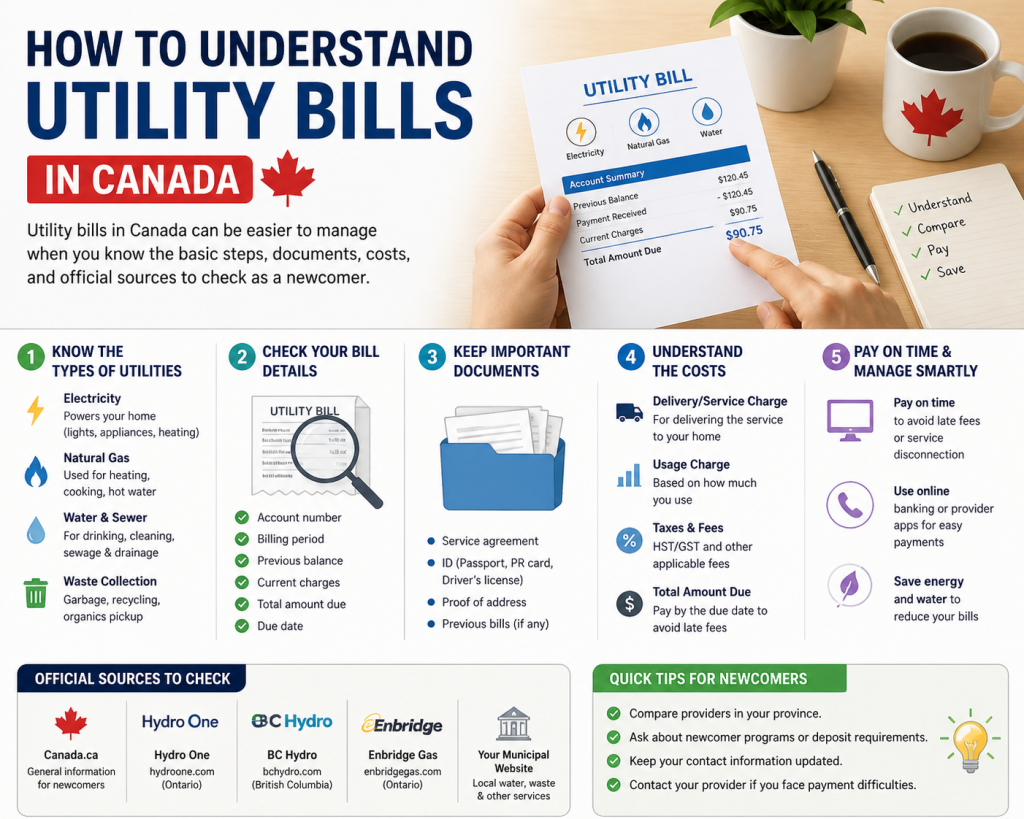
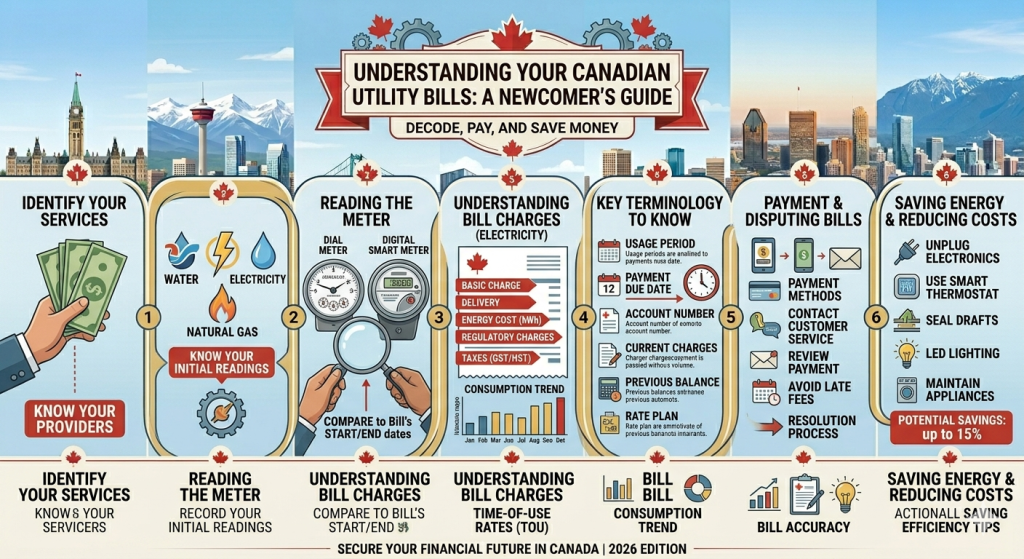
How to Understand Utility Bills in can be easier to manage when you know the basic steps, documents, costs, and official sources to check as a newcomer in Canada.

For newcomers to Canada, learning how to understand utility bills in Canada is a crucial step in managing household expenses and adapting to your new life. Unlike some countries, Canada’s utility billing can involve multiple providers, varying rates, and specific charges that might seem unfamiliar. This comprehensive guide will demystify common utility bills, helping you confidently manage your monthly payments and keep your home comfortable.

Who This Guide Is For

This guide is specifically designed for newcomers, immigrants, international students, temporary workers, and first-time residents in Canada. If you are new to the Canadian billing system and need clear, practical information on electricity, natural gas, water, and internet bills, you are in the right place. We aim to provide beginner-friendly, accurate, and trustworthy information to help you settle in.

Understanding Canadian Utilities: The Basics

In Canada, your home will typically require several essential utilities. Depending on your province, city, and type of housing (apartment, house, condo), some utilities might be included in your rent, while others will be your direct responsibility. It’s vital to clarify this with your landlord or property manager when you rent an apartment in Canada.

1. Electricity (often called “Hydro”)

Electricity powers your lights, appliances, heating (if electric), and electronics. In many provinces, the primary electricity provider is a Crown corporation (government-owned), while in others, you might have a choice of retailer. Bills are usually monthly or bi-monthly.

  • Usage: Measured in kilowatt-hours (kWh).
  • Common Charges:
    • Consumption/Energy Charge: Based on how much electricity you use.
    • Delivery Charge: Covers the cost of transmitting electricity to your home.
    • Regulatory Charge: Funds the operation of the electricity market.
    • Debt Retirement Charge (Ontario, previously): Some older charges might still appear depending on the region and specific circumstances.
    • Taxes: HST/GST applies.

2. Natural Gas

Natural gas is commonly used for heating homes, heating water, and powering stoves/ovens. It’s generally a more affordable heating option than electricity in many parts of Canada. Like electricity, providers can be regulated monopolies or offer retail choices.

  • Usage: Measured in cubic metres (m³) or gigajoules (GJ).
  • Common Charges:
    • Commodity Charge: The cost of the natural gas itself, based on consumption.
    • Delivery/Transportation Charge: Covers the cost of delivering gas through pipelines to your home.
    • Carbon Tax: A federal charge applied to fossil fuels, including natural gas, to encourage reduced emissions. This can be a significant portion of your bill.
    • Customer Charge: A fixed monthly fee for having the service.
    • Taxes: HST/GST applies.

3. Water and Wastewater

Water bills cover your fresh water supply and the treatment of wastewater (sewage). This service is typically provided by your municipality. Billing can be monthly, bi-monthly, or quarterly.

  • Usage: Measured in cubic metres (m³) or litres.
  • Common Charges:
    • Water Consumption: Based on how much water you use.
    • Wastewater/Sewer Surcharge: Covers the cost of treating the water that goes down your drains.
    • Fixed Service Charge: A base fee for access to the water system.
    • Stormwater Management: Sometimes a separate charge for managing rainwater runoff.

4. Internet and Home Phone

While not a traditional “utility” in the same vein as electricity or gas, internet service is essential for modern life in Canada. Many providers offer bundled packages that include internet, home phone, and sometimes TV. Competition among internet providers is high, offering a range of choices.

  • Billing: Usually a fixed monthly fee, often with introductory promotional rates.
  • Factors: Speed (Mbps), data limits (unlimited is common), contract length.

5. Waste Collection and Recycling

In some municipalities, waste collection (garbage and recycling) is included in your property taxes. In others, particularly for apartments, it might be part of your rent or a separate municipal fee. Always check with your landlord or city website.

How to Read Your Utility Bill: A Step-by-Step Breakdown

Understanding the components of your utility bill is key to managing your cost of living in Canada. While layouts vary by provider, most bills share common sections:

  1. Account Information: Look for your account number, service address, and contact details for the utility company. Keep this handy for inquiries.
  2. Billing Period and Due Date: This section indicates the dates for which you are being charged (e.g., April 1 to April 30) and the final date by which your payment must be received to avoid late fees.
  3. Usage Details (Consumption): This is where you see how much electricity (kWh), natural gas (m³ or GJ), or water (m³) you consumed during the billing period. Often, there’s a graph showing your usage trends over several months.
  4. Rates and Charges Breakdown: This is the most detailed section. It itemizes all the different charges:
    • Energy/Commodity Charge: Your actual consumption multiplied by the rate per unit.
    • Delivery/Distribution Charge: The cost to bring the utility to your home.
    • Regulatory/System Access Fees: Charges for maintaining the overall utility infrastructure.
    • Fixed Customer Charge: A flat monthly fee.
    • Taxes: HST (Harmonized Sales Tax) or GST (Goods and Services Tax) plus PST (Provincial Sales Tax) where applicable.
    • Carbon Tax: (For natural gas) A federal charge based on your consumption.
  5. Previous Balance and Payments: Shows your balance from the last bill, any payments received, and adjustments.
  6. Total Amount Due: The final amount you need to pay for the current billing cycle.
  7. Payment Options: Information on how you can pay your bill (online, mail, pre-authorized, etc.).
  8. Important Messages: Look here for updates, energy-saving tips, or service notices.

Billing Options and Payment Methods

Equal Payment Plans (EPP) vs. Variable Billing

Many utility companies offer an Equal Payment Plan (EPP) or Budget Billing option. This averages your estimated annual utility costs into fixed monthly payments.

Feature Equal Payment Plan (EPP) Variable Billing
Monthly Payment Fixed, predictable amount. Fluctuates based on actual usage.
Budgeting Easier for budgeting, avoids seasonal spikes. Can be challenging to budget for, especially in extreme weather.
Annual Review Adjusted annually based on actual usage; you might owe a small balance or have a credit. No annual adjustment needed, as you pay for what you use each month.
Suitability Good for stable budgets, those sensitive to large seasonal bills. Good for those who prefer to pay for exact usage, or who can easily manage fluctuating expenses.
Trade-off Might pay more than actual usage in low-consumption months, building a credit balance. High bills in peak seasons (e.g., winter heating, summer AC) can be a shock.

Decision Criteria: If you prefer stable monthly expenses and easier budgeting, an EPP can be very helpful. If you prefer to see and pay for your exact consumption each month and can handle seasonal fluctuations, variable billing might be better. Many newcomers find EPPs helpful for managing their initial first month in Canada finances.

Payment Methods

Utility companies in Canada offer several convenient ways to pay:

  • Online Banking: Add the utility company as a payee in your Canadian bank account (e.g., through RBC, TD, Scotiabank). This is the most common and recommended method. See our guide on how to open a bank account in Canada as a newcomer.
  • Pre-Authorized Debit (PAD): Set up automatic payments directly from your bank account on the due date.
  • Credit Card: Some providers accept credit card payments, though a convenience fee may apply.
  • Mail: Send a cheque via postal service.
  • In Person: At authorized payment locations (e.g., Canada Post outlets, some banks).

Comparing Utility Providers and Saving Money

Internet Providers: A Comparison Example

For internet services, you often have a choice between major providers and smaller, independent resellers. Here’s a general comparison:

Provider Type Pros Cons Decision Criteria
Major Providers (e.g., Bell, Rogers, Telus)
  • Wide coverage, reliable infrastructure.
  • Often offer bundles (internet, TV, phone).
  • Latest technology (fibre optic).
  • Dedicated customer support.
  • Generally higher prices.
  • May require longer contracts.
  • Less flexibility in plans.
Prioritize reliability, speed, and bundle options. Good if you want a one-stop-shop for communication services.
Independent Resellers (e.g., TekSavvy, Fido, Virgin Plus)
  • Often more competitive pricing.
  • More flexible plans (no contracts).
  • Good customer service reputation for some.
  • Utilize major provider infrastructure, so service quality can be similar.
  • May have slower speeds than top-tier fibre plans.
  • Limited or no TV/phone bundles.
  • Customer support might be smaller.
Prioritize cost savings, flexibility, and good value for money. Good if you only need internet and are budget-conscious.

Practical Trade-off: You might pay more for the perceived stability and convenience of a major provider, or save money with an independent reseller by accepting fewer bundled services. Always compare plans, speeds, and data limits based on your actual needs.

Energy Efficiency Tips to Save Money

Reducing your consumption is the best way to lower your bills:

  • Thermostat Management: Lower your thermostat a few degrees in winter (especially when you’re out or sleeping) and raise it slightly in summer if you have AC. Smart thermostats can help.
  • Seal Drafts: Use weatherstripping and caulk around windows and doors to prevent heat loss/gain.
  • Unplug Electronics: “Phantom load” from electronics still consumes power when turned off but plugged in.
  • LED Lighting: Replace old incandescent bulbs with energy-efficient LED bulbs.
  • Laundry Habits: Wash clothes in cold water and air dry when possible.
  • Appliance Use: Run dishwashers and washing machines only when full.
  • Water Conservation: Take shorter showers, fix leaky faucets.

Checklist: Setting Up and Managing Utilities

  1. Before Moving In: Confirm which utilities are included in your rent and which you need to set up.
  2. Contact Providers: Call electricity, natural gas, and water companies (if applicable) to set up accounts in your name. Have your address, move-in date, and identification ready.
  3. Meter Readings: If possible, take initial meter readings with your landlord or a representative to ensure you’re not charged for previous usage.
  4. Choose Internet/Phone: Research providers and select a plan that fits your needs and budget.
  5. Understand Your First Bill: Don’t just pay it; review it carefully using this guide.
  6. Set Up Payments: Choose your preferred payment method (online banking, PAD) and ensure payments are made on time.
  7. Monitor Usage: Keep an eye on your consumption trends. Sudden spikes might indicate an issue or a change in habits.
  8. Consider EPP: If your bills are highly seasonal, explore the Equal Payment Plan option.
  9. Implement Energy-Saving Tips: Make small changes to reduce your consumption.

Common Mistakes Newcomers Make with Utility Bills

Avoiding these common pitfalls can save you stress and money:

  • Not Understanding What’s Included: Assuming utilities are included in rent when they are not, or vice versa. Always clarify this in your lease agreement.
  • Ignoring Bills: Not opening or reviewing bills can lead to late payment fees, service interruption, or a large, unexpected bill.
  • Missing Due Dates: Late payments can incur fees and negatively impact your financial standing. Some companies might even report late payments to credit bureaus, affecting your credit score.
  • Not Setting Up Accounts Promptly: Delays can mean you temporarily go without essential services or face higher reconnection fees.
  • Underestimating Seasonal Costs: Heating costs in winter and air conditioning costs in summer can be significantly higher than other months. Budget accordingly or opt for an EPP.
  • Not Comparing Internet Providers: Settling for the first internet provider without comparing options could mean paying more for less.
  • Ignoring Energy Efficiency: Simple habits and small investments can lead to significant long-term savings.

Frequently Asked Questions (FAQ)

What is an Equal Payment Plan (EPP)?

An Equal Payment Plan (EPP), also known as Budget Billing, allows you to pay a fixed, averaged amount for your utilities each month, rather than having your bill fluctuate with your actual usage. The utility company estimates your annual consumption and divides it into 12 equal payments. Your account is reviewed annually, and any overpayment or underpayment is adjusted.

Why is my utility bill so high in winter/summer?

Utility bills often spike during extreme weather. In winter, natural gas and electricity usage increases significantly for heating. In summer, electricity usage rises due to air conditioning. Factors like insulation quality, window efficiency, and personal thermostat settings heavily influence these costs. This seasonal variation is a key reason why many Canadians choose an EPP.

Can I choose my electricity provider?

This depends on your province. In some provinces (e.g., Alberta, Ontario), you may have the option to choose an electricity retailer, while the local distribution company still delivers the power and maintains the infrastructure. In other provinces (e.g., British Columbia, Quebec), electricity is provided by a single Crown corporation (like BC Hydro or Hydro-Québec), and you do not have a choice of retailer. Always check with your provincial energy regulator or local utility company.

What happens if I pay my bill late?

Paying a utility bill late typically results in a late payment fee. Repeated late payments can lead to a disconnection notice, and eventually, service interruption. Reconnection fees can be substantial. Furthermore, some utility companies may report consistent late payments to credit bureaus, which can negatively impact your credit history in Canada. It’s one of the common newcomer mistakes to avoid.

How do I set up utilities when I move to a new place?

Once you have your new address and move-in date, contact the local electricity, natural gas, and water providers (if these are not included in your rent). You will need to provide your personal identification (e.g., passport, PR card), your new address, and the move-in date. It’s best to do this a week or two before your move to ensure services are connected when you arrive. For internet, research providers in your area and arrange for installation.

Disclaimer

This article is for general information only and does not provide financial, legal, tax, or immigration advice. Rules, requirements, fees, and programs may change. Always check official sources or speak with a qualified professional before making decisions.

Sources and Official Resources

  • Financial Consumer Agency of Canada: For general financial literacy and budgeting tips. Readers should check Canada.ca or search for “Financial Consumer Agency of Canada.”
  • Provincial Utility Regulators: Each province has a body that oversees utility rates and consumer protection. Search for “[Your Province] energy regulator” or “[Your Province] utility commission.”
  • Local Utility Companies: The websites of your specific electricity, natural gas, and water providers (e.g., Hydro One, Enbridge Gas, City of Toronto Water) will have the most accurate billing information and payment options.

Conclusion

Navigating utility bills in Canada can seem daunting at first, but with a clear understanding of the different types of services, billing components, and payment options, you can manage your household expenses with confidence. By actively reviewing your bills, exploring payment plans, and adopting energy-saving habits, you will be well-equipped to understand utility bills in Canada and thrive in your new home. Welcome to Canada!