temporary worker - First Year Canada
First Year Canada

First Year Canada

  • Start Here
    Welcome to Canada! As you embark on your first year , finding suitable housing is one of the most critical steps. For newcomers, the rental application process can sometimes feel daunting, especially when it comes to understanding what documents landlords require. This guide, current as of May 2026 , is designed to demystify the process and help you prepare a strong application.

    What Documents Do You Need to Rent in Canada as a Newcomer (2026 Guide)

    Who This Guide Is For

    This guide is specifically crafted for:
    • New immigrants and permanent residents making Canada their new home.
    • International students arriving to study at Canadian institutions.
    • Temporary foreign workers seeking accommodation during their employment.
    • Anyone new to Canada who needs practical, step-by-step advice on securing rental housing.

    Practical Explanation: Why Landlords Ask for Documents

    Canadian landlords and property managers request a range of documents to assess your suitability as a tenant. Their primary concerns are:
    • Identity Verification: To confirm you are who you say you are .
    • Financial Stability: To ensure you can consistently pay rent on time.
    • Tenant Reliability: To gauge your past rental behaviour and general character.
    • Legal Compliance: To meet provincial tenancy laws and protect their property.
    Understanding these reasons can help you present your information effectively, even if you lack a Canadian rental history or credit score.

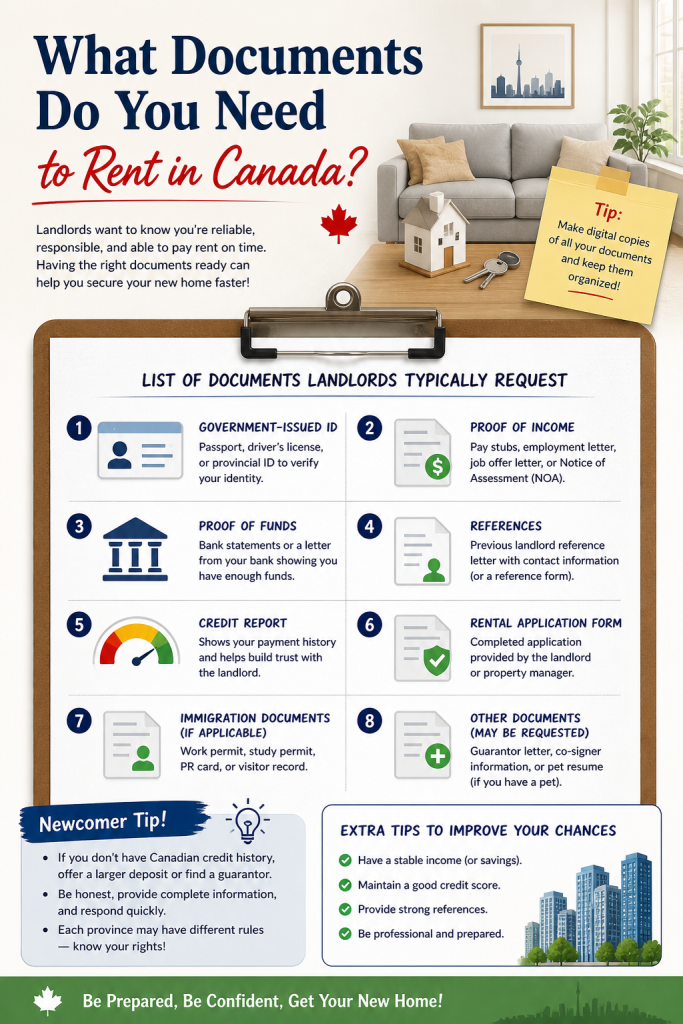
    Core Documents You Will Likely Need

    1. Proof of Identity

    Landlords need to verify your identity. Always provide copies, never originals .
    • Passport: Your primary international identification. Ensure it is valid.
    • Permanent Resident Card (PR Card): If you are a permanent resident .
    • Study Permit or Work Permit: Essential for international students and temporary workers, showing your legal status and duration of stay in Canada.
    • Provincial Driver's License or ID Card: If you have obtained one.

    2. Proof of Income and Financial Stability

    This is often the most critical factor for landlords. They want assurance that you can afford the rent .

    For Those With Canadian Employment:

    • Employment Letter/Offer Letter: A formal letter from your Canadian employer stating your position, salary, and start date.
    • Recent Pay Stubs: Usually 2-3 most recent pay stubs from your Canadian employer.
    • Employment Verification: Some landlords may call your employer to verify your employment.

    For Newcomers Without Canadian Employment (Yet):

    This is where newcomers often face challenges, but there are solutions. You'll need to demonstrate you have sufficient funds to cover rent for several months.
    • Canadian Bank Statements: Recent statements (3-6 months) showing significant savings. If you've just opened an account, a letter from your Canadian bank confirming funds can be helpful. Learn how to set this up with our guide: How to Open a Bank Account in Canada as a Newcomer 2026 Guide.
    • Proof of Funds from Home Country: Bank statements from your home country , translated into English or French, showing substantial savings.
    • Scholarship or Student Loan Letters: For international students, official documents confirming your funding.
    • Guarantor or Co-signer: An individual (often a family member or close friend) who agrees to be financially responsible for the rent if you cannot pay. This person typically needs to  have a strong Canadian credit history and stable income.
    • Proof of Sufficient Funds for Duration of Stay: Especially for students or temporary workers, demonstrating you have enough funds to cover your living expenses for  your expected stay. This is also a key factor in Cost of Living in Canada for Newcomers: Your 2026 Guide.

    Comparison: Income Proof for Renting in Canada

    Here’s a comparison of documents for different newcomer situations:
    Situation Commonly Accepted Documents Tips for Newcomers Practical Trade-offs/Considerations
    Established Canadian Employment Employment letter, 2-3 recent pay stubs, T4 (if applicable) Present clear, professional documents. Be prepared for employer contact. Generally straightforward, high landlord confidence.
    New to Canada, Job Offer Secured (Not Started Yet) Signed employment offer letter (with salary, start date), bank statements showing savings. Highlight start date and salary. Offer to pay a few months' rent upfront (if legal in your province). Landlords may require more assurance (e.g., larger deposit, guarantor) until employment begins.
    New to Canada, Actively Job Searching Canadian bank statements (significant savings), international bank statements (translated), proof of funds, scholarship letters (if student). Emphasize financial stability, explain your job search plan. A guarantor is highly recommended. Most challenging situation. May need to offer more upfront rent or accept a less ideal property.
    International Student Acceptance letter from institution, scholarship letters, proof of funds (bank statements), guarantor. Clearly show your financial plan for your studies. A guarantor from Canada is a strong asset. Landlords are often familiar with student applications but still prioritize financial security.

    3. Credit History/Credit Report

    In Canada, landlords often run a credit check to assess your financial responsibility. This can be a hurdle for newcomers who haven't had time to build a Canadian credit history.
    • Canadian Credit Report: If you have been in Canada for a while and have built credit, landlords will request a report from Equifax or TransUnion.
    • Addressing Lack of Canadian Credit: For newcomers, you won't have a Canadian credit score. You can explain this to the landlord. Strategies include:
      • Guarantor/Co-signer: As mentioned, someone with good Canadian credit history can vouch for you.
      • Higher Security Deposit: While rules vary by province, offering a slightly higher deposit (if permitted) can sometimes reassure a landlord.
      • Proof of Funds: Demonstrating significant savings to cover rent for an extended period.
      • References: Strong personal or professional references can help  mitigate the lack of credit.
    Building a good credit score is vital in Canada.  For more details, refer to our guide: Building Credit in Canada: A Newcomer's Guide.

    4. References

    References provide insights into your character and reliability.
    • Previous Landlord References: If you have rented before, contact information for previous landlords is very helpful. Even if it's from your home country, provide contact details and be prepared for landlords to potentially reach out.
    • Employer References: Contact information for current or past employers.
    • Character References: Individuals (not family) who can speak to your reliability, responsibility, and character. This could be a professor, a community leader , or a professional colleague.

    Additional Documents You May Need

    • Tenant Insurance: While not always mandatory, many landlords require or strongly recommend tenant insurance. This protects your belongings from damage (e.g., fire, theft) and provides liability coverage. It's a wise investment.
    • Vehicle Information: If the rental includes parking, you might need to provide your vehicle's make, model, year, and license plate number.
    • Pet Information: If you have pets, landlords will likely ask for details about them (breed, age, size) and may require a pet deposit or have specific pet policies.

    Step-by-Step: Preparing Your Rental Application

    1. Gather All Documents:  Before you even start viewing properties, compile all the potential documents listed above.
    2. Make Copies: Never give out original documents. Have clear, legible photocopies or digital scans ready. Organize them neatly.
    3. Translate Key Documents: If you have documents from your home country (e.g., bank statements, previous rental agreements) that are not in English or French, get them officially translated.
    4. Prepare a Rental Resume: Consider creating a brief personal summary outlining your professional background, why you're moving, and your rental needs. This can be especially helpful for newcomers.
    5. Be Honest and Transparent: Provide accurate information. Landlords will appreciate your honesty, especially about your newcomer status and lack of Canadian history.
    6. Be Responsive: When a landlord requests additional information, provide it promptly.

    Checklist: Essential Rental Documents for Newcomers

    Use this checklist to ensure you're prepared:
    • ✓ Valid Passport
    • ✓ Permanent Resident Card (if applicable)
    • ✓ Study Permit or Work Permit (if applicable )
    • ✓ Provincial Driver's License or ID Card (if available)
    • ✓ Employment Offer Letter (Canadian employer)
    • ✓ Recent Canadian Pay Stubs (2-3 months)
    • ✓ Canadian Bank Statements (3-6 months, showing savings)
    • ✓ International Bank Statements (translated, showing savings)
    • ✓ Scholarship/Student Loan Letters (for students)
    • ✓ Guarantor's Contact Information and Financial Documents (if applicable)
    • ✓ Previous Landlord References (contact details)
    • ✓ Employer References (contact details)
    • ✓ Character References (contact details)
    • ✓ Proof of Tenant Insurance (or willingness to obtain)
    • ✓ Vehicle Information (if parking included)
    • ✓ Pet Information (if applicable)

    Common Mistakes to Avoid

    • Providing Original Documents: Never hand over your original passport, permits, or other vital documents. Always provide copies.
    • Lack of Preparedness: Showing up to a viewing without any documents or having to scramble to get them can make you seem disorganized.
    • Underestimating Financial Proof: Landlords are risk-averse. If you don't have a Canadian job yet, significant savings are crucial.
    • Ignoring Credit History: While you won't have Canadian credit, acknowledging this and offering solutions (guarantor, extra deposit) is better than ignoring it.
    • Not Asking Questions: If a document request seems unusual or you don't understand it, politely ask for clarification.
    • Falling for Scams: Be wary of landlords who ask for large cash deposits, insist on wire transfers, or pressure you to sign a lease without viewing the property or meeting them. Always verify the property and landlord.

    Frequently Asked Questions (FAQ)

    Q: Can I rent in Canada without a job?

    A: Yes, it's possible, but more challenging. You will need to demonstrate significant financial stability through bank statements (Canadian or international), scholarship letters, or by having a reliable guarantor with a stable Canadian income.

    Q: What if I don't have a Canadian credit history?

    A: This is common for newcomers. Be upfront about it. Offer alternative reassurances like a guarantor, proof of substantial savings, or excellent references. Some landlords may be more flexible than others, especially in competitive markets.

    Q: Is a guarantor always required?

    A: Not always, but it significantly strengthens your application if you lack a Canadian job, credit history, or extensive savings. It provides an extra layer of security for the landlord.

    Q: Do I need tenant insurance?

    A: While not legally mandatory in all provinces, many landlords require it as part of the lease agreement. Even if not required, it's highly recommended to protect your belongings and provide liability coverage.

    Q: How long does the rental application process usually take?

    A: It varies. If you have all your documents ready and the landlord is efficient, you could hear back within a few days. However, it can sometimes take a week or more, especially if background or reference checks are extensive.

    Disclaimer

    This article is for general information only and does not provide financial, legal, tax, or immigration advice. Rules, requirements, fees, and programs may change. Always check official sources or speak with a qualified professional before making decisions.

    Sources or Official Resources

    For the most accurate and up-to-date information regarding tenancy laws and regulations in your specific province or territory, always refer to the official government websites:
    • Canada Mortgage and Housing Corporation (CMHC): General housing resources and information for Canadians. Check their official website.
    • Provincial/Territorial Government Websites: Each province and territory has specific tenancy acts and residential tenancy boards that govern landlord-tenant relationships. Search for "Residential Tenancies Act [Your Province/Territory]" or "[Your Province/Territory] Landlord and Tenant Board" (e.g., Ontario Landlord and Tenant Board, BC Residential Tenancy Branch).
    • Immigration, Refugees and Citizenship Canada (IRCC): For information on permits and immigration status. Check Canada.ca.

    Conclusion

    Renting in Canada as a newcomer requires preparation, but it is certainly achievable.  By understanding what documents landlords typically look for and proactively gathering them, you can present a strong, confident application. Remember to be organized, transparent, and patient. With the right approach, you'll be settling into your new Canadian home in no time. For more essential information during your initial period, consult our First Month in Canada: Your Essential Checklist for Newcomers.
  • Banking
    Welcome to Canada! As you embark on your first year , finding suitable housing is one of the most critical steps. For newcomers, the rental application process can sometimes feel daunting, especially when it comes to understanding what documents landlords require. This guide, current as of May 2026 , is designed to demystify the process and help you prepare a strong application.

    What Documents Do You Need to Rent in Canada as a Newcomer (2026 Guide)

    Who This Guide Is For

    This guide is specifically crafted for:
    • New immigrants and permanent residents making Canada their new home.
    • International students arriving to study at Canadian institutions.
    • Temporary foreign workers seeking accommodation during their employment.
    • Anyone new to Canada who needs practical, step-by-step advice on securing rental housing.

    Practical Explanation: Why Landlords Ask for Documents

    Canadian landlords and property managers request a range of documents to assess your suitability as a tenant. Their primary concerns are:
    • Identity Verification: To confirm you are who you say you are .
    • Financial Stability: To ensure you can consistently pay rent on time.
    • Tenant Reliability: To gauge your past rental behaviour and general character.
    • Legal Compliance: To meet provincial tenancy laws and protect their property.
    Understanding these reasons can help you present your information effectively, even if you lack a Canadian rental history or credit score.

    Core Documents You Will Likely Need

    1. Proof of Identity

    Landlords need to verify your identity. Always provide copies, never originals .
    • Passport: Your primary international identification. Ensure it is valid.
    • Permanent Resident Card (PR Card): If you are a permanent resident .
    • Study Permit or Work Permit: Essential for international students and temporary workers, showing your legal status and duration of stay in Canada.
    • Provincial Driver's License or ID Card: If you have obtained one.

    2. Proof of Income and Financial Stability

    This is often the most critical factor for landlords. They want assurance that you can afford the rent .

    For Those With Canadian Employment:

    • Employment Letter/Offer Letter: A formal letter from your Canadian employer stating your position, salary, and start date.
    • Recent Pay Stubs: Usually 2-3 most recent pay stubs from your Canadian employer.
    • Employment Verification: Some landlords may call your employer to verify your employment.

    For Newcomers Without Canadian Employment (Yet):

    This is where newcomers often face challenges, but there are solutions. You'll need to demonstrate you have sufficient funds to cover rent for several months.
    • Canadian Bank Statements: Recent statements (3-6 months) showing significant savings. If you've just opened an account, a letter from your Canadian bank confirming funds can be helpful. Learn how to set this up with our guide: How to Open a Bank Account in Canada as a Newcomer 2026 Guide.
    • Proof of Funds from Home Country: Bank statements from your home country , translated into English or French, showing substantial savings.
    • Scholarship or Student Loan Letters: For international students, official documents confirming your funding.
    • Guarantor or Co-signer: An individual (often a family member or close friend) who agrees to be financially responsible for the rent if you cannot pay. This person typically needs to  have a strong Canadian credit history and stable income.
    • Proof of Sufficient Funds for Duration of Stay: Especially for students or temporary workers, demonstrating you have enough funds to cover your living expenses for  your expected stay. This is also a key factor in Cost of Living in Canada for Newcomers: Your 2026 Guide.

    Comparison: Income Proof for Renting in Canada

    Here’s a comparison of documents for different newcomer situations:
    Situation Commonly Accepted Documents Tips for Newcomers Practical Trade-offs/Considerations
    Established Canadian Employment Employment letter, 2-3 recent pay stubs, T4 (if applicable) Present clear, professional documents. Be prepared for employer contact. Generally straightforward, high landlord confidence.
    New to Canada, Job Offer Secured (Not Started Yet) Signed employment offer letter (with salary, start date), bank statements showing savings. Highlight start date and salary. Offer to pay a few months' rent upfront (if legal in your province). Landlords may require more assurance (e.g., larger deposit, guarantor) until employment begins.
    New to Canada, Actively Job Searching Canadian bank statements (significant savings), international bank statements (translated), proof of funds, scholarship letters (if student). Emphasize financial stability, explain your job search plan. A guarantor is highly recommended. Most challenging situation. May need to offer more upfront rent or accept a less ideal property.
    International Student Acceptance letter from institution, scholarship letters, proof of funds (bank statements), guarantor. Clearly show your financial plan for your studies. A guarantor from Canada is a strong asset. Landlords are often familiar with student applications but still prioritize financial security.

    3. Credit History/Credit Report

    In Canada, landlords often run a credit check to assess your financial responsibility. This can be a hurdle for newcomers who haven't had time to build a Canadian credit history.
    • Canadian Credit Report: If you have been in Canada for a while and have built credit, landlords will request a report from Equifax or TransUnion.
    • Addressing Lack of Canadian Credit: For newcomers, you won't have a Canadian credit score. You can explain this to the landlord. Strategies include:
      • Guarantor/Co-signer: As mentioned, someone with good Canadian credit history can vouch for you.
      • Higher Security Deposit: While rules vary by province, offering a slightly higher deposit (if permitted) can sometimes reassure a landlord.
      • Proof of Funds: Demonstrating significant savings to cover rent for an extended period.
      • References: Strong personal or professional references can help  mitigate the lack of credit.
    Building a good credit score is vital in Canada.  For more details, refer to our guide: Building Credit in Canada: A Newcomer's Guide.

    4. References

    References provide insights into your character and reliability.
    • Previous Landlord References: If you have rented before, contact information for previous landlords is very helpful. Even if it's from your home country, provide contact details and be prepared for landlords to potentially reach out.
    • Employer References: Contact information for current or past employers.
    • Character References: Individuals (not family) who can speak to your reliability, responsibility, and character. This could be a professor, a community leader , or a professional colleague.

    Additional Documents You May Need

    • Tenant Insurance: While not always mandatory, many landlords require or strongly recommend tenant insurance. This protects your belongings from damage (e.g., fire, theft) and provides liability coverage. It's a wise investment.
    • Vehicle Information: If the rental includes parking, you might need to provide your vehicle's make, model, year, and license plate number.
    • Pet Information: If you have pets, landlords will likely ask for details about them (breed, age, size) and may require a pet deposit or have specific pet policies.

    Step-by-Step: Preparing Your Rental Application

    1. Gather All Documents:  Before you even start viewing properties, compile all the potential documents listed above.
    2. Make Copies: Never give out original documents. Have clear, legible photocopies or digital scans ready. Organize them neatly.
    3. Translate Key Documents: If you have documents from your home country (e.g., bank statements, previous rental agreements) that are not in English or French, get them officially translated.
    4. Prepare a Rental Resume: Consider creating a brief personal summary outlining your professional background, why you're moving, and your rental needs. This can be especially helpful for newcomers.
    5. Be Honest and Transparent: Provide accurate information. Landlords will appreciate your honesty, especially about your newcomer status and lack of Canadian history.
    6. Be Responsive: When a landlord requests additional information, provide it promptly.

    Checklist: Essential Rental Documents for Newcomers

    Use this checklist to ensure you're prepared:
    • ✓ Valid Passport
    • ✓ Permanent Resident Card (if applicable)
    • ✓ Study Permit or Work Permit (if applicable )
    • ✓ Provincial Driver's License or ID Card (if available)
    • ✓ Employment Offer Letter (Canadian employer)
    • ✓ Recent Canadian Pay Stubs (2-3 months)
    • ✓ Canadian Bank Statements (3-6 months, showing savings)
    • ✓ International Bank Statements (translated, showing savings)
    • ✓ Scholarship/Student Loan Letters (for students)
    • ✓ Guarantor's Contact Information and Financial Documents (if applicable)
    • ✓ Previous Landlord References (contact details)
    • ✓ Employer References (contact details)
    • ✓ Character References (contact details)
    • ✓ Proof of Tenant Insurance (or willingness to obtain)
    • ✓ Vehicle Information (if parking included)
    • ✓ Pet Information (if applicable)

    Common Mistakes to Avoid

    • Providing Original Documents: Never hand over your original passport, permits, or other vital documents. Always provide copies.
    • Lack of Preparedness: Showing up to a viewing without any documents or having to scramble to get them can make you seem disorganized.
    • Underestimating Financial Proof: Landlords are risk-averse. If you don't have a Canadian job yet, significant savings are crucial.
    • Ignoring Credit History: While you won't have Canadian credit, acknowledging this and offering solutions (guarantor, extra deposit) is better than ignoring it.
    • Not Asking Questions: If a document request seems unusual or you don't understand it, politely ask for clarification.
    • Falling for Scams: Be wary of landlords who ask for large cash deposits, insist on wire transfers, or pressure you to sign a lease without viewing the property or meeting them. Always verify the property and landlord.

    Frequently Asked Questions (FAQ)

    Q: Can I rent in Canada without a job?

    A: Yes, it's possible, but more challenging. You will need to demonstrate significant financial stability through bank statements (Canadian or international), scholarship letters, or by having a reliable guarantor with a stable Canadian income.

    Q: What if I don't have a Canadian credit history?

    A: This is common for newcomers. Be upfront about it. Offer alternative reassurances like a guarantor, proof of substantial savings, or excellent references. Some landlords may be more flexible than others, especially in competitive markets.

    Q: Is a guarantor always required?

    A: Not always, but it significantly strengthens your application if you lack a Canadian job, credit history, or extensive savings. It provides an extra layer of security for the landlord.

    Q: Do I need tenant insurance?

    A: While not legally mandatory in all provinces, many landlords require it as part of the lease agreement. Even if not required, it's highly recommended to protect your belongings and provide liability coverage.

    Q: How long does the rental application process usually take?

    A: It varies. If you have all your documents ready and the landlord is efficient, you could hear back within a few days. However, it can sometimes take a week or more, especially if background or reference checks are extensive.

    Disclaimer

    This article is for general information only and does not provide financial, legal, tax, or immigration advice. Rules, requirements, fees, and programs may change. Always check official sources or speak with a qualified professional before making decisions.

    Sources or Official Resources

    For the most accurate and up-to-date information regarding tenancy laws and regulations in your specific province or territory, always refer to the official government websites:
    • Canada Mortgage and Housing Corporation (CMHC): General housing resources and information for Canadians. Check their official website.
    • Provincial/Territorial Government Websites: Each province and territory has specific tenancy acts and residential tenancy boards that govern landlord-tenant relationships. Search for "Residential Tenancies Act [Your Province/Territory]" or "[Your Province/Territory] Landlord and Tenant Board" (e.g., Ontario Landlord and Tenant Board, BC Residential Tenancy Branch).
    • Immigration, Refugees and Citizenship Canada (IRCC): For information on permits and immigration status. Check Canada.ca.

    Conclusion

    Renting in Canada as a newcomer requires preparation, but it is certainly achievable.  By understanding what documents landlords typically look for and proactively gathering them, you can present a strong, confident application. Remember to be organized, transparent, and patient. With the right approach, you'll be settling into your new Canadian home in no time. For more essential information during your initial period, consult our First Month in Canada: Your Essential Checklist for Newcomers.
  • Cost of Living
    Welcome to Canada! As you embark on your first year , finding suitable housing is one of the most critical steps. For newcomers, the rental application process can sometimes feel daunting, especially when it comes to understanding what documents landlords require. This guide, current as of May 2026 , is designed to demystify the process and help you prepare a strong application.

    What Documents Do You Need to Rent in Canada as a Newcomer (2026 Guide)

    Who This Guide Is For

    This guide is specifically crafted for:
    • New immigrants and permanent residents making Canada their new home.
    • International students arriving to study at Canadian institutions.
    • Temporary foreign workers seeking accommodation during their employment.
    • Anyone new to Canada who needs practical, step-by-step advice on securing rental housing.

    Practical Explanation: Why Landlords Ask for Documents

    Canadian landlords and property managers request a range of documents to assess your suitability as a tenant. Their primary concerns are:
    • Identity Verification: To confirm you are who you say you are .
    • Financial Stability: To ensure you can consistently pay rent on time.
    • Tenant Reliability: To gauge your past rental behaviour and general character.
    • Legal Compliance: To meet provincial tenancy laws and protect their property.
    Understanding these reasons can help you present your information effectively, even if you lack a Canadian rental history or credit score.

    Core Documents You Will Likely Need

    1. Proof of Identity

    Landlords need to verify your identity. Always provide copies, never originals .
    • Passport: Your primary international identification. Ensure it is valid.
    • Permanent Resident Card (PR Card): If you are a permanent resident .
    • Study Permit or Work Permit: Essential for international students and temporary workers, showing your legal status and duration of stay in Canada.
    • Provincial Driver's License or ID Card: If you have obtained one.

    2. Proof of Income and Financial Stability

    This is often the most critical factor for landlords. They want assurance that you can afford the rent .

    For Those With Canadian Employment:

    • Employment Letter/Offer Letter: A formal letter from your Canadian employer stating your position, salary, and start date.
    • Recent Pay Stubs: Usually 2-3 most recent pay stubs from your Canadian employer.
    • Employment Verification: Some landlords may call your employer to verify your employment.

    For Newcomers Without Canadian Employment (Yet):

    This is where newcomers often face challenges, but there are solutions. You'll need to demonstrate you have sufficient funds to cover rent for several months.
    • Canadian Bank Statements: Recent statements (3-6 months) showing significant savings. If you've just opened an account, a letter from your Canadian bank confirming funds can be helpful. Learn how to set this up with our guide: How to Open a Bank Account in Canada as a Newcomer 2026 Guide.
    • Proof of Funds from Home Country: Bank statements from your home country , translated into English or French, showing substantial savings.
    • Scholarship or Student Loan Letters: For international students, official documents confirming your funding.
    • Guarantor or Co-signer: An individual (often a family member or close friend) who agrees to be financially responsible for the rent if you cannot pay. This person typically needs to  have a strong Canadian credit history and stable income.
    • Proof of Sufficient Funds for Duration of Stay: Especially for students or temporary workers, demonstrating you have enough funds to cover your living expenses for  your expected stay. This is also a key factor in Cost of Living in Canada for Newcomers: Your 2026 Guide.

    Comparison: Income Proof for Renting in Canada

    Here’s a comparison of documents for different newcomer situations:
    Situation Commonly Accepted Documents Tips for Newcomers Practical Trade-offs/Considerations
    Established Canadian Employment Employment letter, 2-3 recent pay stubs, T4 (if applicable) Present clear, professional documents. Be prepared for employer contact. Generally straightforward, high landlord confidence.
    New to Canada, Job Offer Secured (Not Started Yet) Signed employment offer letter (with salary, start date), bank statements showing savings. Highlight start date and salary. Offer to pay a few months' rent upfront (if legal in your province). Landlords may require more assurance (e.g., larger deposit, guarantor) until employment begins.
    New to Canada, Actively Job Searching Canadian bank statements (significant savings), international bank statements (translated), proof of funds, scholarship letters (if student). Emphasize financial stability, explain your job search plan. A guarantor is highly recommended. Most challenging situation. May need to offer more upfront rent or accept a less ideal property.
    International Student Acceptance letter from institution, scholarship letters, proof of funds (bank statements), guarantor. Clearly show your financial plan for your studies. A guarantor from Canada is a strong asset. Landlords are often familiar with student applications but still prioritize financial security.

    3. Credit History/Credit Report

    In Canada, landlords often run a credit check to assess your financial responsibility. This can be a hurdle for newcomers who haven't had time to build a Canadian credit history.
    • Canadian Credit Report: If you have been in Canada for a while and have built credit, landlords will request a report from Equifax or TransUnion.
    • Addressing Lack of Canadian Credit: For newcomers, you won't have a Canadian credit score. You can explain this to the landlord. Strategies include:
      • Guarantor/Co-signer: As mentioned, someone with good Canadian credit history can vouch for you.
      • Higher Security Deposit: While rules vary by province, offering a slightly higher deposit (if permitted) can sometimes reassure a landlord.
      • Proof of Funds: Demonstrating significant savings to cover rent for an extended period.
      • References: Strong personal or professional references can help  mitigate the lack of credit.
    Building a good credit score is vital in Canada.  For more details, refer to our guide: Building Credit in Canada: A Newcomer's Guide.

    4. References

    References provide insights into your character and reliability.
    • Previous Landlord References: If you have rented before, contact information for previous landlords is very helpful. Even if it's from your home country, provide contact details and be prepared for landlords to potentially reach out.
    • Employer References: Contact information for current or past employers.
    • Character References: Individuals (not family) who can speak to your reliability, responsibility, and character. This could be a professor, a community leader , or a professional colleague.

    Additional Documents You May Need

    • Tenant Insurance: While not always mandatory, many landlords require or strongly recommend tenant insurance. This protects your belongings from damage (e.g., fire, theft) and provides liability coverage. It's a wise investment.
    • Vehicle Information: If the rental includes parking, you might need to provide your vehicle's make, model, year, and license plate number.
    • Pet Information: If you have pets, landlords will likely ask for details about them (breed, age, size) and may require a pet deposit or have specific pet policies.

    Step-by-Step: Preparing Your Rental Application

    1. Gather All Documents:  Before you even start viewing properties, compile all the potential documents listed above.
    2. Make Copies: Never give out original documents. Have clear, legible photocopies or digital scans ready. Organize them neatly.
    3. Translate Key Documents: If you have documents from your home country (e.g., bank statements, previous rental agreements) that are not in English or French, get them officially translated.
    4. Prepare a Rental Resume: Consider creating a brief personal summary outlining your professional background, why you're moving, and your rental needs. This can be especially helpful for newcomers.
    5. Be Honest and Transparent: Provide accurate information. Landlords will appreciate your honesty, especially about your newcomer status and lack of Canadian history.
    6. Be Responsive: When a landlord requests additional information, provide it promptly.

    Checklist: Essential Rental Documents for Newcomers

    Use this checklist to ensure you're prepared:
    • ✓ Valid Passport
    • ✓ Permanent Resident Card (if applicable)
    • ✓ Study Permit or Work Permit (if applicable )
    • ✓ Provincial Driver's License or ID Card (if available)
    • ✓ Employment Offer Letter (Canadian employer)
    • ✓ Recent Canadian Pay Stubs (2-3 months)
    • ✓ Canadian Bank Statements (3-6 months, showing savings)
    • ✓ International Bank Statements (translated, showing savings)
    • ✓ Scholarship/Student Loan Letters (for students)
    • ✓ Guarantor's Contact Information and Financial Documents (if applicable)
    • ✓ Previous Landlord References (contact details)
    • ✓ Employer References (contact details)
    • ✓ Character References (contact details)
    • ✓ Proof of Tenant Insurance (or willingness to obtain)
    • ✓ Vehicle Information (if parking included)
    • ✓ Pet Information (if applicable)

    Common Mistakes to Avoid

    • Providing Original Documents: Never hand over your original passport, permits, or other vital documents. Always provide copies.
    • Lack of Preparedness: Showing up to a viewing without any documents or having to scramble to get them can make you seem disorganized.
    • Underestimating Financial Proof: Landlords are risk-averse. If you don't have a Canadian job yet, significant savings are crucial.
    • Ignoring Credit History: While you won't have Canadian credit, acknowledging this and offering solutions (guarantor, extra deposit) is better than ignoring it.
    • Not Asking Questions: If a document request seems unusual or you don't understand it, politely ask for clarification.
    • Falling for Scams: Be wary of landlords who ask for large cash deposits, insist on wire transfers, or pressure you to sign a lease without viewing the property or meeting them. Always verify the property and landlord.

    Frequently Asked Questions (FAQ)

    Q: Can I rent in Canada without a job?

    A: Yes, it's possible, but more challenging. You will need to demonstrate significant financial stability through bank statements (Canadian or international), scholarship letters, or by having a reliable guarantor with a stable Canadian income.

    Q: What if I don't have a Canadian credit history?

    A: This is common for newcomers. Be upfront about it. Offer alternative reassurances like a guarantor, proof of substantial savings, or excellent references. Some landlords may be more flexible than others, especially in competitive markets.

    Q: Is a guarantor always required?

    A: Not always, but it significantly strengthens your application if you lack a Canadian job, credit history, or extensive savings. It provides an extra layer of security for the landlord.

    Q: Do I need tenant insurance?

    A: While not legally mandatory in all provinces, many landlords require it as part of the lease agreement. Even if not required, it's highly recommended to protect your belongings and provide liability coverage.

    Q: How long does the rental application process usually take?

    A: It varies. If you have all your documents ready and the landlord is efficient, you could hear back within a few days. However, it can sometimes take a week or more, especially if background or reference checks are extensive.

    Disclaimer

    This article is for general information only and does not provide financial, legal, tax, or immigration advice. Rules, requirements, fees, and programs may change. Always check official sources or speak with a qualified professional before making decisions.

    Sources or Official Resources

    For the most accurate and up-to-date information regarding tenancy laws and regulations in your specific province or territory, always refer to the official government websites:
    • Canada Mortgage and Housing Corporation (CMHC): General housing resources and information for Canadians. Check their official website.
    • Provincial/Territorial Government Websites: Each province and territory has specific tenancy acts and residential tenancy boards that govern landlord-tenant relationships. Search for "Residential Tenancies Act [Your Province/Territory]" or "[Your Province/Territory] Landlord and Tenant Board" (e.g., Ontario Landlord and Tenant Board, BC Residential Tenancy Branch).
    • Immigration, Refugees and Citizenship Canada (IRCC): For information on permits and immigration status. Check Canada.ca.

    Conclusion

    Renting in Canada as a newcomer requires preparation, but it is certainly achievable.  By understanding what documents landlords typically look for and proactively gathering them, you can present a strong, confident application. Remember to be organized, transparent, and patient. With the right approach, you'll be settling into your new Canadian home in no time. For more essential information during your initial period, consult our First Month in Canada: Your Essential Checklist for Newcomers.
  • Credit Score
    Welcome to Canada! As you embark on your first year , finding suitable housing is one of the most critical steps. For newcomers, the rental application process can sometimes feel daunting, especially when it comes to understanding what documents landlords require. This guide, current as of May 2026 , is designed to demystify the process and help you prepare a strong application.

    What Documents Do You Need to Rent in Canada as a Newcomer (2026 Guide)

    Who This Guide Is For

    This guide is specifically crafted for:
    • New immigrants and permanent residents making Canada their new home.
    • International students arriving to study at Canadian institutions.
    • Temporary foreign workers seeking accommodation during their employment.
    • Anyone new to Canada who needs practical, step-by-step advice on securing rental housing.

    Practical Explanation: Why Landlords Ask for Documents

    Canadian landlords and property managers request a range of documents to assess your suitability as a tenant. Their primary concerns are:
    • Identity Verification: To confirm you are who you say you are .
    • Financial Stability: To ensure you can consistently pay rent on time.
    • Tenant Reliability: To gauge your past rental behaviour and general character.
    • Legal Compliance: To meet provincial tenancy laws and protect their property.
    Understanding these reasons can help you present your information effectively, even if you lack a Canadian rental history or credit score.

    Core Documents You Will Likely Need

    1. Proof of Identity

    Landlords need to verify your identity. Always provide copies, never originals .
    • Passport: Your primary international identification. Ensure it is valid.
    • Permanent Resident Card (PR Card): If you are a permanent resident .
    • Study Permit or Work Permit: Essential for international students and temporary workers, showing your legal status and duration of stay in Canada.
    • Provincial Driver's License or ID Card: If you have obtained one.

    2. Proof of Income and Financial Stability

    This is often the most critical factor for landlords. They want assurance that you can afford the rent .

    For Those With Canadian Employment:

    • Employment Letter/Offer Letter: A formal letter from your Canadian employer stating your position, salary, and start date.
    • Recent Pay Stubs: Usually 2-3 most recent pay stubs from your Canadian employer.
    • Employment Verification: Some landlords may call your employer to verify your employment.

    For Newcomers Without Canadian Employment (Yet):

    This is where newcomers often face challenges, but there are solutions. You'll need to demonstrate you have sufficient funds to cover rent for several months.
    • Canadian Bank Statements: Recent statements (3-6 months) showing significant savings. If you've just opened an account, a letter from your Canadian bank confirming funds can be helpful. Learn how to set this up with our guide: How to Open a Bank Account in Canada as a Newcomer 2026 Guide.
    • Proof of Funds from Home Country: Bank statements from your home country , translated into English or French, showing substantial savings.
    • Scholarship or Student Loan Letters: For international students, official documents confirming your funding.
    • Guarantor or Co-signer: An individual (often a family member or close friend) who agrees to be financially responsible for the rent if you cannot pay. This person typically needs to  have a strong Canadian credit history and stable income.
    • Proof of Sufficient Funds for Duration of Stay: Especially for students or temporary workers, demonstrating you have enough funds to cover your living expenses for  your expected stay. This is also a key factor in Cost of Living in Canada for Newcomers: Your 2026 Guide.

    Comparison: Income Proof for Renting in Canada

    Here’s a comparison of documents for different newcomer situations:
    Situation Commonly Accepted Documents Tips for Newcomers Practical Trade-offs/Considerations
    Established Canadian Employment Employment letter, 2-3 recent pay stubs, T4 (if applicable) Present clear, professional documents. Be prepared for employer contact. Generally straightforward, high landlord confidence.
    New to Canada, Job Offer Secured (Not Started Yet) Signed employment offer letter (with salary, start date), bank statements showing savings. Highlight start date and salary. Offer to pay a few months' rent upfront (if legal in your province). Landlords may require more assurance (e.g., larger deposit, guarantor) until employment begins.
    New to Canada, Actively Job Searching Canadian bank statements (significant savings), international bank statements (translated), proof of funds, scholarship letters (if student). Emphasize financial stability, explain your job search plan. A guarantor is highly recommended. Most challenging situation. May need to offer more upfront rent or accept a less ideal property.
    International Student Acceptance letter from institution, scholarship letters, proof of funds (bank statements), guarantor. Clearly show your financial plan for your studies. A guarantor from Canada is a strong asset. Landlords are often familiar with student applications but still prioritize financial security.

    3. Credit History/Credit Report

    In Canada, landlords often run a credit check to assess your financial responsibility. This can be a hurdle for newcomers who haven't had time to build a Canadian credit history.
    • Canadian Credit Report: If you have been in Canada for a while and have built credit, landlords will request a report from Equifax or TransUnion.
    • Addressing Lack of Canadian Credit: For newcomers, you won't have a Canadian credit score. You can explain this to the landlord. Strategies include:
      • Guarantor/Co-signer: As mentioned, someone with good Canadian credit history can vouch for you.
      • Higher Security Deposit: While rules vary by province, offering a slightly higher deposit (if permitted) can sometimes reassure a landlord.
      • Proof of Funds: Demonstrating significant savings to cover rent for an extended period.
      • References: Strong personal or professional references can help  mitigate the lack of credit.
    Building a good credit score is vital in Canada.  For more details, refer to our guide: Building Credit in Canada: A Newcomer's Guide.

    4. References

    References provide insights into your character and reliability.
    • Previous Landlord References: If you have rented before, contact information for previous landlords is very helpful. Even if it's from your home country, provide contact details and be prepared for landlords to potentially reach out.
    • Employer References: Contact information for current or past employers.
    • Character References: Individuals (not family) who can speak to your reliability, responsibility, and character. This could be a professor, a community leader , or a professional colleague.

    Additional Documents You May Need

    • Tenant Insurance: While not always mandatory, many landlords require or strongly recommend tenant insurance. This protects your belongings from damage (e.g., fire, theft) and provides liability coverage. It's a wise investment.
    • Vehicle Information: If the rental includes parking, you might need to provide your vehicle's make, model, year, and license plate number.
    • Pet Information: If you have pets, landlords will likely ask for details about them (breed, age, size) and may require a pet deposit or have specific pet policies.

    Step-by-Step: Preparing Your Rental Application

    1. Gather All Documents:  Before you even start viewing properties, compile all the potential documents listed above.
    2. Make Copies: Never give out original documents. Have clear, legible photocopies or digital scans ready. Organize them neatly.
    3. Translate Key Documents: If you have documents from your home country (e.g., bank statements, previous rental agreements) that are not in English or French, get them officially translated.
    4. Prepare a Rental Resume: Consider creating a brief personal summary outlining your professional background, why you're moving, and your rental needs. This can be especially helpful for newcomers.
    5. Be Honest and Transparent: Provide accurate information. Landlords will appreciate your honesty, especially about your newcomer status and lack of Canadian history.
    6. Be Responsive: When a landlord requests additional information, provide it promptly.

    Checklist: Essential Rental Documents for Newcomers

    Use this checklist to ensure you're prepared:
    • ✓ Valid Passport
    • ✓ Permanent Resident Card (if applicable)
    • ✓ Study Permit or Work Permit (if applicable )
    • ✓ Provincial Driver's License or ID Card (if available)
    • ✓ Employment Offer Letter (Canadian employer)
    • ✓ Recent Canadian Pay Stubs (2-3 months)
    • ✓ Canadian Bank Statements (3-6 months, showing savings)
    • ✓ International Bank Statements (translated, showing savings)
    • ✓ Scholarship/Student Loan Letters (for students)
    • ✓ Guarantor's Contact Information and Financial Documents (if applicable)
    • ✓ Previous Landlord References (contact details)
    • ✓ Employer References (contact details)
    • ✓ Character References (contact details)
    • ✓ Proof of Tenant Insurance (or willingness to obtain)
    • ✓ Vehicle Information (if parking included)
    • ✓ Pet Information (if applicable)

    Common Mistakes to Avoid

    • Providing Original Documents: Never hand over your original passport, permits, or other vital documents. Always provide copies.
    • Lack of Preparedness: Showing up to a viewing without any documents or having to scramble to get them can make you seem disorganized.
    • Underestimating Financial Proof: Landlords are risk-averse. If you don't have a Canadian job yet, significant savings are crucial.
    • Ignoring Credit History: While you won't have Canadian credit, acknowledging this and offering solutions (guarantor, extra deposit) is better than ignoring it.
    • Not Asking Questions: If a document request seems unusual or you don't understand it, politely ask for clarification.
    • Falling for Scams: Be wary of landlords who ask for large cash deposits, insist on wire transfers, or pressure you to sign a lease without viewing the property or meeting them. Always verify the property and landlord.

    Frequently Asked Questions (FAQ)

    Q: Can I rent in Canada without a job?

    A: Yes, it's possible, but more challenging. You will need to demonstrate significant financial stability through bank statements (Canadian or international), scholarship letters, or by having a reliable guarantor with a stable Canadian income.

    Q: What if I don't have a Canadian credit history?

    A: This is common for newcomers. Be upfront about it. Offer alternative reassurances like a guarantor, proof of substantial savings, or excellent references. Some landlords may be more flexible than others, especially in competitive markets.

    Q: Is a guarantor always required?

    A: Not always, but it significantly strengthens your application if you lack a Canadian job, credit history, or extensive savings. It provides an extra layer of security for the landlord.

    Q: Do I need tenant insurance?

    A: While not legally mandatory in all provinces, many landlords require it as part of the lease agreement. Even if not required, it's highly recommended to protect your belongings and provide liability coverage.

    Q: How long does the rental application process usually take?

    A: It varies. If you have all your documents ready and the landlord is efficient, you could hear back within a few days. However, it can sometimes take a week or more, especially if background or reference checks are extensive.

    Disclaimer

    This article is for general information only and does not provide financial, legal, tax, or immigration advice. Rules, requirements, fees, and programs may change. Always check official sources or speak with a qualified professional before making decisions.

    Sources or Official Resources

    For the most accurate and up-to-date information regarding tenancy laws and regulations in your specific province or territory, always refer to the official government websites:
    • Canada Mortgage and Housing Corporation (CMHC): General housing resources and information for Canadians. Check their official website.
    • Provincial/Territorial Government Websites: Each province and territory has specific tenancy acts and residential tenancy boards that govern landlord-tenant relationships. Search for "Residential Tenancies Act [Your Province/Territory]" or "[Your Province/Territory] Landlord and Tenant Board" (e.g., Ontario Landlord and Tenant Board, BC Residential Tenancy Branch).
    • Immigration, Refugees and Citizenship Canada (IRCC): For information on permits and immigration status. Check Canada.ca.

    Conclusion

    Renting in Canada as a newcomer requires preparation, but it is certainly achievable.  By understanding what documents landlords typically look for and proactively gathering them, you can present a strong, confident application. Remember to be organized, transparent, and patient. With the right approach, you'll be settling into your new Canadian home in no time. For more essential information during your initial period, consult our First Month in Canada: Your Essential Checklist for Newcomers.
  • Documents & Taxes
    Welcome to Canada! As you embark on your first year , finding suitable housing is one of the most critical steps. For newcomers, the rental application process can sometimes feel daunting, especially when it comes to understanding what documents landlords require. This guide, current as of May 2026 , is designed to demystify the process and help you prepare a strong application.

    What Documents Do You Need to Rent in Canada as a Newcomer (2026 Guide)

    Who This Guide Is For

    This guide is specifically crafted for:
    • New immigrants and permanent residents making Canada their new home.
    • International students arriving to study at Canadian institutions.
    • Temporary foreign workers seeking accommodation during their employment.
    • Anyone new to Canada who needs practical, step-by-step advice on securing rental housing.

    Practical Explanation: Why Landlords Ask for Documents

    Canadian landlords and property managers request a range of documents to assess your suitability as a tenant. Their primary concerns are:
    • Identity Verification: To confirm you are who you say you are .
    • Financial Stability: To ensure you can consistently pay rent on time.
    • Tenant Reliability: To gauge your past rental behaviour and general character.
    • Legal Compliance: To meet provincial tenancy laws and protect their property.
    Understanding these reasons can help you present your information effectively, even if you lack a Canadian rental history or credit score.

    Core Documents You Will Likely Need

    1. Proof of Identity

    Landlords need to verify your identity. Always provide copies, never originals .
    • Passport: Your primary international identification. Ensure it is valid.
    • Permanent Resident Card (PR Card): If you are a permanent resident .
    • Study Permit or Work Permit: Essential for international students and temporary workers, showing your legal status and duration of stay in Canada.
    • Provincial Driver's License or ID Card: If you have obtained one.

    2. Proof of Income and Financial Stability

    This is often the most critical factor for landlords. They want assurance that you can afford the rent .

    For Those With Canadian Employment:

    • Employment Letter/Offer Letter: A formal letter from your Canadian employer stating your position, salary, and start date.
    • Recent Pay Stubs: Usually 2-3 most recent pay stubs from your Canadian employer.
    • Employment Verification: Some landlords may call your employer to verify your employment.

    For Newcomers Without Canadian Employment (Yet):

    This is where newcomers often face challenges, but there are solutions. You'll need to demonstrate you have sufficient funds to cover rent for several months.
    • Canadian Bank Statements: Recent statements (3-6 months) showing significant savings. If you've just opened an account, a letter from your Canadian bank confirming funds can be helpful. Learn how to set this up with our guide: How to Open a Bank Account in Canada as a Newcomer 2026 Guide.
    • Proof of Funds from Home Country: Bank statements from your home country , translated into English or French, showing substantial savings.
    • Scholarship or Student Loan Letters: For international students, official documents confirming your funding.
    • Guarantor or Co-signer: An individual (often a family member or close friend) who agrees to be financially responsible for the rent if you cannot pay. This person typically needs to  have a strong Canadian credit history and stable income.
    • Proof of Sufficient Funds for Duration of Stay: Especially for students or temporary workers, demonstrating you have enough funds to cover your living expenses for  your expected stay. This is also a key factor in Cost of Living in Canada for Newcomers: Your 2026 Guide.

    Comparison: Income Proof for Renting in Canada

    Here’s a comparison of documents for different newcomer situations:
    Situation Commonly Accepted Documents Tips for Newcomers Practical Trade-offs/Considerations
    Established Canadian Employment Employment letter, 2-3 recent pay stubs, T4 (if applicable) Present clear, professional documents. Be prepared for employer contact. Generally straightforward, high landlord confidence.
    New to Canada, Job Offer Secured (Not Started Yet) Signed employment offer letter (with salary, start date), bank statements showing savings. Highlight start date and salary. Offer to pay a few months' rent upfront (if legal in your province). Landlords may require more assurance (e.g., larger deposit, guarantor) until employment begins.
    New to Canada, Actively Job Searching Canadian bank statements (significant savings), international bank statements (translated), proof of funds, scholarship letters (if student). Emphasize financial stability, explain your job search plan. A guarantor is highly recommended. Most challenging situation. May need to offer more upfront rent or accept a less ideal property.
    International Student Acceptance letter from institution, scholarship letters, proof of funds (bank statements), guarantor. Clearly show your financial plan for your studies. A guarantor from Canada is a strong asset. Landlords are often familiar with student applications but still prioritize financial security.

    3. Credit History/Credit Report

    In Canada, landlords often run a credit check to assess your financial responsibility. This can be a hurdle for newcomers who haven't had time to build a Canadian credit history.
    • Canadian Credit Report: If you have been in Canada for a while and have built credit, landlords will request a report from Equifax or TransUnion.
    • Addressing Lack of Canadian Credit: For newcomers, you won't have a Canadian credit score. You can explain this to the landlord. Strategies include:
      • Guarantor/Co-signer: As mentioned, someone with good Canadian credit history can vouch for you.
      • Higher Security Deposit: While rules vary by province, offering a slightly higher deposit (if permitted) can sometimes reassure a landlord.
      • Proof of Funds: Demonstrating significant savings to cover rent for an extended period.
      • References: Strong personal or professional references can help  mitigate the lack of credit.
    Building a good credit score is vital in Canada.  For more details, refer to our guide: Building Credit in Canada: A Newcomer's Guide.

    4. References

    References provide insights into your character and reliability.
    • Previous Landlord References: If you have rented before, contact information for previous landlords is very helpful. Even if it's from your home country, provide contact details and be prepared for landlords to potentially reach out.
    • Employer References: Contact information for current or past employers.
    • Character References: Individuals (not family) who can speak to your reliability, responsibility, and character. This could be a professor, a community leader , or a professional colleague.

    Additional Documents You May Need

    • Tenant Insurance: While not always mandatory, many landlords require or strongly recommend tenant insurance. This protects your belongings from damage (e.g., fire, theft) and provides liability coverage. It's a wise investment.
    • Vehicle Information: If the rental includes parking, you might need to provide your vehicle's make, model, year, and license plate number.
    • Pet Information: If you have pets, landlords will likely ask for details about them (breed, age, size) and may require a pet deposit or have specific pet policies.

    Step-by-Step: Preparing Your Rental Application

    1. Gather All Documents:  Before you even start viewing properties, compile all the potential documents listed above.
    2. Make Copies: Never give out original documents. Have clear, legible photocopies or digital scans ready. Organize them neatly.
    3. Translate Key Documents: If you have documents from your home country (e.g., bank statements, previous rental agreements) that are not in English or French, get them officially translated.
    4. Prepare a Rental Resume: Consider creating a brief personal summary outlining your professional background, why you're moving, and your rental needs. This can be especially helpful for newcomers.
    5. Be Honest and Transparent: Provide accurate information. Landlords will appreciate your honesty, especially about your newcomer status and lack of Canadian history.
    6. Be Responsive: When a landlord requests additional information, provide it promptly.

    Checklist: Essential Rental Documents for Newcomers

    Use this checklist to ensure you're prepared:
    • ✓ Valid Passport
    • ✓ Permanent Resident Card (if applicable)
    • ✓ Study Permit or Work Permit (if applicable )
    • ✓ Provincial Driver's License or ID Card (if available)
    • ✓ Employment Offer Letter (Canadian employer)
    • ✓ Recent Canadian Pay Stubs (2-3 months)
    • ✓ Canadian Bank Statements (3-6 months, showing savings)
    • ✓ International Bank Statements (translated, showing savings)
    • ✓ Scholarship/Student Loan Letters (for students)
    • ✓ Guarantor's Contact Information and Financial Documents (if applicable)
    • ✓ Previous Landlord References (contact details)
    • ✓ Employer References (contact details)
    • ✓ Character References (contact details)
    • ✓ Proof of Tenant Insurance (or willingness to obtain)
    • ✓ Vehicle Information (if parking included)
    • ✓ Pet Information (if applicable)

    Common Mistakes to Avoid

    • Providing Original Documents: Never hand over your original passport, permits, or other vital documents. Always provide copies.
    • Lack of Preparedness: Showing up to a viewing without any documents or having to scramble to get them can make you seem disorganized.
    • Underestimating Financial Proof: Landlords are risk-averse. If you don't have a Canadian job yet, significant savings are crucial.
    • Ignoring Credit History: While you won't have Canadian credit, acknowledging this and offering solutions (guarantor, extra deposit) is better than ignoring it.
    • Not Asking Questions: If a document request seems unusual or you don't understand it, politely ask for clarification.
    • Falling for Scams: Be wary of landlords who ask for large cash deposits, insist on wire transfers, or pressure you to sign a lease without viewing the property or meeting them. Always verify the property and landlord.

    Frequently Asked Questions (FAQ)

    Q: Can I rent in Canada without a job?

    A: Yes, it's possible, but more challenging. You will need to demonstrate significant financial stability through bank statements (Canadian or international), scholarship letters, or by having a reliable guarantor with a stable Canadian income.

    Q: What if I don't have a Canadian credit history?

    A: This is common for newcomers. Be upfront about it. Offer alternative reassurances like a guarantor, proof of substantial savings, or excellent references. Some landlords may be more flexible than others, especially in competitive markets.

    Q: Is a guarantor always required?

    A: Not always, but it significantly strengthens your application if you lack a Canadian job, credit history, or extensive savings. It provides an extra layer of security for the landlord.

    Q: Do I need tenant insurance?

    A: While not legally mandatory in all provinces, many landlords require it as part of the lease agreement. Even if not required, it's highly recommended to protect your belongings and provide liability coverage.

    Q: How long does the rental application process usually take?

    A: It varies. If you have all your documents ready and the landlord is efficient, you could hear back within a few days. However, it can sometimes take a week or more, especially if background or reference checks are extensive.

    Disclaimer

    This article is for general information only and does not provide financial, legal, tax, or immigration advice. Rules, requirements, fees, and programs may change. Always check official sources or speak with a qualified professional before making decisions.

    Sources or Official Resources

    For the most accurate and up-to-date information regarding tenancy laws and regulations in your specific province or territory, always refer to the official government websites:
    • Canada Mortgage and Housing Corporation (CMHC): General housing resources and information for Canadians. Check their official website.
    • Provincial/Territorial Government Websites: Each province and territory has specific tenancy acts and residential tenancy boards that govern landlord-tenant relationships. Search for "Residential Tenancies Act [Your Province/Territory]" or "[Your Province/Territory] Landlord and Tenant Board" (e.g., Ontario Landlord and Tenant Board, BC Residential Tenancy Branch).
    • Immigration, Refugees and Citizenship Canada (IRCC): For information on permits and immigration status. Check Canada.ca.

    Conclusion

    Renting in Canada as a newcomer requires preparation, but it is certainly achievable.  By understanding what documents landlords typically look for and proactively gathering them, you can present a strong, confident application. Remember to be organized, transparent, and patient. With the right approach, you'll be settling into your new Canadian home in no time. For more essential information during your initial period, consult our First Month in Canada: Your Essential Checklist for Newcomers.
  • Jobs
    Welcome to Canada! As you embark on your first year , finding suitable housing is one of the most critical steps. For newcomers, the rental application process can sometimes feel daunting, especially when it comes to understanding what documents landlords require. This guide, current as of May 2026 , is designed to demystify the process and help you prepare a strong application.

    What Documents Do You Need to Rent in Canada as a Newcomer (2026 Guide)

    Who This Guide Is For

    This guide is specifically crafted for:
    • New immigrants and permanent residents making Canada their new home.
    • International students arriving to study at Canadian institutions.
    • Temporary foreign workers seeking accommodation during their employment.
    • Anyone new to Canada who needs practical, step-by-step advice on securing rental housing.

    Practical Explanation: Why Landlords Ask for Documents

    Canadian landlords and property managers request a range of documents to assess your suitability as a tenant. Their primary concerns are:
    • Identity Verification: To confirm you are who you say you are .
    • Financial Stability: To ensure you can consistently pay rent on time.
    • Tenant Reliability: To gauge your past rental behaviour and general character.
    • Legal Compliance: To meet provincial tenancy laws and protect their property.
    Understanding these reasons can help you present your information effectively, even if you lack a Canadian rental history or credit score.

    Core Documents You Will Likely Need

    1. Proof of Identity

    Landlords need to verify your identity. Always provide copies, never originals .
    • Passport: Your primary international identification. Ensure it is valid.
    • Permanent Resident Card (PR Card): If you are a permanent resident .
    • Study Permit or Work Permit: Essential for international students and temporary workers, showing your legal status and duration of stay in Canada.
    • Provincial Driver's License or ID Card: If you have obtained one.

    2. Proof of Income and Financial Stability

    This is often the most critical factor for landlords. They want assurance that you can afford the rent .

    For Those With Canadian Employment:

    • Employment Letter/Offer Letter: A formal letter from your Canadian employer stating your position, salary, and start date.
    • Recent Pay Stubs: Usually 2-3 most recent pay stubs from your Canadian employer.
    • Employment Verification: Some landlords may call your employer to verify your employment.

    For Newcomers Without Canadian Employment (Yet):

    This is where newcomers often face challenges, but there are solutions. You'll need to demonstrate you have sufficient funds to cover rent for several months.
    • Canadian Bank Statements: Recent statements (3-6 months) showing significant savings. If you've just opened an account, a letter from your Canadian bank confirming funds can be helpful. Learn how to set this up with our guide: How to Open a Bank Account in Canada as a Newcomer 2026 Guide.
    • Proof of Funds from Home Country: Bank statements from your home country , translated into English or French, showing substantial savings.
    • Scholarship or Student Loan Letters: For international students, official documents confirming your funding.
    • Guarantor or Co-signer: An individual (often a family member or close friend) who agrees to be financially responsible for the rent if you cannot pay. This person typically needs to  have a strong Canadian credit history and stable income.
    • Proof of Sufficient Funds for Duration of Stay: Especially for students or temporary workers, demonstrating you have enough funds to cover your living expenses for  your expected stay. This is also a key factor in Cost of Living in Canada for Newcomers: Your 2026 Guide.

    Comparison: Income Proof for Renting in Canada

    Here’s a comparison of documents for different newcomer situations:
    Situation Commonly Accepted Documents Tips for Newcomers Practical Trade-offs/Considerations
    Established Canadian Employment Employment letter, 2-3 recent pay stubs, T4 (if applicable) Present clear, professional documents. Be prepared for employer contact. Generally straightforward, high landlord confidence.
    New to Canada, Job Offer Secured (Not Started Yet) Signed employment offer letter (with salary, start date), bank statements showing savings. Highlight start date and salary. Offer to pay a few months' rent upfront (if legal in your province). Landlords may require more assurance (e.g., larger deposit, guarantor) until employment begins.
    New to Canada, Actively Job Searching Canadian bank statements (significant savings), international bank statements (translated), proof of funds, scholarship letters (if student). Emphasize financial stability, explain your job search plan. A guarantor is highly recommended. Most challenging situation. May need to offer more upfront rent or accept a less ideal property.
    International Student Acceptance letter from institution, scholarship letters, proof of funds (bank statements), guarantor. Clearly show your financial plan for your studies. A guarantor from Canada is a strong asset. Landlords are often familiar with student applications but still prioritize financial security.

    3. Credit History/Credit Report

    In Canada, landlords often run a credit check to assess your financial responsibility. This can be a hurdle for newcomers who haven't had time to build a Canadian credit history.
    • Canadian Credit Report: If you have been in Canada for a while and have built credit, landlords will request a report from Equifax or TransUnion.
    • Addressing Lack of Canadian Credit: For newcomers, you won't have a Canadian credit score. You can explain this to the landlord. Strategies include:
      • Guarantor/Co-signer: As mentioned, someone with good Canadian credit history can vouch for you.
      • Higher Security Deposit: While rules vary by province, offering a slightly higher deposit (if permitted) can sometimes reassure a landlord.
      • Proof of Funds: Demonstrating significant savings to cover rent for an extended period.
      • References: Strong personal or professional references can help  mitigate the lack of credit.
    Building a good credit score is vital in Canada.  For more details, refer to our guide: Building Credit in Canada: A Newcomer's Guide.

    4. References

    References provide insights into your character and reliability.
    • Previous Landlord References: If you have rented before, contact information for previous landlords is very helpful. Even if it's from your home country, provide contact details and be prepared for landlords to potentially reach out.
    • Employer References: Contact information for current or past employers.
    • Character References: Individuals (not family) who can speak to your reliability, responsibility, and character. This could be a professor, a community leader , or a professional colleague.

    Additional Documents You May Need

    • Tenant Insurance: While not always mandatory, many landlords require or strongly recommend tenant insurance. This protects your belongings from damage (e.g., fire, theft) and provides liability coverage. It's a wise investment.
    • Vehicle Information: If the rental includes parking, you might need to provide your vehicle's make, model, year, and license plate number.
    • Pet Information: If you have pets, landlords will likely ask for details about them (breed, age, size) and may require a pet deposit or have specific pet policies.

    Step-by-Step: Preparing Your Rental Application

    1. Gather All Documents:  Before you even start viewing properties, compile all the potential documents listed above.
    2. Make Copies: Never give out original documents. Have clear, legible photocopies or digital scans ready. Organize them neatly.
    3. Translate Key Documents: If you have documents from your home country (e.g., bank statements, previous rental agreements) that are not in English or French, get them officially translated.
    4. Prepare a Rental Resume: Consider creating a brief personal summary outlining your professional background, why you're moving, and your rental needs. This can be especially helpful for newcomers.
    5. Be Honest and Transparent: Provide accurate information. Landlords will appreciate your honesty, especially about your newcomer status and lack of Canadian history.
    6. Be Responsive: When a landlord requests additional information, provide it promptly.

    Checklist: Essential Rental Documents for Newcomers

    Use this checklist to ensure you're prepared:
    • ✓ Valid Passport
    • ✓ Permanent Resident Card (if applicable)
    • ✓ Study Permit or Work Permit (if applicable )
    • ✓ Provincial Driver's License or ID Card (if available)
    • ✓ Employment Offer Letter (Canadian employer)
    • ✓ Recent Canadian Pay Stubs (2-3 months)
    • ✓ Canadian Bank Statements (3-6 months, showing savings)
    • ✓ International Bank Statements (translated, showing savings)
    • ✓ Scholarship/Student Loan Letters (for students)
    • ✓ Guarantor's Contact Information and Financial Documents (if applicable)
    • ✓ Previous Landlord References (contact details)
    • ✓ Employer References (contact details)
    • ✓ Character References (contact details)
    • ✓ Proof of Tenant Insurance (or willingness to obtain)
    • ✓ Vehicle Information (if parking included)
    • ✓ Pet Information (if applicable)

    Common Mistakes to Avoid

    • Providing Original Documents: Never hand over your original passport, permits, or other vital documents. Always provide copies.
    • Lack of Preparedness: Showing up to a viewing without any documents or having to scramble to get them can make you seem disorganized.
    • Underestimating Financial Proof: Landlords are risk-averse. If you don't have a Canadian job yet, significant savings are crucial.
    • Ignoring Credit History: While you won't have Canadian credit, acknowledging this and offering solutions (guarantor, extra deposit) is better than ignoring it.
    • Not Asking Questions: If a document request seems unusual or you don't understand it, politely ask for clarification.
    • Falling for Scams: Be wary of landlords who ask for large cash deposits, insist on wire transfers, or pressure you to sign a lease without viewing the property or meeting them. Always verify the property and landlord.

    Frequently Asked Questions (FAQ)

    Q: Can I rent in Canada without a job?

    A: Yes, it's possible, but more challenging. You will need to demonstrate significant financial stability through bank statements (Canadian or international), scholarship letters, or by having a reliable guarantor with a stable Canadian income.

    Q: What if I don't have a Canadian credit history?

    A: This is common for newcomers. Be upfront about it. Offer alternative reassurances like a guarantor, proof of substantial savings, or excellent references. Some landlords may be more flexible than others, especially in competitive markets.

    Q: Is a guarantor always required?

    A: Not always, but it significantly strengthens your application if you lack a Canadian job, credit history, or extensive savings. It provides an extra layer of security for the landlord.

    Q: Do I need tenant insurance?

    A: While not legally mandatory in all provinces, many landlords require it as part of the lease agreement. Even if not required, it's highly recommended to protect your belongings and provide liability coverage.

    Q: How long does the rental application process usually take?

    A: It varies. If you have all your documents ready and the landlord is efficient, you could hear back within a few days. However, it can sometimes take a week or more, especially if background or reference checks are extensive.

    Disclaimer

    This article is for general information only and does not provide financial, legal, tax, or immigration advice. Rules, requirements, fees, and programs may change. Always check official sources or speak with a qualified professional before making decisions.

    Sources or Official Resources

    For the most accurate and up-to-date information regarding tenancy laws and regulations in your specific province or territory, always refer to the official government websites:
    • Canada Mortgage and Housing Corporation (CMHC): General housing resources and information for Canadians. Check their official website.
    • Provincial/Territorial Government Websites: Each province and territory has specific tenancy acts and residential tenancy boards that govern landlord-tenant relationships. Search for "Residential Tenancies Act [Your Province/Territory]" or "[Your Province/Territory] Landlord and Tenant Board" (e.g., Ontario Landlord and Tenant Board, BC Residential Tenancy Branch).
    • Immigration, Refugees and Citizenship Canada (IRCC): For information on permits and immigration status. Check Canada.ca.

    Conclusion

    Renting in Canada as a newcomer requires preparation, but it is certainly achievable.  By understanding what documents landlords typically look for and proactively gathering them, you can present a strong, confident application. Remember to be organized, transparent, and patient. With the right approach, you'll be settling into your new Canadian home in no time. For more essential information during your initial period, consult our First Month in Canada: Your Essential Checklist for Newcomers.
  • Renting
    Welcome to Canada! As you embark on your first year , finding suitable housing is one of the most critical steps. For newcomers, the rental application process can sometimes feel daunting, especially when it comes to understanding what documents landlords require. This guide, current as of May 2026 , is designed to demystify the process and help you prepare a strong application.

    What Documents Do You Need to Rent in Canada as a Newcomer (2026 Guide)

    Who This Guide Is For

    This guide is specifically crafted for:
    • New immigrants and permanent residents making Canada their new home.
    • International students arriving to study at Canadian institutions.
    • Temporary foreign workers seeking accommodation during their employment.
    • Anyone new to Canada who needs practical, step-by-step advice on securing rental housing.

    Practical Explanation: Why Landlords Ask for Documents

    Canadian landlords and property managers request a range of documents to assess your suitability as a tenant. Their primary concerns are:
    • Identity Verification: To confirm you are who you say you are .
    • Financial Stability: To ensure you can consistently pay rent on time.
    • Tenant Reliability: To gauge your past rental behaviour and general character.
    • Legal Compliance: To meet provincial tenancy laws and protect their property.
    Understanding these reasons can help you present your information effectively, even if you lack a Canadian rental history or credit score.

    Core Documents You Will Likely Need

    1. Proof of Identity

    Landlords need to verify your identity. Always provide copies, never originals .
    • Passport: Your primary international identification. Ensure it is valid.
    • Permanent Resident Card (PR Card): If you are a permanent resident .
    • Study Permit or Work Permit: Essential for international students and temporary workers, showing your legal status and duration of stay in Canada.
    • Provincial Driver's License or ID Card: If you have obtained one.

    2. Proof of Income and Financial Stability

    This is often the most critical factor for landlords. They want assurance that you can afford the rent .

    For Those With Canadian Employment:

    • Employment Letter/Offer Letter: A formal letter from your Canadian employer stating your position, salary, and start date.
    • Recent Pay Stubs: Usually 2-3 most recent pay stubs from your Canadian employer.
    • Employment Verification: Some landlords may call your employer to verify your employment.

    For Newcomers Without Canadian Employment (Yet):

    This is where newcomers often face challenges, but there are solutions. You'll need to demonstrate you have sufficient funds to cover rent for several months.
    • Canadian Bank Statements: Recent statements (3-6 months) showing significant savings. If you've just opened an account, a letter from your Canadian bank confirming funds can be helpful. Learn how to set this up with our guide: How to Open a Bank Account in Canada as a Newcomer 2026 Guide.
    • Proof of Funds from Home Country: Bank statements from your home country , translated into English or French, showing substantial savings.
    • Scholarship or Student Loan Letters: For international students, official documents confirming your funding.
    • Guarantor or Co-signer: An individual (often a family member or close friend) who agrees to be financially responsible for the rent if you cannot pay. This person typically needs to  have a strong Canadian credit history and stable income.
    • Proof of Sufficient Funds for Duration of Stay: Especially for students or temporary workers, demonstrating you have enough funds to cover your living expenses for  your expected stay. This is also a key factor in Cost of Living in Canada for Newcomers: Your 2026 Guide.

    Comparison: Income Proof for Renting in Canada

    Here’s a comparison of documents for different newcomer situations:
    Situation Commonly Accepted Documents Tips for Newcomers Practical Trade-offs/Considerations
    Established Canadian Employment Employment letter, 2-3 recent pay stubs, T4 (if applicable) Present clear, professional documents. Be prepared for employer contact. Generally straightforward, high landlord confidence.
    New to Canada, Job Offer Secured (Not Started Yet) Signed employment offer letter (with salary, start date), bank statements showing savings. Highlight start date and salary. Offer to pay a few months' rent upfront (if legal in your province). Landlords may require more assurance (e.g., larger deposit, guarantor) until employment begins.
    New to Canada, Actively Job Searching Canadian bank statements (significant savings), international bank statements (translated), proof of funds, scholarship letters (if student). Emphasize financial stability, explain your job search plan. A guarantor is highly recommended. Most challenging situation. May need to offer more upfront rent or accept a less ideal property.
    International Student Acceptance letter from institution, scholarship letters, proof of funds (bank statements), guarantor. Clearly show your financial plan for your studies. A guarantor from Canada is a strong asset. Landlords are often familiar with student applications but still prioritize financial security.

    3. Credit History/Credit Report

    In Canada, landlords often run a credit check to assess your financial responsibility. This can be a hurdle for newcomers who haven't had time to build a Canadian credit history.
    • Canadian Credit Report: If you have been in Canada for a while and have built credit, landlords will request a report from Equifax or TransUnion.
    • Addressing Lack of Canadian Credit: For newcomers, you won't have a Canadian credit score. You can explain this to the landlord. Strategies include:
      • Guarantor/Co-signer: As mentioned, someone with good Canadian credit history can vouch for you.
      • Higher Security Deposit: While rules vary by province, offering a slightly higher deposit (if permitted) can sometimes reassure a landlord.
      • Proof of Funds: Demonstrating significant savings to cover rent for an extended period.
      • References: Strong personal or professional references can help  mitigate the lack of credit.
    Building a good credit score is vital in Canada.  For more details, refer to our guide: Building Credit in Canada: A Newcomer's Guide.

    4. References

    References provide insights into your character and reliability.
    • Previous Landlord References: If you have rented before, contact information for previous landlords is very helpful. Even if it's from your home country, provide contact details and be prepared for landlords to potentially reach out.
    • Employer References: Contact information for current or past employers.
    • Character References: Individuals (not family) who can speak to your reliability, responsibility, and character. This could be a professor, a community leader , or a professional colleague.

    Additional Documents You May Need

    • Tenant Insurance: While not always mandatory, many landlords require or strongly recommend tenant insurance. This protects your belongings from damage (e.g., fire, theft) and provides liability coverage. It's a wise investment.
    • Vehicle Information: If the rental includes parking, you might need to provide your vehicle's make, model, year, and license plate number.
    • Pet Information: If you have pets, landlords will likely ask for details about them (breed, age, size) and may require a pet deposit or have specific pet policies.

    Step-by-Step: Preparing Your Rental Application

    1. Gather All Documents:  Before you even start viewing properties, compile all the potential documents listed above.
    2. Make Copies: Never give out original documents. Have clear, legible photocopies or digital scans ready. Organize them neatly.
    3. Translate Key Documents: If you have documents from your home country (e.g., bank statements, previous rental agreements) that are not in English or French, get them officially translated.
    4. Prepare a Rental Resume: Consider creating a brief personal summary outlining your professional background, why you're moving, and your rental needs. This can be especially helpful for newcomers.
    5. Be Honest and Transparent: Provide accurate information. Landlords will appreciate your honesty, especially about your newcomer status and lack of Canadian history.
    6. Be Responsive: When a landlord requests additional information, provide it promptly.

    Checklist: Essential Rental Documents for Newcomers

    Use this checklist to ensure you're prepared:
    • ✓ Valid Passport
    • ✓ Permanent Resident Card (if applicable)
    • ✓ Study Permit or Work Permit (if applicable )
    • ✓ Provincial Driver's License or ID Card (if available)
    • ✓ Employment Offer Letter (Canadian employer)
    • ✓ Recent Canadian Pay Stubs (2-3 months)
    • ✓ Canadian Bank Statements (3-6 months, showing savings)
    • ✓ International Bank Statements (translated, showing savings)
    • ✓ Scholarship/Student Loan Letters (for students)
    • ✓ Guarantor's Contact Information and Financial Documents (if applicable)
    • ✓ Previous Landlord References (contact details)
    • ✓ Employer References (contact details)
    • ✓ Character References (contact details)
    • ✓ Proof of Tenant Insurance (or willingness to obtain)
    • ✓ Vehicle Information (if parking included)
    • ✓ Pet Information (if applicable)

    Common Mistakes to Avoid

    • Providing Original Documents: Never hand over your original passport, permits, or other vital documents. Always provide copies.
    • Lack of Preparedness: Showing up to a viewing without any documents or having to scramble to get them can make you seem disorganized.
    • Underestimating Financial Proof: Landlords are risk-averse. If you don't have a Canadian job yet, significant savings are crucial.
    • Ignoring Credit History: While you won't have Canadian credit, acknowledging this and offering solutions (guarantor, extra deposit) is better than ignoring it.
    • Not Asking Questions: If a document request seems unusual or you don't understand it, politely ask for clarification.
    • Falling for Scams: Be wary of landlords who ask for large cash deposits, insist on wire transfers, or pressure you to sign a lease without viewing the property or meeting them. Always verify the property and landlord.

    Frequently Asked Questions (FAQ)

    Q: Can I rent in Canada without a job?

    A: Yes, it's possible, but more challenging. You will need to demonstrate significant financial stability through bank statements (Canadian or international), scholarship letters, or by having a reliable guarantor with a stable Canadian income.

    Q: What if I don't have a Canadian credit history?

    A: This is common for newcomers. Be upfront about it. Offer alternative reassurances like a guarantor, proof of substantial savings, or excellent references. Some landlords may be more flexible than others, especially in competitive markets.

    Q: Is a guarantor always required?

    A: Not always, but it significantly strengthens your application if you lack a Canadian job, credit history, or extensive savings. It provides an extra layer of security for the landlord.

    Q: Do I need tenant insurance?

    A: While not legally mandatory in all provinces, many landlords require it as part of the lease agreement. Even if not required, it's highly recommended to protect your belongings and provide liability coverage.

    Q: How long does the rental application process usually take?

    A: It varies. If you have all your documents ready and the landlord is efficient, you could hear back within a few days. However, it can sometimes take a week or more, especially if background or reference checks are extensive.

    Disclaimer

    This article is for general information only and does not provide financial, legal, tax, or immigration advice. Rules, requirements, fees, and programs may change. Always check official sources or speak with a qualified professional before making decisions.

    Sources or Official Resources

    For the most accurate and up-to-date information regarding tenancy laws and regulations in your specific province or territory, always refer to the official government websites:
    • Canada Mortgage and Housing Corporation (CMHC): General housing resources and information for Canadians. Check their official website.
    • Provincial/Territorial Government Websites: Each province and territory has specific tenancy acts and residential tenancy boards that govern landlord-tenant relationships. Search for "Residential Tenancies Act [Your Province/Territory]" or "[Your Province/Territory] Landlord and Tenant Board" (e.g., Ontario Landlord and Tenant Board, BC Residential Tenancy Branch).
    • Immigration, Refugees and Citizenship Canada (IRCC): For information on permits and immigration status. Check Canada.ca.

    Conclusion

    Renting in Canada as a newcomer requires preparation, but it is certainly achievable.  By understanding what documents landlords typically look for and proactively gathering them, you can present a strong, confident application. Remember to be organized, transparent, and patient. With the right approach, you'll be settling into your new Canadian home in no time. For more essential information during your initial period, consult our First Month in Canada: Your Essential Checklist for Newcomers.
  • Student Life
    Welcome to Canada! As you embark on your first year , finding suitable housing is one of the most critical steps. For newcomers, the rental application process can sometimes feel daunting, especially when it comes to understanding what documents landlords require. This guide, current as of May 2026 , is designed to demystify the process and help you prepare a strong application.

    What Documents Do You Need to Rent in Canada as a Newcomer (2026 Guide)

    Who This Guide Is For

    This guide is specifically crafted for:
    • New immigrants and permanent residents making Canada their new home.
    • International students arriving to study at Canadian institutions.
    • Temporary foreign workers seeking accommodation during their employment.
    • Anyone new to Canada who needs practical, step-by-step advice on securing rental housing.

    Practical Explanation: Why Landlords Ask for Documents

    Canadian landlords and property managers request a range of documents to assess your suitability as a tenant. Their primary concerns are:
    • Identity Verification: To confirm you are who you say you are .
    • Financial Stability: To ensure you can consistently pay rent on time.
    • Tenant Reliability: To gauge your past rental behaviour and general character.
    • Legal Compliance: To meet provincial tenancy laws and protect their property.
    Understanding these reasons can help you present your information effectively, even if you lack a Canadian rental history or credit score.

    Core Documents You Will Likely Need

    1. Proof of Identity

    Landlords need to verify your identity. Always provide copies, never originals .
    • Passport: Your primary international identification. Ensure it is valid.
    • Permanent Resident Card (PR Card): If you are a permanent resident .
    • Study Permit or Work Permit: Essential for international students and temporary workers, showing your legal status and duration of stay in Canada.
    • Provincial Driver's License or ID Card: If you have obtained one.

    2. Proof of Income and Financial Stability

    This is often the most critical factor for landlords. They want assurance that you can afford the rent .

    For Those With Canadian Employment:

    • Employment Letter/Offer Letter: A formal letter from your Canadian employer stating your position, salary, and start date.
    • Recent Pay Stubs: Usually 2-3 most recent pay stubs from your Canadian employer.
    • Employment Verification: Some landlords may call your employer to verify your employment.

    For Newcomers Without Canadian Employment (Yet):

    This is where newcomers often face challenges, but there are solutions. You'll need to demonstrate you have sufficient funds to cover rent for several months.
    • Canadian Bank Statements: Recent statements (3-6 months) showing significant savings. If you've just opened an account, a letter from your Canadian bank confirming funds can be helpful. Learn how to set this up with our guide: How to Open a Bank Account in Canada as a Newcomer 2026 Guide.
    • Proof of Funds from Home Country: Bank statements from your home country , translated into English or French, showing substantial savings.
    • Scholarship or Student Loan Letters: For international students, official documents confirming your funding.
    • Guarantor or Co-signer: An individual (often a family member or close friend) who agrees to be financially responsible for the rent if you cannot pay. This person typically needs to  have a strong Canadian credit history and stable income.
    • Proof of Sufficient Funds for Duration of Stay: Especially for students or temporary workers, demonstrating you have enough funds to cover your living expenses for  your expected stay. This is also a key factor in Cost of Living in Canada for Newcomers: Your 2026 Guide.

    Comparison: Income Proof for Renting in Canada

    Here’s a comparison of documents for different newcomer situations:
    Situation Commonly Accepted Documents Tips for Newcomers Practical Trade-offs/Considerations
    Established Canadian Employment Employment letter, 2-3 recent pay stubs, T4 (if applicable) Present clear, professional documents. Be prepared for employer contact. Generally straightforward, high landlord confidence.
    New to Canada, Job Offer Secured (Not Started Yet) Signed employment offer letter (with salary, start date), bank statements showing savings. Highlight start date and salary. Offer to pay a few months' rent upfront (if legal in your province). Landlords may require more assurance (e.g., larger deposit, guarantor) until employment begins.
    New to Canada, Actively Job Searching Canadian bank statements (significant savings), international bank statements (translated), proof of funds, scholarship letters (if student). Emphasize financial stability, explain your job search plan. A guarantor is highly recommended. Most challenging situation. May need to offer more upfront rent or accept a less ideal property.
    International Student Acceptance letter from institution, scholarship letters, proof of funds (bank statements), guarantor. Clearly show your financial plan for your studies. A guarantor from Canada is a strong asset. Landlords are often familiar with student applications but still prioritize financial security.

    3. Credit History/Credit Report

    In Canada, landlords often run a credit check to assess your financial responsibility. This can be a hurdle for newcomers who haven't had time to build a Canadian credit history.
    • Canadian Credit Report: If you have been in Canada for a while and have built credit, landlords will request a report from Equifax or TransUnion.
    • Addressing Lack of Canadian Credit: For newcomers, you won't have a Canadian credit score. You can explain this to the landlord. Strategies include:
      • Guarantor/Co-signer: As mentioned, someone with good Canadian credit history can vouch for you.
      • Higher Security Deposit: While rules vary by province, offering a slightly higher deposit (if permitted) can sometimes reassure a landlord.
      • Proof of Funds: Demonstrating significant savings to cover rent for an extended period.
      • References: Strong personal or professional references can help  mitigate the lack of credit.
    Building a good credit score is vital in Canada.  For more details, refer to our guide: Building Credit in Canada: A Newcomer's Guide.

    4. References

    References provide insights into your character and reliability.
    • Previous Landlord References: If you have rented before, contact information for previous landlords is very helpful. Even if it's from your home country, provide contact details and be prepared for landlords to potentially reach out.
    • Employer References: Contact information for current or past employers.
    • Character References: Individuals (not family) who can speak to your reliability, responsibility, and character. This could be a professor, a community leader , or a professional colleague.

    Additional Documents You May Need

    • Tenant Insurance: While not always mandatory, many landlords require or strongly recommend tenant insurance. This protects your belongings from damage (e.g., fire, theft) and provides liability coverage. It's a wise investment.
    • Vehicle Information: If the rental includes parking, you might need to provide your vehicle's make, model, year, and license plate number.
    • Pet Information: If you have pets, landlords will likely ask for details about them (breed, age, size) and may require a pet deposit or have specific pet policies.

    Step-by-Step: Preparing Your Rental Application

    1. Gather All Documents:  Before you even start viewing properties, compile all the potential documents listed above.
    2. Make Copies: Never give out original documents. Have clear, legible photocopies or digital scans ready. Organize them neatly.
    3. Translate Key Documents: If you have documents from your home country (e.g., bank statements, previous rental agreements) that are not in English or French, get them officially translated.
    4. Prepare a Rental Resume: Consider creating a brief personal summary outlining your professional background, why you're moving, and your rental needs. This can be especially helpful for newcomers.
    5. Be Honest and Transparent: Provide accurate information. Landlords will appreciate your honesty, especially about your newcomer status and lack of Canadian history.
    6. Be Responsive: When a landlord requests additional information, provide it promptly.

    Checklist: Essential Rental Documents for Newcomers

    Use this checklist to ensure you're prepared:
    • ✓ Valid Passport
    • ✓ Permanent Resident Card (if applicable)
    • ✓ Study Permit or Work Permit (if applicable )
    • ✓ Provincial Driver's License or ID Card (if available)
    • ✓ Employment Offer Letter (Canadian employer)
    • ✓ Recent Canadian Pay Stubs (2-3 months)
    • ✓ Canadian Bank Statements (3-6 months, showing savings)
    • ✓ International Bank Statements (translated, showing savings)
    • ✓ Scholarship/Student Loan Letters (for students)
    • ✓ Guarantor's Contact Information and Financial Documents (if applicable)
    • ✓ Previous Landlord References (contact details)
    • ✓ Employer References (contact details)
    • ✓ Character References (contact details)
    • ✓ Proof of Tenant Insurance (or willingness to obtain)
    • ✓ Vehicle Information (if parking included)
    • ✓ Pet Information (if applicable)

    Common Mistakes to Avoid

    • Providing Original Documents: Never hand over your original passport, permits, or other vital documents. Always provide copies.
    • Lack of Preparedness: Showing up to a viewing without any documents or having to scramble to get them can make you seem disorganized.
    • Underestimating Financial Proof: Landlords are risk-averse. If you don't have a Canadian job yet, significant savings are crucial.
    • Ignoring Credit History: While you won't have Canadian credit, acknowledging this and offering solutions (guarantor, extra deposit) is better than ignoring it.
    • Not Asking Questions: If a document request seems unusual or you don't understand it, politely ask for clarification.
    • Falling for Scams: Be wary of landlords who ask for large cash deposits, insist on wire transfers, or pressure you to sign a lease without viewing the property or meeting them. Always verify the property and landlord.

    Frequently Asked Questions (FAQ)

    Q: Can I rent in Canada without a job?

    A: Yes, it's possible, but more challenging. You will need to demonstrate significant financial stability through bank statements (Canadian or international), scholarship letters, or by having a reliable guarantor with a stable Canadian income.

    Q: What if I don't have a Canadian credit history?

    A: This is common for newcomers. Be upfront about it. Offer alternative reassurances like a guarantor, proof of substantial savings, or excellent references. Some landlords may be more flexible than others, especially in competitive markets.

    Q: Is a guarantor always required?

    A: Not always, but it significantly strengthens your application if you lack a Canadian job, credit history, or extensive savings. It provides an extra layer of security for the landlord.

    Q: Do I need tenant insurance?

    A: While not legally mandatory in all provinces, many landlords require it as part of the lease agreement. Even if not required, it's highly recommended to protect your belongings and provide liability coverage.

    Q: How long does the rental application process usually take?

    A: It varies. If you have all your documents ready and the landlord is efficient, you could hear back within a few days. However, it can sometimes take a week or more, especially if background or reference checks are extensive.

    Disclaimer

    This article is for general information only and does not provide financial, legal, tax, or immigration advice. Rules, requirements, fees, and programs may change. Always check official sources or speak with a qualified professional before making decisions.

    Sources or Official Resources

    For the most accurate and up-to-date information regarding tenancy laws and regulations in your specific province or territory, always refer to the official government websites:
    • Canada Mortgage and Housing Corporation (CMHC): General housing resources and information for Canadians. Check their official website.
    • Provincial/Territorial Government Websites: Each province and territory has specific tenancy acts and residential tenancy boards that govern landlord-tenant relationships. Search for "Residential Tenancies Act [Your Province/Territory]" or "[Your Province/Territory] Landlord and Tenant Board" (e.g., Ontario Landlord and Tenant Board, BC Residential Tenancy Branch).
    • Immigration, Refugees and Citizenship Canada (IRCC): For information on permits and immigration status. Check Canada.ca.

    Conclusion

    Renting in Canada as a newcomer requires preparation, but it is certainly achievable.  By understanding what documents landlords typically look for and proactively gathering them, you can present a strong, confident application. Remember to be organized, transparent, and patient. With the right approach, you'll be settling into your new Canadian home in no time. For more essential information during your initial period, consult our First Month in Canada: Your Essential Checklist for Newcomers.

Tag: temporary worker

  • Home
  • Posts Tagged temporary worker
  • Renting
  • 0
  • 15 min read

What Documents Do You Need to Rent in Canada as a Newcomer (2026 Guide)

  • First Year Canada Editorial Team
  • May 2, 2026
What Documents Do You Need to Rent in Canada as a Newcomer (2026 Guide)

Moving to Canada and looking for a place to live? This comprehensive guide for newcomers, updated for May 2026, breaks down all the documents you’ll need to successfully apply for a rental property.

Recent Posts

  • Understanding utility bills in Canada – How to Understand Utility Bills in Canada: A Newcomer’s Guide (2026)
  • Documents Needed to Rent in Canada as a Newcomer
  • What Is a Lease Agreement in Canada? Your Newcomer’s Guide (2026)
  • Finding a Family Doctor in Canada – Finding the Right Family Doctor in Canada as a Newcomer
  • LinkedIn Tips Canada for Newcomers
  1. Cost of Living in Canada for Newcomers: Your 2026 Guide on Your Essential Student Budget in Canada Guide for Newcomers
  2. choose a bank Canada newcomer - How to Choose a Bank in Canada as a Newcomer in 2026 on First Month in Canada: Your Essential Checklist for Newcomers
  3. Avoid Common Newcomer Mistakes Canada: Your 2026 Guide on Cost of Living in Canada for Newcomers Your 2026 Guide
  4. best cities in Canada - Best Cities for Newcomers in Canada: Your 2026 Guide on First job Canada no experience – How to Find Your First Job in Canada Without Canadian Experience
  5. first job Canada no experience - Find Your First Job in Canada Without Canadian Experience on How to Open a Bank Account in Canada as a Newcomer 2026 Guide
First Year Canada
First Year Canada helps newcomers understand their first year in Canada with practical guides on banking, renting, credit score, jobs, documents, taxes, cost of living, and everyday life.

Quick Links

  • Contact
  • Privacy Policy
  • Editorial Policy
  • Disclaimer
  • Terms of Use
  • About

Cloud Tags

banking bills budgeting Canada Canada guide cost of living credit score day jobs Canada documents electricity employment essentials expenses finance Finding a Doctor in Canada first apartment Canada first job Canada first year first year Canada gas guide Healthcare in Canada housing immigrants international students internet job search Canada landlord LinkedIn mistakes newcomer Newcomer Benefits newcomer jobs newcomers newcomers in Canada newcomer work rental contract renting renting in Canada rent without credit history settlement tenant rights utilities utility bills water
First Year Canada 2026  |  Privacy Policy