
Understanding Canadian utility bills is a practical topic for newcomers who want clear, begi
er-friendly information about their first year in Canada .
Arriving in Canada brings many new experiences, and among the practicalities is learning how to manage your household expenses. A key part of this is understanding Canadian utility bills. For newcomers, these bills can seem complex at first glance, with various charges and terms. This comprehensive guide from FirstYearCanada.com will break down everything you need to know, helping you feel confident and in control of your utility costs.
Who This Guide Is For
This guide is specifically designed for:
- New immigrants and permanent residents in Canada.
- International students studying in Canada.
- Temporary foreign workers.
- Anyone experiencing their first year in Canada and needing practical information on household management.
Our goal is to provide clear, actionable insights to help you settle in smoothly and manage your finances effectively.
Practical Explanation: What Are Utilities and How Are They Billed?
Utilities are essential services that keep your home ru
ing comfortably. In Canada, the most common utilities you will encounter are electricity, natural gas (for heating and cooking), water, and internet. Sometimes, waste collection and sewage are also billed separately or as part of your water bill.
Common Utility Types
- Electricity: Powers lights, appliances, electronics, and sometimes heating/cooling.
- Natural Gas: Primarily used for heating homes, heating water, and cooking.
- Water & Sewer: For drinking, bathing, cleaning, and waste disposal.
- Internet & TV: Essential for communication, entertainment, and work/study.
How Utility Bills Work in Canada
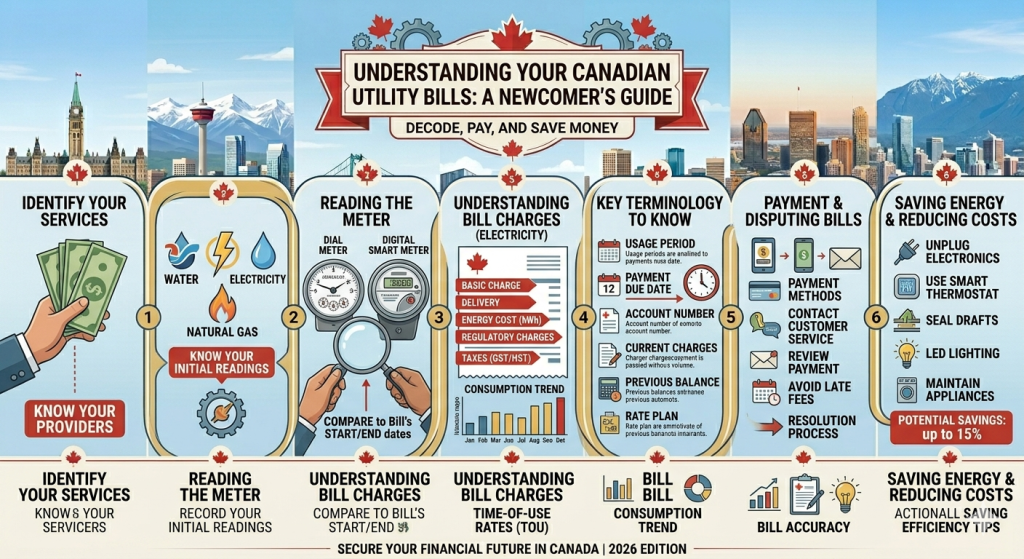
Utility services are typically provided by specific companies or local municipalities, depending on your location and the type of service. You will usually receive a bill monthly or bi-monthly (every two months). Here’s what you generally see on a bill:
- Consumption: This is how much of the utility you used during the billing period (e.g., kilowatt-hours for electricity, cubic meters for natural gas and water).
- Delivery/Transmission Charges: Fees for bringing the utility from its source to your home.
- Regulatory Charges: Costs associated with maintaining the system and complying with government regulations.
- Fixed Charges: A flat fee that doesn’t change based on your usage.
- Taxes: Applicable provincial and federal taxes (e.g., HST/GST).
Understanding Time-of-Use (TOU) Electricity
Many provinces, particularly Ontario, use Time-of-Use (TOU) pricing for electricity. This means the price you pay for electricity changes depending on the time of day, day of the week, and season. There are typically three periods:
- On-Peak: Highest rates, usually during weekday mornings and evenings.
- Mid-Peak: Moderate rates, during weekday afternoons.
- Off-Peak: Lowest rates, typically overnight, on weekends, and holidays.
Understanding TOU can help you adjust your usage habits to save money, for example , by ru
ing your dishwasher or laundry during off-peak hours.
Step-by-Step: How to Understand Your First Utility Bill
When your first utility bill arrives, follow these steps to decode it:
-
Identify the Provider and Account Information
Look for the company name (e.g., Hydro One, Enbridge Gas, City of Toronto Water) and your account number. Keep this handy for any inquiries.
-
Check the Billing Period and Due Date
The bill will clearly state the dates for which you are being charged and the deadline for payment. Missing a payment can result in late fees or even service disco
ection.
-
Locate Your Consumption Details
Find the section showing your usage. For electricity, it will be in kWh; for natural gas, it might be in m³ or GJ (Gigajoules); for water, it’s typically in m³.
-
Review the Charges Breakdown
Each bill will itemize the charges: usage costs, delivery fees, regulatory charges, and taxes. Understand what each line item represents. Sometimes, a previous balance or credit will also be shown.
-
Understand Payment Options
The bill will list accepted payment methods, which commonly include:
- Online Banking: Adding the utility company as a payee.
- Pre-Authorized Payments: Automatic deductions from your bank account.
- Mail: Sending a cheque.
- In-Person: At a bank, post office, or the utility provider’s office.
For more on managing your finances, check out our guide on How to Open a Bank Account in Canada as a Newcomer 2026 Guide.
-
Note Contact Information
If you have questions, the bill will provide customer service phone numbers or website addresses. Don’t hesitate to call if something is unclear.
Checklist: Managing Your Utilities in Canada
Use this checklist to ensure you’re on top of your utility management :
- Before Moving In:
- Confirm which utilities are included in your rent (if applicable).
- Contact utility companies (electricity, gas, water, internet) to set up accounts in your name. You may need your lease agreement and identification.
- Arrange for services to be coected on your move-in date.
- Upon Receiving Your First Bill:
- Review all charges carefully.
- Understand the billing period and due date .
- Set up your preferred payment method (e.g., online banking or pre-authorized debit).
- Ongoing Management:
- Monitor your usage regularly to identify trends or unexpected spikes.
- Practice energy conservation (turn off lights, unplug unused electronics, adjust thermostat).
- Budget for utility costs. For a broader overview, see our Cost of Living in Canada for Newcomers: Your 2026 Guide.
- Keep copies of your bills for your records.
- If moving, contact utility companies to close your account and provide a forwarding address for the final bill.
Common Utility Types and Providers in Canada
This table provides examples of common utility types and typical providers you might encounter. Note that specific providers vary by province and municipality.
| Utility Type | What it is | Common Providers (Examples) | Billing Frequency |
|---|---|---|---|
| Electricity | Power for lights, appliances, heating/cooling | Hydro One (ON), BC Hydro (BC), FortisAlberta (AB), Nova Scotia Power (NS), ENMAX (Calgary) | Monthly, Bi-monthly |
| Natural Gas | Heating, hot water, cooking | Enbridge Gas (ON), FortisBC (BC), ATCO Gas (AB), SaskEnergy (SK), Énergir (QC) | Monthly, Bi-monthly |
| Water & Sewer | Drinking, waste, sanitation | Municipalities (e.g., City of Toronto, City of Vancouver, City of Montreal) | Monthly, Quarterly |
| Internet & TV | Co
ectivity, entertainment |
Bell, Rogers, Telus, Shaw, Videotron, Freedom Mobile | Monthly |
Common Mistakes to Avoid When Dealing with Utility Bills
- Ignoring Bills: Always open and review your bills. Ignoring them can lead to late fees, interest charges, and even service discoection.
- Missing Payment Deadlines: Set reminders or use pre-authorized payments to ensure bills are paid on time.
- Not Understanding Time-of-Use (TOU) Pricing: If you have TOU electricity, not adjusting your usage can lead to higher costs.
- Forgetting to Set Up/Close Accounts: Failing to set up accounts when you move in or close them when you move out can result in incorrect billing or being responsible for previous/future tenants’ usage. This is crucial when renting in Canada as a newcomer.
- Not Budgeting: Utilities are a significant part of your living expenses. Include them in your monthly budget to avoid financial surprises.
- Not Asking Questions: If you don’t understand a charge or your bill seems unusually high, contact the utility provider immediately for clarification.
Frequently Asked Questions (FAQ) about Canadian Utility Bills
Q: How do I set up utility accounts when I first move to Canada?
A: Once you have secured your housing, contact the local electricity, natural gas, and water providers for your area to set up accounts. You will typically need to provide your new address, move-in date, and personal identification (like your passport or permanent resident card). You may also need to provide your lease agreement. For internet and TV, you can choose from various providers and set up service directly with them.
Q: Are utilities usually included in rent in Canada ?
A: It depends on your lease agreement. Some rental agreements, especially for apartments, may include certain utilities like heat or hot water. However, it’s common for tenants to be responsible for electricity, natural gas, and internet separately. Always clarify what is included and what is not before signing a lease.
Q: Can I choose my utility provider in Canada ?
A: For essential services like electricity distribution, natural gas distribution, and water, you generally ca
ot choose your provider; you are served by the company or municipality designated for your area. However, in some provinces, you may have a choice of electricity retailers or natural gas marketers who buy the commodity from the distributor and resell it to you. For internet and TV, you have many providers to choose from, allowing you to compare plans and prices.
Q: What should I do if my utility bill seems too high ?
A: First, check your usage during the billing period. Have you used more electricity or gas than usual? Did you leave heating/cooling on while away? Next, review the charges breakdown for any unusual fees. If you still believe there’s an error, contact the utility provider’s customer service immediately to inquire about the bill. They can often explain the charges or investigate potential issues.
Q: What happens if I can’t pay my utility bill on time ?
A: If you anticipate difficulty paying your bill, contact the utility provider before the due date. Many companies offer payment arrangements, such as extending the due date or setting up a payment plan. Ignoring the bill can lead to late payment fees, interest charges, and eventually, service disco
ection. Reco
ection fees can be costly.
Q : How can I save money on my utility bills in Canada ?
A: There are several ways to reduce your utility costs:
- Adjust Thermostat: Lower your thermostat in winter and raise it in summer. Even a few degrees can make a difference.
- Energy-Efficient Habits: Turn off lights when leaving a room, unplug electronics not in use, take shorter showers.
- Use TOU Wisely: If you have Time-of-Use electricity, shift high-energy activities (laundry, dishwasher) to off-peak hours.
- Seal Drafts: Use weatherstripping or caulk to seal gaps around windows and doors to prevent heat loss/gain.
- Compare Internet/TV Providers: Regularly review your internet and TV plans and compare them with competitors to ensure you’re getting the best value.
Disclaimer
This article is for general information only and does not provide financial, legal, tax, or immigration advice. Rules, requirements, fees, and programs may change. Always check official sources or speak with a qualified professional before making decisions.
Sources and Official Resources
- Financial Consumer Agency of Canada (FCAC): www.canada.ca/en/financial-consumer-agency. html (General financial literacy)
- Provincial Energy Regulators: (e.g., Ontario Energy Board, BC Utilities Commission). Check your provincial government’s official website for specific regulatory bodies.
- Major Utility Providers: (e.g., Hydro One, Enbridge Gas, BC Hydro, FortisBC, ENMAX). Visit their respective official websites for detailed billing information and customer service.
- Canada.ca: www.canada.ca/en/services/environment/weather/climatechange/climate-action/energy-efficiency. html (Information on energy efficiency)
Conclusion
Understanding Canadian utility bills is a crucial step in managing your household finances as a newcomer. By familiarizing yourself with the types of utilities, how they are billed, and common terms, you can confidently read your statements, budget effectively, and even find ways to save money. Remember, if you ever have questions, your utility provider’s customer service is there to help . Take control of your utilities and make your first year in Canada a financially smooth one!