
Arriving in Canada as a newcomer brings many exciting opportunities, but also new processes to learn, especially when it comes to housing. Securing a place to live is a top priority, and understanding your rental agreement is a critical step. This guide will walk you through how to read and sign a rental lease in Canada, focusing on key aspects that newcomers should be aware of as of June 16, 2026.
A rental lease is a legally binding contract between you (the tenant) and your landlord. It outlines the terms and conditions of your tenancy, your rights, and your responsibilities. Taking the time to fully understand this document before signing is essential to protect yourself and ensure a positive renting experience.
Who This Guide Is For
This comprehensive guide is specifically designed for newcomers to Canada, including international students, temporary workers, and permanent residents who are renting for the first time in a Canadian province or territory. It aims to provide practical, accurate, and beginner-friendly information to help you navigate the rental process with confidence.
Understanding the Canadian Rental Landscape
Renting in Canada involves understanding that rules can vary significantly across provinces and territories. Each jurisdiction has its own landlord and tenant legislation, which governs everything from lease agreements and rent increases to eviction procedures and maintenance responsibilities. This means that a rule that applies in Ontario might be different in British Columbia or Quebec. Always check the official government resources for your specific province or territory.
What is a Rental Lease?
A rental lease, also known as a tenancy agreement, is a formal written contract that details the terms under which a tenant rents a property from a landlord. It specifies the duration of the tenancy, the amount of rent, payment due dates, and other important conditions. Having a written lease is crucial for both parties as it provides a clear record of the agreement and helps prevent misunderstandings. For more details, you can refer to our article on What Is a Lease Agreement in Canada? Your Newcomer’ s Guide.
Step-by-Step Guide: How to Read and Sign a Rental Lease in Canada
Step 1: Before You Start Looking – Research and Budget
- Understand Provincial Rules: Before you even start viewing properties, familiarize yourself with the landlord and tenant laws in the province or territory where you plan to live. Key terms like “fixed-term lease” versus “month-to-month” can have different implications.
- Budgeting: Determine what you can realistically afford. Rent is often a significant expense, and you’ll also need to factor in utilities (electricity, heating, water, internet), tenant insurance, and deposits. Our guide on Understanding utility bills in Canada can be helpful.
Step 2: Finding a Place and Application
- Property Viewings: When viewing potential rentals, ask questions about the property, neighbourhood, and any included utilities.
- Application Process: Landlords typically require a rental application. This may ask for personal information, employment details, references, and proof of income. Newcomers often face challenges with credit history; our article How To Rent An Apartment In Canada Without Credit History offers valuable tips. For a comprehensive list of required documents, see Documents Needed to Rent in Canada as a Newcomer.
Step 3: Receiving and Reviewing the Lease
Once your application is approved, the landlord will provide you with a lease agreement. This is your opportunity to carefully review every detail before you read and sign a rental lease in Canada.
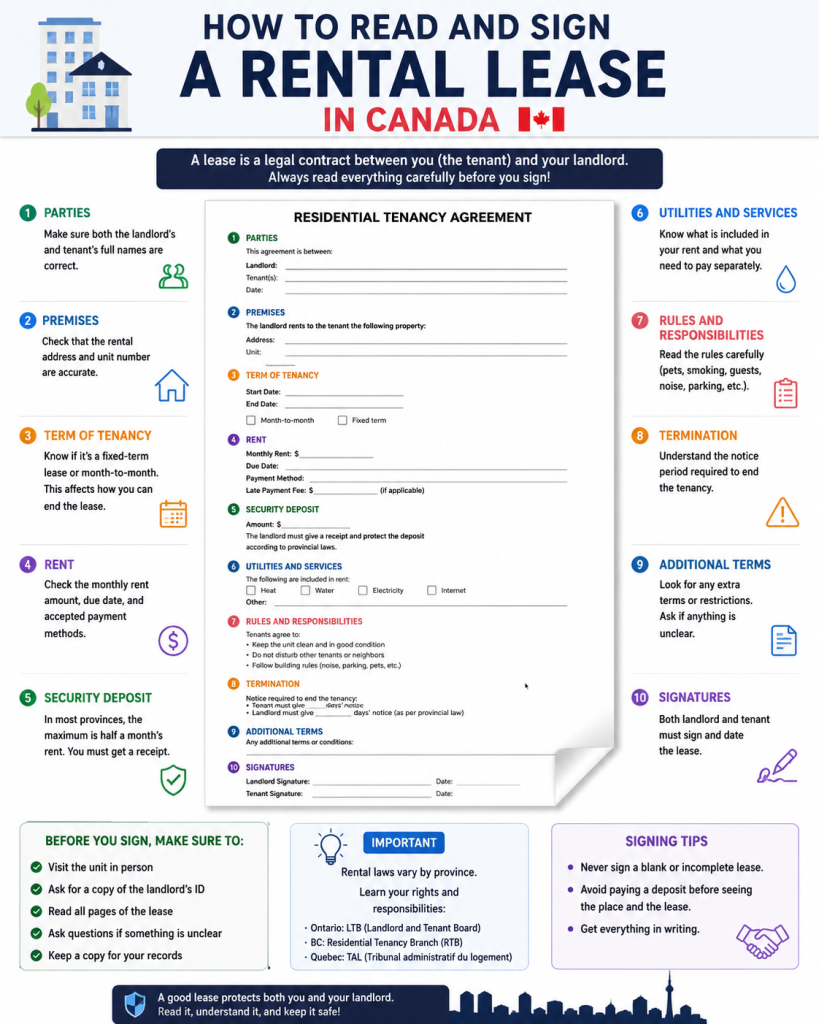
Key Sections to Scrutinize in Your Lease:
- Parties to the Agreement: Ensure your full legal name and the landlord’s full legal name (or company name) are correctly spelled.
- Property Address: Verify the exact address of the rental unit.
- Term of Tenancy: This states the start and end dates of the lease. Common terms are 6 months or 1 year. Understand if it automatically renews or converts to a month-to-month tenancy afterward.
- Rent Amount and Payment: Clearly states the monthly rent, due date, and accepted payment methods (e.g., Interac e-Transfer, post-dated cheques).
- Utilities: Specifies which utilities (e.g., electricity, heat, water, internet) are included in the rent and which ones you are responsible for.
- Deposits: Details the amount of the security deposit (often called a ‘damage deposit’ outside Ontario) and ‘first and last month’s rent’ (common in Ontario). Understand the conditions for its return.
- Maintenance and Repairs: Outlines who is responsible for what. Generally, landlords handle major repairs, while tenants are responsible for general cleanliness and minor maintenance.
- Rules and Regulations: Includes rules about pets, smoking, guests, noise, parking, and any common area usage.
- Termination Clause: Explains how the lease can be ended by either party, including notice periods required.
- Signatures: Ensure there are spaces for all tenants and the landlord to sign and date the agreement.
Step 4: Clarifying and Negotiating
Do not hesitate to ask your landlord for clarification on any part of the lease you do not understand. If there are terms you wish to negotiate (e.g., pet policy, specific repairs before move-in), do so before signing. Any agreed-upon changes should be made in writing on the lease document and initialled by both parties.
Step 5: Signing the Lease
Once you are completely satisfied and understand all terms, you can read and sign a rental lease in Canada. Ensure that all tenants who will be living in the unit (and are financially responsible) sign the document. Always request and keep a signed copy of the lease for your records. This is your proof of agreement.
Step 6: After Signing
- Pay Deposits: Pay any required deposits as stipulated in the lease. Keep records of these payments.
- Tenant Insurance: Consider obtaining tenant insurance. While often not mandatory, it is highly recommended to protect your belongings from damage or theft and provide liability coverage.
- Move-in Inspection: Conduct a thorough move-in inspection with your landlord, noting any existing damage to the property. Take photos or videos as evidence and ensure a signed copy of the inspection report is provided to you.
Checklist for Reviewing Your Rental Lease
- ✓ Are all names and the property address correct?
- ✓ Is the lease term (start and end dates) accurate?
- ✓ Is the monthly rent amount and due date clearly stated?
- ✓ What payment methods are accepted?
- ✓ Which utilities are included, and which are extra?
- ✓ Are the deposit amounts correct, and what are the conditions for their return?
- ✓ Are there any specific rules about pets, smoking, or guests?
- ✓ What are the procedures for maintenance requests?
- ✓ How much notice is required to end the tenancy?
- ✓ Have you received a signed copy for your records?
Common Lease Terms Explained
| Term | Explanation |
|---|---|
| Fixed-Term Lease | A lease for a specific period (e.g., 1 year). It has a defined start and end date. |
| Month-to-Month Tenancy | A lease that continues indefinitely until either party gives proper written notice to end it. Often follows a fixed-term lease. |
| Security Deposit | Money paid by the tenant to the landlord to cover potential damages or unpaid rent. Rules on amount and return vary by province. |
| First and Last Month’s Rent | Common in Ontario, where tenants pay the first month’s rent and an amount equal to the last month’s rent upfront. This is often the only deposit allowed. |
| Utilities Included | Means the cost of services like electricity, heat, or water is covered by the monthly rent. |
| Subletting | When a tenant rents out their unit to another person for a portion of their lease term, with the landlord’s permission. |
| Assignment | When a tenant transfers their entire lease agreement to another person, who then takes over the original tenant’s responsibilities. |
Common Mistakes Newcomers Make
As a newcomer, you might encounter unfamiliar processes. Here are some common mistakes to avoid when you read and sign a rental lease in Canada:
- Not Reading the Entire Lease: Skipping sections or not fully understanding the legal language can lead to serious issues later.
- Signing Under Pressure: Never feel pressured to sign a lease immediately. Take your time to review it thoroughly, perhaps with a trusted friend or settlement worker.
- Not Getting a Signed Copy: Always ensure you receive a copy of the lease signed by both you and the landlord. Without it, proving the terms of your agreement can be difficult.
- Ignoring Provincial Differences: Assuming rental rules are uniform across Canada can be a costly mistake. Always verify the laws specific to your province or territory.
- Falling for Scams: Be wary of landlords who demand cash payments without a receipt, ask for excessive deposits, or rush you into signing without allowing you to view the property or read the lease. For more tips, refer to our guide on Common Mistakes Newcomers Make in Canada.
Frequently Asked Questions (FAQ)
What documents do newcomers need to rent in Canada?
Newcomers typically need proof of identity (passport, study permit, work permit), proof of income (job offer letter, bank statements, employment contract), and references (from previous landlords, employers, or even academic institutions). Some landlords may also request a credit check, which can be challenging for those without a Canadian credit history. Having these documents prepared can streamline your application process.
Can I rent without Canadian credit history?
Yes, it is possible to rent without Canadian credit history, though it might require extra effort. Landlords understand that newcomers won’t have a credit score. You can offer alternatives like providing a larger security deposit (where permitted by provincial law), offering to pay several months’ rent upfront (also subject to provincial rules), providing strong character references, or having a guarantor (co-signer) who has good credit in Canada. Highlighting stable employment or substantial savings can also help.
What should I ask before signing a lease?
Before signing, ask about the exact move-in date, the process for submitting maintenance requests, who to contact in emergencies, the landlord’s policy on rent increases (and how much notice they provide), and any specific rules regarding pets, parking, or guest policies. Clarify which utilities are included and which are extra, and how deposits will be handled. Also, inquire about the notice period required if you wish to move out at the end of the lease term.
Are rental rules the same in every province?
No, rental rules are not the same in every province and territory in Canada. Each jurisdiction has its own specific legislation governing landlord-tenant relationships. For example, the rules around rent control, security deposit limits, and eviction processes vary significantly from Ontario to British Columbia to Quebec. It is crucial to research the specific laws and regulations of the province or territory where you intend to live to understand your rights and responsibilities fully.
How can I avoid rental scams?
To avoid rental scams, always be cautious. Never pay a deposit or sign a lease without seeing the property in person (or via a trusted representative). Be wary of landlords who pressure you for immediate payment, request funds via wire transfer, or refuse to provide a written lease. Research the landlord or property management company, and ensure the rent seems reasonable for the area. Always get receipts for any money you pay and keep all communications in writing.
Disclaimer
This article is for general information only and does not provide financial, legal, tax, or immigration advice. Rules, requirements, fees, and programs may change. Always check official sources or speak with a qualified professional before making decisions.
Sources and Official Resources
- Canada.ca – Housing and homelessness
- Canada Mortgage and Housing Corporation (CMHC)
- Ontario Ministry of Municipal Affairs and Housing – Renting in Ontario: Your Rights (Note: Please check your specific provincial or territorial government website for relevant tenancy laws.)
Conclusion
Understanding how to read and sign a rental lease in Canada is a fundamental skill for any newcomer. By taking the time to review your lease carefully, asking questions, and knowing your rights and responsibilities, you can establish a secure and stable home in your first year in Canada. Remember, being informed is your best protection in the Canadian rental market.
”
}